
Local service guide
Tree cutting and arborist services in Austin, TX
Tree cutting in Austin should start with a private arborist’s assessment, a property-jurisdiction check and a plan for nearby power lines. Austin regulates residential trees at 19 inches or more in diameter; its residential instructions require review for removal, pruning 25% or more of the canopy, or potential root-zone impacts. Check approved plans for enrolled small trees too. Ask the contractor to identify approvals, equipment access and debris disposal before agreeing to a start date. [1] [2] [4]
Choose an assessment, pruning or removal
Hire a qualified private arborist to assess a declining tree before committing to removal. City Arborist staff administer preservation rules and do not provide condition assessments outside permit review. The City recommends private arborists for diagnosis and care recommendations. [2]
Describe the problem you want solved: a broken limb, roof contact, canopy decline or clearance for planned work. Ask the arborist to explain the options and recommend a scope. Request written findings if you need a diagnosis or supporting documentation for an application.
Ask who will assess the tree and who will supervise the crew. Request credentials and current insurance documentation. For removal, have the bidder explain how the crew will lower limbs, protect structures and move equipment onto the property. Compare those plans alongside the price.
Check jurisdiction, tree size and proposed impacts
Austin’s Tree Preservation Ordinance applies in Full and Limited Purpose jurisdictions, but excludes the Extra-territorial Jurisdiction. Confirm your property’s jurisdiction before applying city thresholds. Use the City’s address-based Property Profile tool rather than relying on the mailing address. [2]
For residential trees, measure circumference 4.5 feet above ground and divide by 3.14 to calculate diameter. For a multi-stem tree, add the largest stem diameter to half of each remaining stem diameter. Follow the City’s measurement adjustments for slopes, leaning trunks and swelling. [1]
The residential application page requires a Tree Ordinance Review Application, or TORA, for pruning 25% or more of a regulated tree’s canopy. The City Arborist FAQ instead says no more than 25% may be removed without a permit. For work at exactly 25%, confirm the requirement with City staff before authorizing cuts; use the residential page’s conservative threshold when planning. [1] [2]
Certain species at 24 inches or more qualify as Heritage Trees. Removal or impacts exceeding code requirements require a variance; proposed variances for Heritage Trees at 30 inches or more require a public process. Ask the arborist to confirm classification and approval requirements before proposing a removal date. [2]
Arrange the application and start date
For work requiring a building or other permit, include tree review in that application. For tree work that needs no other permit, Austin provides a standalone residential TORA through Austin Build + Connect. Agree who will submit it, respond to reviewer comments and provide supporting documents. [1]
The City requests photographs and plans or sketches appropriate to the work. For a dead, diseased or imminent-hazard application, include a close-up of the defect and a clear image of the entire tree from root to crown. Photograph from a safe position. [1]
The City says review may take up to 10 business days after the application passes its completeness check. Allow for that review before setting the work date. After approval, check for Active status and read the permit’s conditions and inspection requirements with the contractor. [1]
Specify oak-wilt precautions
The City recommends pruning oaks from July through January, when fungal spores are least likely to infect a tree, and painting oak pruning cuts and wounds. For elective work, ask the arborist to explain the timing and identify who will paint fresh wounds. [3]
For suspected oak wilt, choose an arborist who can diagnose the problem and discuss treatment. The City explains that the fungus can spread through root systems even when trees receive treatment. Share known infection locations and treatment histories with adjacent owners, and ask whether nearby oaks need assessment. [3]
Coordinate utility work and compare complete quotes
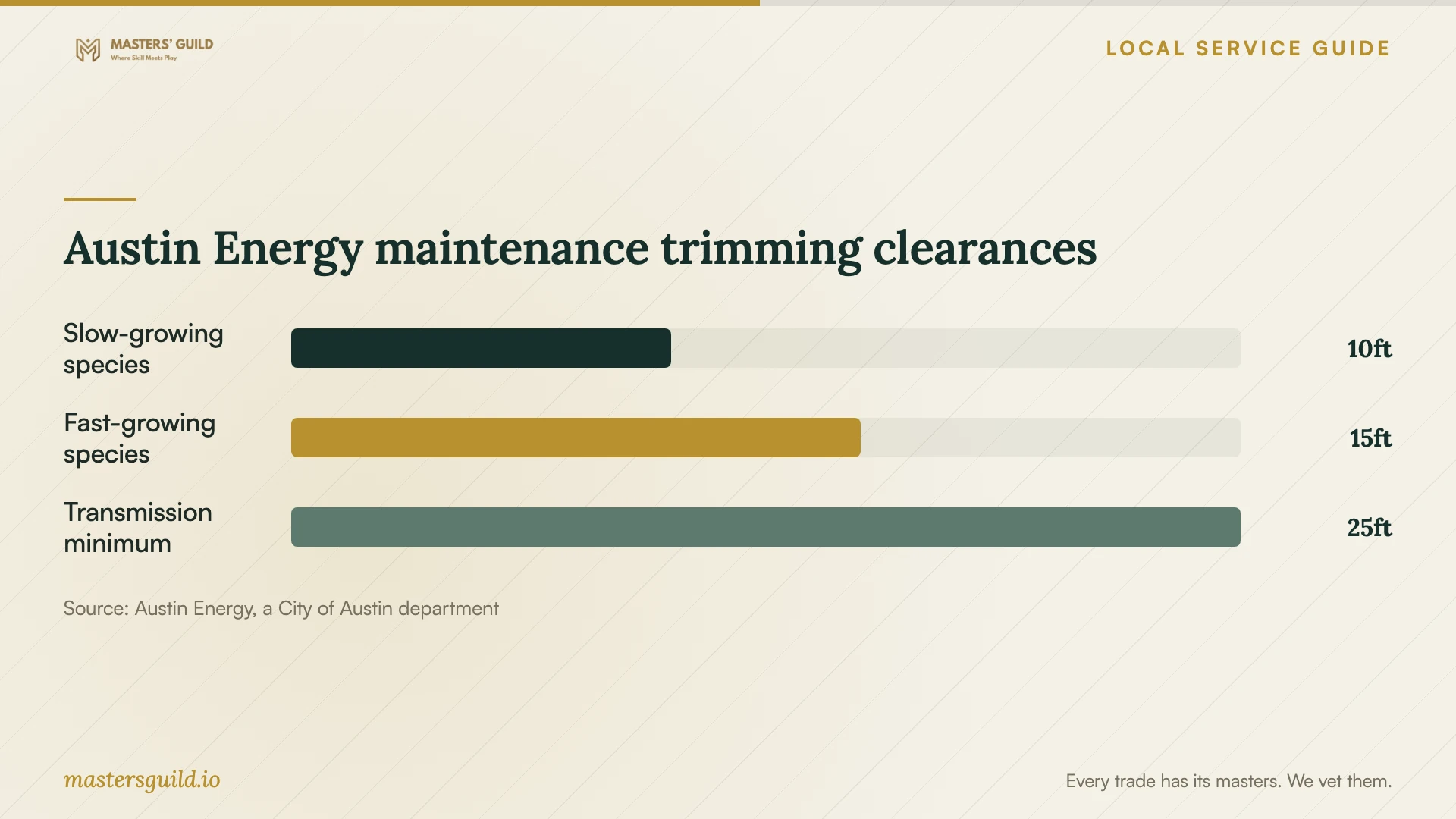
Austin Energy tells owners not to trim limbs within 10 feet of power lines themselves. If your private contractor cannot safely work near the wires, request make-ready trimming or call the Forestry Division at 512-322-6771. Include the brush Austin Energy leaves behind in the private contractor’s hauling scope. [4]
Austin Energy says an inspector evaluates routine requests within 2 to 4 weeks; trimming may take several more weeks depending on the work and workload. For sparks or a limb pulling a line from a pole or house, report the utility emergency at 512-322-9100. [4]
Request site-specific quotes and compare the complete scope. Separate removal from stump grinding, specify grinding depth and decide who will remove chips, logs and brush. Ask bidders to list equipment charges, permit handling, cleanup and exclusions. Put any work you must arrange in the agreement.
Austin Energy maintenance trimming clearances
Local details that affect your job
Root protection changes equipment access
Austin allows no impacts within the inner quarter of a regulated tree’s critical root zone, no cut or fill greater than 4 inches within the inner half, and requires preservation without impact of 50% of the full root-zone ground area. Ask the arborist to mark equipment routes and staging areas on the work sketch, including around retained trees. [1]
Check small-tree enrollment before approving work
For ordinary private residential work, Austin’s guidance generally exempts trees under 19 inches from TORA requirements, though other permits or impacts to nearby regulated trees may require review. Check approved plans and Small Tree Fee Credit enrollment before authorizing removal or impacts. The program requires enrolled trees to receive regulated-tree treatment and preservation protection. A builder may opt out, but must revise the plans. [1]
Utility-directed removal follows separate instructions
Austin Energy’s utility-removal guidance says Development Services must issue a removal permit for trees 19 inches or greater and authorize removals between 8 and 19 inches. That guidance concerns utility-directed removals. Confirm authorization with the utility representative instead of applying the ordinary private residential small-tree exemption to its work plan. [1] [4]
Choose the next step before scheduling
| Situation | Next step | Detail to settle |
|---|---|---|
| Tree condition is uncertain | Arrange a private arborist assessment | Request findings and options before approving removal |
| Regulated tree needs canopy pruning | Use the residential 25%-or-more review threshold | Confirm the conflicting exact-25% boundary with City staff |
| Small tree appears on development plans | Check Small Tree Fee Credit enrollment | Enrolled trees need protection; opting out requires a plan revision |
| Utility proposes removal of an 8-to-19-inch tree | Confirm Development Services authorization with Austin Energy | Use the utility work process |
| Private crew cannot safely work near wires | Coordinate Austin Energy make-ready trimming | Include leftover brush disposal in the quote |
| Elective oak pruning | Discuss the July through January window | Specify painting of cuts and wounds |
Your hiring checklist
- Photograph the whole tree, visible defects and nearby structures from a safe position.
- Ask the arborist to identify the species, measure the trunk and explain treatment, pruning or removal options.
- Check jurisdiction, approved plans and any small-tree enrollment before authorizing work.
- Assign responsibility for applications, reviewer responses and permit conditions.
- Request credentials, insurance documentation and the crew supervisor’s name.
- Agree on equipment access, staging and protection for retained trees.
- Specify oak-wound precautions and utility coordination where relevant.
- List stump work, hauling, cleanup, exclusions and payment terms in the agreement.
Frequently Asked Questions
Does a dead or dangerous tree still need review?
Austin provides a dead, diseased and imminent-hazard TORA category for regulated trees. Do not assume poor condition removes the review requirement. Document the defect from a safe location and confirm the process with City staff and your arborist. [1]
Can I prune branches from my neighbor’s tree?
The City describes property-line pruning as a civil matter and encourages neighbors to agree on a plan. Discuss the scope before authorizing cuts. For regulated trees, follow the residential page’s 25%-or-more review instruction and confirm with City staff if the proposed work removes exactly 25%, because the City FAQ uses different boundary wording. [1] [2]
Can I remove a residential tree under 19 inches without a TORA?
For ordinary private residential work, the City generally says yes, but check approved plans first. Small Tree Fee Credit enrollment requires regulated-tree treatment and preservation protection; opting out requires a plan revision. Other permits and nearby regulated-tree impacts may still matter. Austin Energy also states separate authorization requirements for utility-directed removals between 8 and 19 inches. [1] [4]
Sources and scope
This guide combines the sources below with practical planning guidance. Figures apply to the stated geography and period; request a written quote for your property.