
Local service guide
Roof Cleaning and Repair in Austin, TX
Arrange Roof Cleaning and repair by requesting separate written scopes for cleaning, leak diagnosis and replacement. Before accepting replacement work in Austin, check the property's Wildland-Urban Interface status: replacing 50% or more of roofing there changes the permit exemption and requires full replacement. For proposed power washing, have the operator confirm a compliant wastewater disposal plan with Austin Water before starting. [1] [2] [3]
Define the work before comparing prices
Describe the problem you want the contractor to resolve: staining, debris, water entry or damaged covering. Send photographs taken from a safe location and identify where you have seen water indoors. Ask bidders to explain what they will inspect and which findings would change their proposed work.
Request separate prices for cleaning and repairs. For cleaning, have the contractor identify the roof material, products, application method and manufacturer guidance they intend to follow. For repairs, request the location, materials and extent of work. Distinguish work on the visible covering from repairs to the roof deck or supporting structure.
Compare quotes using the same requested scope. Include access arrangements, protection of landscaping, wastewater handling, debris removal and completion photographs. Request proof of insurance covering the proposed work and identify who will supervise the crew. Ask each bidder to explain exclusions rather than choosing from the total price alone.
Confirm the residential permit exemption
Austin's residential exemptions apply to one- and two-family dwellings and townhouses no more than three stories. The city lists replacement asphalt shingles and replacement roof coverings that do not adversely affect the roof structure as exempt, except when a property lies in the WUI and the work replaces 50% or more of roofing. It also lists roof decking of no more than 128 square feet as exempt. [1]
Have the contractor identify the exemption they intend to use and measure any proposed roof-deck work. If the complete scope exceeds a listed exemption or changes the structure, confirm requirements with Austin Development Services before signing. Put responsibility for permits and inspections in the agreement. The city requires exempt work to comply with applicable building codes, city codes and ordinances. [1]
Check wildfire requirements before ordering materials
Austin Fire directs owners to use its interactive WUI map to identify a project's proximity zone. For Zones A and B, confirm the distance to the nearest wildland on site. The city states that replacing 50% or more of roofing in the WUI requires full replacement. Have the bidder document the replacement percentage before you approve a partial reroof. [2]
Austin's WUI roofing guidance requires a Class A roof assembly. The city distinguishes the exterior covering from the complete assembly, which includes the deck and underlayment or insulation tested together for fire resistance. Ask the contractor to confirm with the manufacturer that the proposed assembly supports the required rating and identify the products in the quote. [2]
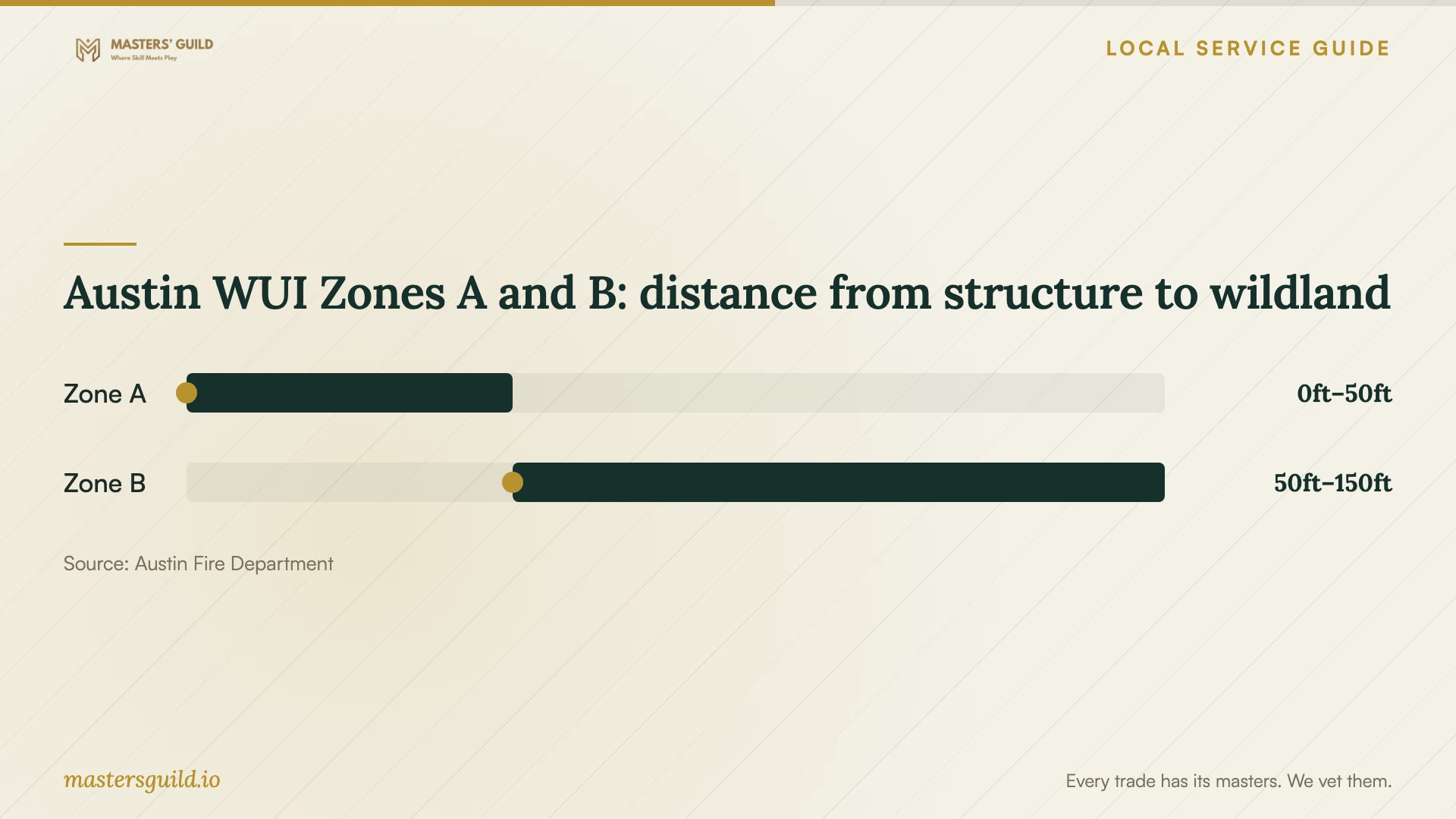
Use the proximity-distance chart to understand the distinction between Zones A and B before reviewing the map with your contractor. Austin groups those zones together on its map, so the map alone cannot settle which applies. Confirm site conditions before pricing zone-specific work on eaves or vents. [2]
Settle wastewater collection and permitted disposal
Austin Water directs power-washing operators to confirm their disposal plan with Utility Compliance Services before beginning operations. Its guidance prohibits storm-sewer discharge of wastewater containing pollutants or cleaning compounds without treatment before entering the environment. Have the bidder trace the proposed discharge route from the roof and downspouts and explain how they will collect the wastewater. [3]
For sanitary-sewer disposal, Austin Water specifies collection and transport to a private fixed-site facility connected to the city's sanitary sewer. Industrial wastewater discharge requires permit authorization, and the facility must have appropriate pretreatment, such as a sand/oil interceptor or grit trap. Ask the operator to identify the receiving facility and confirm that its permit covers the proposed discharge. [3]
Operators may not dump hauled industrial wastewater into a cleanout, manhole or toilet at the cleaning site unless that site is permitted by Austin Water and has an appropriately sized sand/oil interceptor. Do not accept access to your sewer cleanout as the disposal plan. Austin Water's page addresses power washers and mobile car washes; for another cleaning method, have the contractor confirm the applicable requirements with the utility. [3]
Agree on changes, weather delays and completion
Require photographs and a written change order before the contractor expands work after discovering hidden damage. Agree on who can approve changes, how the contractor will price them and how they will protect an opened roof while you decide. Keep cleaning and repair changes separate so you can track what you authorized.
Set weather-delay terms before scheduling: who contacts you, how you choose another date and how the crew secures unfinished work. Identify equipment placement and access to water or power. Agree on cleanup, completion photographs, repair warranty terms and a contact for concerns after the job.
Austin WUI Zones A and B: distance from structure to wildland
Local details that affect your job
Resolve the 50% threshold before a partial reroof
Ask the contractor to document the percentage of roofing they will replace. In the WUI, Austin's residential roof-covering permit exemption excludes replacement of 50% or more, and Austin Fire requires full replacement at that threshold. Settle both the permit route and replacement scope before ordering materials. [1] [2]
Establish jurisdiction using the property
Austin's WUI code applies in Full Purpose and Limited Purpose areas. It does not apply to properties fully within the extraterritorial jurisdiction. For properties spanning jurisdictions, the city reviews the extent of compliance case by case. Confirm your property's jurisdiction before asking bidders to price WUI-related work. [2]
Have the operator confirm wastewater disposal
Austin Water directs power-washing operators to call Utility Compliance Services at 512-972-1060, option 5, before operations to confirm a compliant disposal plan. Require the operator to complete that check. On-site disposal of hauled industrial wastewater through a cleanout, manhole or toilet requires a site permitted by Austin Water with an appropriately sized sand/oil interceptor. [3]
Match the proposed work to your next step
| Situation | Next step | Settle before hiring |
|---|---|---|
| Staining or accumulated debris | Request a cleaning assessment | Products, application method, manufacturer guidance and wastewater plan |
| Water entry or damaged covering | Request a repair diagnosis | Damage location, repair scope and approval of additional work |
| Residential roof-deck work | Request the measured area | Austin lists roof decking of no more than 128 square feet as exempt; confirm the complete scope |
| Replacement of 50% or more in the WUI | Resolve full replacement and permits | Austin Fire requires full replacement; the residential roof-covering permit exemption has an exception at this threshold |
| Power washing with sewer disposal | Confirm the permitted disposal route | Industrial wastewater discharge requires permit authorization; on-site disposal requires an Austin Water-permitted site and an appropriately sized sand/oil interceptor |
Your hiring checklist
- Send photographs from a safe location and describe indoor water entry.
- Request separate cleaning, repair and replacement scopes with itemized prices.
- Ask for the cleaning products, method and manufacturer guidance.
- Have the contractor document replacement percentage and proposed deck-repair area.
- Confirm permit responsibility and applicable WUI requirements with the contractor.
- Request the wastewater collection route and receiving-facility details.
- Check insurance and agree on written approval of additional work.
- Set weather-delay, cleanup, completion-photograph and warranty terms.
Frequently Asked Questions
Do I need a permit for roof repair?
Austin lists certain residential roof-covering replacements and roof-decking work of no more than 128 square feet as exempt. Roof-covering replacement must not adversely affect the structure, and the WUI exception applies when replacing 50% or more of roofing. Confirm your complete scope with Development Services; exempt work must still comply with codes. [1]
Must I replace my existing roof because I live in the WUI?
Austin Fire says existing buildings do not need changes solely to meet the current WUI code, except when a code official determines a serious safety hazard. Review planned work separately: the city's WUI guidance requires full replacement when replacing 50% or more of roofing. [2]
Can the cleaner use my sewer cleanout for wastewater?
Austin Water prohibits disposal of hauled industrial wastewater through a cleanout, manhole or toilet at the cleaning site unless the site is permitted by Austin Water and has an appropriately sized sand/oil interceptor. Sanitary-sewer industrial wastewater discharge requires permit authorization. Have the power-washing operator confirm the disposal plan before starting. [3]
How should I compare cleaning and repair prices?
Give bidders the same requested scope and compare cleaning and repairs separately. Check materials, access, wastewater handling, cleanup and warranty terms. Ask how each contractor will price hidden damage and require written approval before they expand the work.
Sources and scope
This guide combines the sources below with practical planning guidance. Figures apply to the stated geography and period; request a written quote for your property.