
Local service guide
Pest Control Services in Austin, TX: Hiring Guide
Arrange Pest Control Services in Austin by identifying the pest, checking the company’s Texas structural pest control credentials for the proposed treatment, and comparing written scopes. Request termite disclosure documents at the bid stage. For mosquito work, include breeding-site corrections and use Austin 3-1-1 to report standing water or drainage concerns. [1] [3] [4]
Give bidders the same problem description
Describe where you see activity, when you first noticed it, and which rooms or outdoor areas need attention. Include photographs, previous treatments, and access constraints. Ask the provider to identify the pest and explain whether an inspection is necessary before recommending a method.
Request separate descriptions of inspection, treatment, prevention, and follow-up. Ask which pests and areas the price covers, how the contractor will assess the result, and who handles callbacks. For recurring service, get the visit schedule, cancellation terms, and total commitment in writing before comparing it with a one-time visit.
Build your budget from itemized proposals for your property. Have bidders separate initial treatment, later visits, exclusion or repair work, and renewal charges. If two proposals differ, have each bidder explain the difference in scope before choosing on price.
Match the license category to the work
The Texas Department of Agriculture lists ants, roaches, mosquitoes, rats, and mice within its general pest control category. Its termite category covers termites and other wood-destroying organisms through methods other than fumigation. The department lists structural fumigation as a separate category. [3]
Request the business’s license information and the credentials of the person who will inspect or treat your home. For termite services, TDA advises homeowners to request verification of licensure and says its Structural Pest Control Service can confirm a company’s license. Discuss the inspector’s and applicator’s termite training. [3] [4]
Request written preparation and return instructions before scheduling. Tell the provider about children, pets, aquariums, and areas they cannot access. Agree on who will answer questions after treatment and what observations you should record if activity continues.
Require a complete termite proposal
At the bid stage and before treatment, Texas requires the proposing company to provide termite disclosure documents. The company must include a structure diagram, the recommended pesticide label and proposed termiticide concentration, treatment definitions, and complete warranty details. A certified applicator or technician licensed in the termite category and employed by the proposing company must sign the approval. [4]
Check the warranty’s covered areas, duration, renewal options and cost, retreatment obligations, and damage-repair obligations. TDA says the company must list included areas if the warranty does not cover the entire treated structure. Read the conditions involving owner action or inaction that could void coverage, and have the bidder explain anything unclear. [4]
A wood-destroying insect inspector examines accessible areas for visible evidence without dismantling or removing objects. TDA states that the inspection does not guarantee the absence of wood-destroying insects and does not constitute a structural damage report. Have the inspector describe inaccessible areas and explain whether you need a separate assessment of suspected damage. [4]
Include water-source correction in mosquito work
Austin Public Health recommends draining standing water each week, replacing water in pet dishes and birdbaths at least once a week, repairing leaks, maintaining door and window screens, and screening rainwater cisterns. Have the contractor identify breeding sites and separate their work from the maintenance you will handle. [1]
The department identifies mosquito dunks containing Bacillus thuringiensis israeliensis as a biological larvicide option for rain barrels and permanent bodies of water. Discuss whether this approach fits your site and request product instructions. The city also recommends insect repellent and protective clothing to reduce bites. [1]
Discuss containers, flowerpot saucers, gutters, and other water-holding areas during the inspection. Ask how the proposed service addresses those sites, how you should maintain them between visits, and what follow-up the contractor recommends if mosquitoes continue to interfere with outdoor use.
Agree on follow-up before treatment
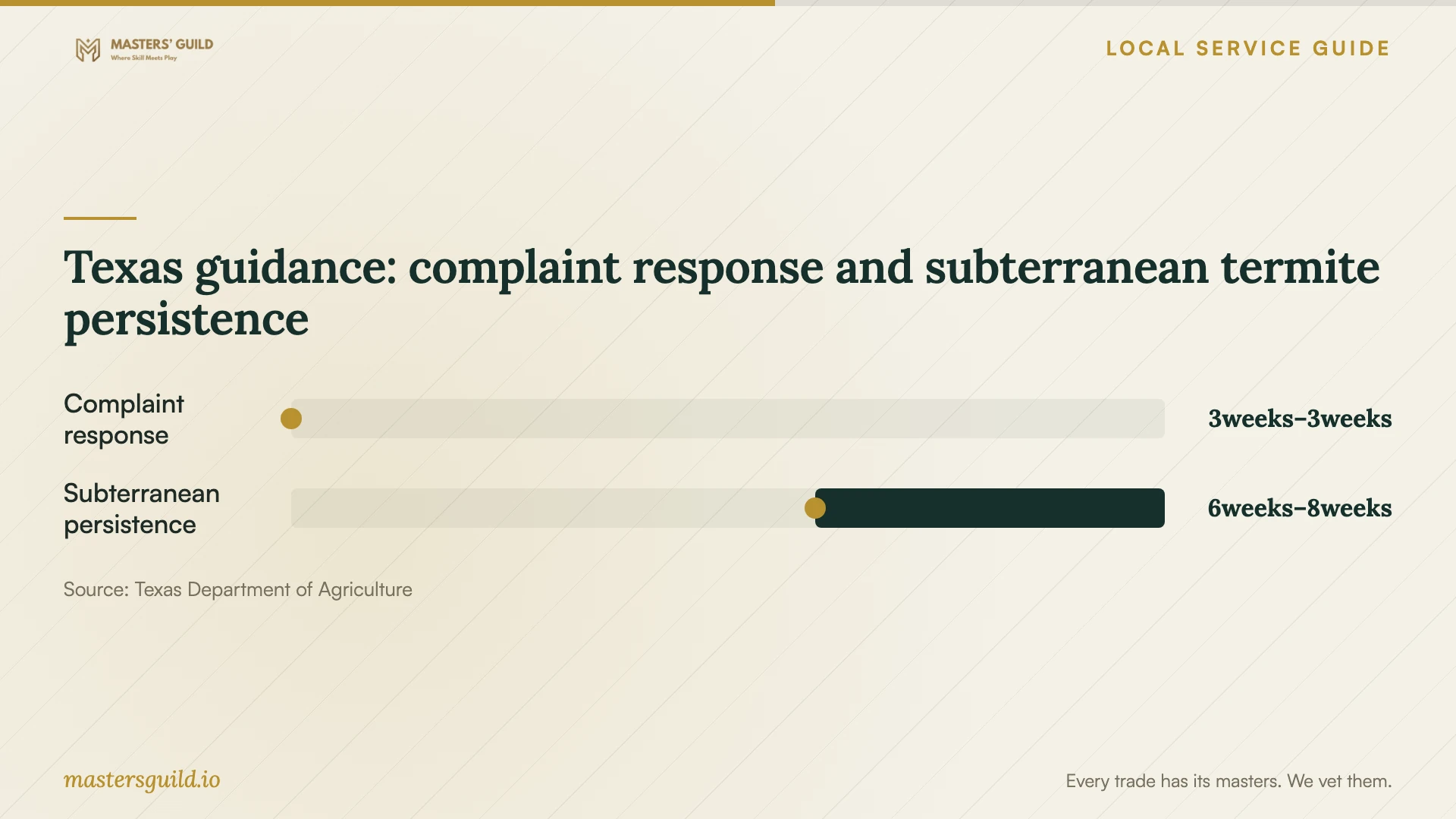
Have the contractor specify when you should report continued activity and what triggers another inspection. In its guidance about subterranean termite retreatment, TDA says termites can remain in walls for six to eight weeks after proper treatment. The source does not establish that timeframe for every termite species or treatment method. Contact your licensed provider for identification and assessment of continued activity rather than waiting for that period to end. [4]
If you cannot resolve a termite-treatment problem with the company, TDA directs consumers to contact its Structural Pest Control Service at 866-918-4481. The department determines whether it has authority to accept the complaint. Its FAQ describes an approximate three-week complaint response time and advises against repair or another treatment before an inspector investigates. Ask the agency how to preserve evidence in your case. [4]
Texas guidance: complaint response and subterranean termite persistence
Local details that affect your job
Report mosquito and drainage concerns through Austin 3-1-1
Austin Public Health directs residents to report standing water, drainage concerns, or mosquito problems through 3-1-1. Use that route for a concern outside your contractor’s service area, and describe the location. Have the contractor define the boundaries of private treatment. The department notes that website content updates may be delayed, so confirm case-specific handling through 3-1-1. [1]
Check your parcel’s integrated pest management requirements
Austin describes required integrated pest management plans in connection with site plan review for affected properties. The city requires distribution of plan information to the property owner and anyone responsible for on-site pest management, landscaping, or facility maintenance. Owners and assignees must comply with the accompanying restrictive covenant. Check property documents and give an applicable plan to the contractor. For an individual parcel requiring site plan review, the city assigns submission responsibility to the homeowner if no developer or previous owner submitted a plan. The city lists 512-974-2581 for help. [2]
Choose the next step for your problem
| Situation | Next step | What to confirm |
|---|---|---|
| Ants, roaches, rats, or mice | Request pest identification and a written scope. | General pest control credentials and the areas included. |
| Suspected termites | Arrange an inspection and compare termite proposals. | Disclosure documents, approval signature, warranty scope, and renewal cost. |
| Proposed structural fumigation | Check credentials in the separate structural fumigation category. | Written preparation and occupancy instructions. |
| Mosquitoes and standing water | Address breeding sites and report drainage concerns through Austin 3-1-1. | Which water sources the contractor will address and which you will maintain. |
| Property with a required IPM plan | Give the applicable plan to the bidder. | How the proposed work complies with the property’s plan. |
Your hiring checklist
- Photograph activity and list affected rooms or outdoor areas.
- Give bidders the same description, treatment history, and access details.
- Request business and individual credentials for the proposed treatment.
- Compare itemized scopes, follow-up terms, and total commitments.
- Get preparation, pet precautions, and return instructions before scheduling.
- Read termite disclosures, approval signatures, and warranty exclusions.
- Check property documents and share any applicable integrated pest management plan.
- Keep proposals, treatment records, and dated observations for follow-up.
Frequently Asked Questions
Does a general pest license cover termite treatment?
Texas lists general pest control and termite control as separate categories. Structural fumigation has its own category. Ask the provider to show credentials covering the method it proposes. [3]
What approval should a termite proposal include?
A certified applicator or technician licensed in the termite category and employed by the proposing company must sign the approval in the disclosure documents. Texas requires the company to provide those documents at the bid stage and before treatment, alongside the diagram, pesticide information, treatment definitions, and warranty details. [4]
Does every homeowner need an Austin IPM plan?
The city describes the requirement for affected properties in connection with site plan review. Check whether your parcel has a required plan or restrictive covenant. Share an applicable plan with the contractor and confirm any submission question with the city. [2]
Should I buy another termite treatment if I still see activity?
Contact your existing provider for identification and assessment before authorizing more work. In guidance about subterranean termite retreatment, TDA says termites can remain in walls for six to eight weeks after proper treatment. It does not establish that timeframe for every species or treatment method. TDA also says subterranean termite retreatment requires evidence of reinfestation, barrier disruption, or breakdown of the soil termiticide barrier. Report activity rather than waiting out the stated period. [4]
Sources and scope
This guide combines the sources below with practical planning guidance. Figures apply to the stated geography and period; request a written quote for your property.