
Local service guide
Lighting Installation in Austin, TX: Business Planning
For Lighting Installation in Austin, hire a licensed electrical contractor and have them confirm the permit route for your complete scope before setting an installation date. For a business LED upgrade, check Austin Energy’s Small Business Bundle before choosing equipment or a contractor: qualifying customers must use a participating contractor. Request a written scope covering fixtures, wiring, controls, permit handling and inspection responsibilities. [2] [3] [4] [5]
Define the lighting job before requesting quotes
Start with a room-by-room fixture list. Mark which lights you want replaced in their existing locations, which you want moved and where you want new lighting. Include your desired switches, dimmers, occupancy controls and operating hours. Send photographs of the fixtures, ceiling and electrical panel, plus model information for equipment you intend to supply.
Tell the contractor how you use each space. For a shop, identify displays and checkout areas; for an office, identify desks and meeting rooms. Have them explain the proposed light output, color appearance and control compatibility. Request a sample fixture or demonstration before approving a large order.
Separate electrical work from ceiling repair and painting in the quote. Identify who supplies fixtures, removes packaging, disposes of old equipment and returns to correct defects. For leased premises, get your landlord’s approval for the proposed work and agree on who keeps the completion records.
Confirm the commercial permit route
Austin’s commercial electrical exemptions include replacement of a luminaire when the maximum voltage is 480 and maximum ampacity is 30. The city requires exempt work to comply with applicable codes and ordinances. Give the contractor the complete scope and have them identify the exemption they intend to use. Confirm the permit status of additional wiring or relocated lights as part of that assessment. [1]
Austin offers a stand-alone trade permit route for qualifying commercial electrical work unrelated to a building permit. In its professional-contractor instructions, the city requires a Building Permit Application and Commercial Plan Review approval before issuing trade permits when a commercial or multi-family project involves more than one trade permit or exceeds the identified scope. The city also identifies work related to an active building permit as a situation that may require Commercial Plan Review through a revision application. Tell the electrician about the full renovation before they choose an application route. [3]
For a stand-alone permit, the city allows construction to begin after approval, payment and activation. Include those steps in the schedule, then identify inspection visits and who will provide access. Avoid setting a reopening date around installation alone. [3]
Check the company and its written proposal
Request the company’s electrical contractor license number and check its status through TDLR’s license verification service. TDLR requires an electrical contractor to assign its own Master Electrician license to the business or employ a licensed Master Electrician of Record. For permitted work in Austin, have the company confirm that its city registration is current. [2] [4]
TDLR requires the contractor’s name, address, phone number and license number on proposals, invoices and written contracts. Match those details to the company you intend to hire. Request insurance documentation, the name of your project contact and a written explanation of how the contractor will approve extra work. [4]
Check that the license fits the work. TDLR does not authorize a Residential Appliance Installer to install general luminaires; its stated exceptions concern certain ceiling-fan light kits and pool lights. For your shop or office lighting project, request an electrical contractor proposal that identifies the electrical work. [4]
Check LED bundle eligibility before ordering
Austin Energy’s Small Business Bundle requires three or more energy efficiency improvements. Its example combines an HVAC tune-up, LED lighting and smart thermostats. The utility offers a free in-person energy assessment and requires a participating contractor to install equipment for the offering. Have that contractor confirm eligibility and the proposed rebate before you purchase fixtures. [5]
For small businesses, the utility lists these eligibility conditions: a W-9 verifying Texas ownership or franchise status, five or fewer locations, annual electricity spending below $60,000 and Austin Energy Rate Tier 1 on the utility bill. The utility limits funding to Austin Energy customers on a first-come, first-served basis and can change offerings without notice. [5]
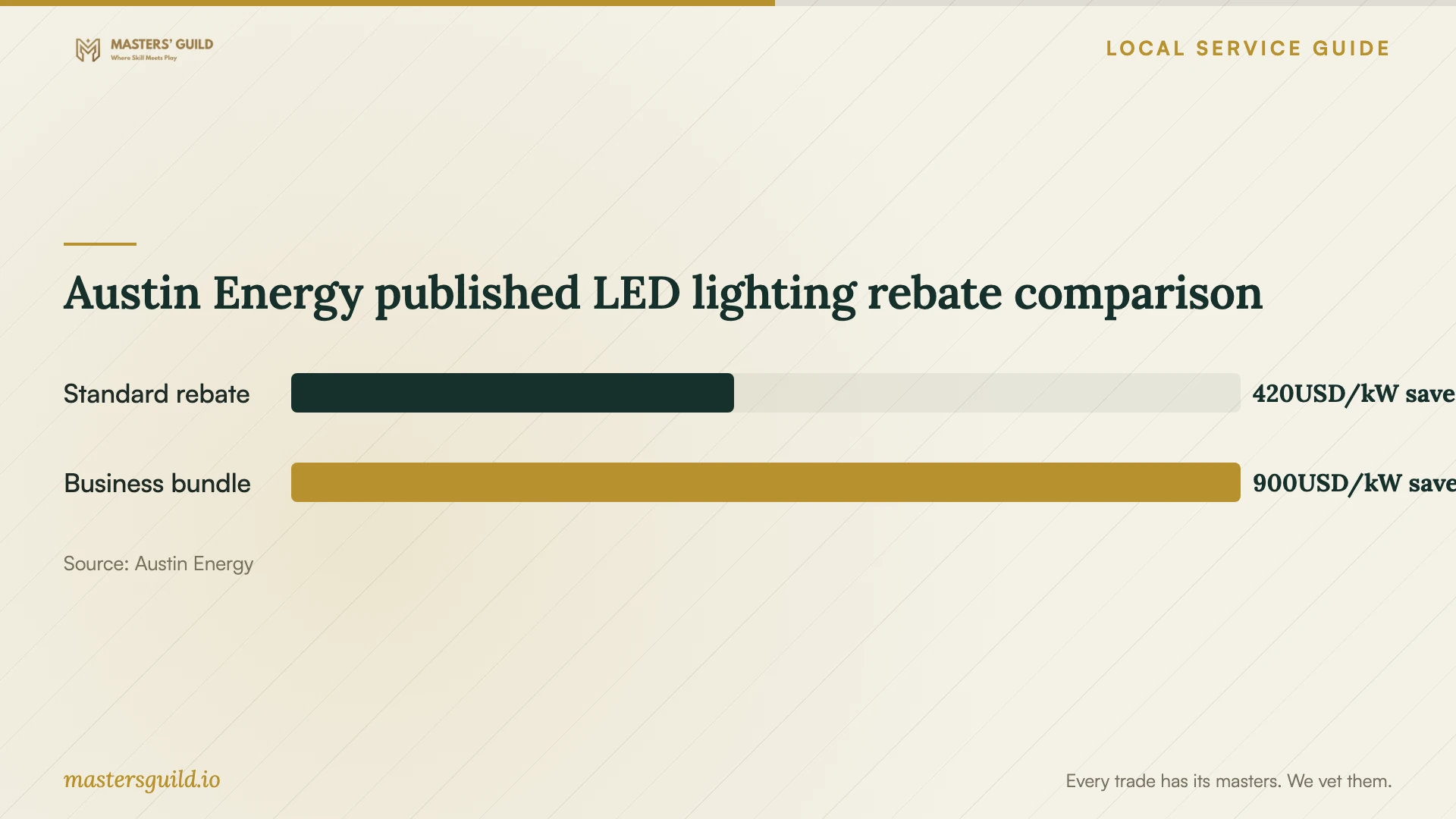
Request a quote showing the gross project cost, proposed incentive and your remaining payment as separate amounts. Have the contractor explain how they determine the kW saved and what happens if the approved incentive differs from the proposal. Austin Energy recommends obtaining at least three estimates from participating contractors. [5]
Agree on access and completion
Arrange the work around your business operations. Identify areas that must stay accessible, equipment that needs power and times when the contractor can use ladders or lifts. Request a plan covering power interruptions, dust protection and return visits. Put your agreed work hours and access contact in the scope.
Before accepting completion, walk through the space with the contractor. Test switching and dimming, review control settings and inspect the agreed ceiling repairs. Collect fixture model numbers, warranties and maintenance instructions. For permitted work, request the final inspection result; Austin assigns final trade inspection scheduling to the trade contractor. [2]
Austin Energy published LED lighting rebate comparison
Local details that affect your job
Commercial replacement exemptions differ from residential rules
Austin lists a commercial luminaire replacement exemption with maximum voltage of 480 and maximum ampacity of 30. Its residential list does not contain that same general luminaire replacement provision. Have the contractor confirm the building classification and complete scope before relying on the commercial exemption for your premises. [1]
A larger renovation can change the application route
Austin allows qualifying commercial electrical work unrelated to a building permit through a stand-alone trade permit. Its professional-contractor instructions require a Building Permit Application and Commercial Plan Review approval before trade permit issuance for commercial or multi-family projects involving more than one trade permit or exceeding the identified scope. Work related to an active building permit may require review through a revision application. Tell the electrician about planned mechanical, plumbing and building work before they apply. [3]
Bundle participation affects contractor selection
Austin Energy requires a participating contractor for the Small Business Bundle. The contractor handles paperwork and collects the rebate payment from the utility. Confirm program participation before hiring if you intend to use the bundle, and request a written breakdown of your remaining payment. [5]
Choose the next step for your lighting scope
| Your situation | Next step | Reason |
|---|---|---|
| Replace commercial lights in place | Have the contractor assess the complete work against the commercial exemption | Austin lists luminaire replacement limits of 480 volts and 30 amps |
| Electrical work separate from a remodel | Have the contractor assess stand-alone permit eligibility | Austin allows qualifying electrical work unrelated to a building permit through this route |
| Commercial project needs multiple trade permits or exceeds the identified stand-alone scope | Coordinate a Building Permit Application and Commercial Plan Review approval before trade permit issuance | Austin requires this route in its professional-contractor instructions |
| Lighting relates to an active building permit | Coordinate with the renovation team and confirm the revision application route | Austin identifies this as a situation that may require Commercial Plan Review |
| Seek a Small Business Bundle incentive | Confirm eligibility and select a participating contractor | Austin Energy requires participating installation and three or more efficiency improvements |
Your hiring checklist
- Prepare a fixture list showing replacements, relocations, additions and desired controls.
- Send ceiling photographs and identify access restrictions.
- Get landlord approval for alterations to leased premises.
- Check the contractor’s license and ask about current Austin registration.
- Have the contractor document the permit route for the complete renovation and identify inspection responsibilities.
- Confirm bundle eligibility before ordering equipment if you plan to use an incentive.
- Compare quotes with matching equipment, repair work and payment terms.
- Agree on power interruptions, work hours and completion records.
Frequently Asked Questions
Does replacing a business light require an Austin permit?
Austin lists a commercial exemption for luminaire replacement when the maximum voltage is 480 and maximum ampacity is 30. Have the contractor confirm that your complete scope qualifies. The city requires exempt work to comply with applicable codes and ordinances. [1]
Who handles permits and final inspections?
Austin assigns requesting and activating the trade permit, paying permit fees, performing the permitted work and scheduling related inspections, including final trade inspections, to the assigned trade contractor. Confirm that the quote covers those responsibilities. [2]
Can any electrician install lighting under the Small Business Bundle?
Austin Energy requires a participating contractor to install equipment for this offering. Check participation before hiring. The utility recommends comparing at least three estimates from participating contractors. [5]
How should I compare installation prices?
Give each contractor the same fixture schedule and control requirements. Request separate amounts for equipment, electrical labor, access equipment, repairs and permit handling. For an incentive proposal, compare the gross price and your proposed payment, and establish how the contractor will handle a change in rebate approval.
Sources and scope
This guide combines the sources below with practical planning guidance. Figures apply to the stated geography and period; request a written quote for your property.