
Local service guide
Lawn mowing in Austin, TX: Plan Your Service
Lawn mowing in Austin should follow grass growth: hire a provider who agrees on a grass-specific cutting height, removes no more than one-third of green growth per cut, and adjusts visits as growth changes. Request a written scope covering mowing, trimming, edging, clipping cleanup, wet-weather delays and any haul-away charges before choosing a recurring plan. [5]
Choose a schedule that follows growth
Use the one-third rule to judge a proposed schedule. AgriLife gives this example: for a 2-inch cutting height, mow before the grass exceeds 3 inches. Growth depends on temperature, precipitation, light and nutrient management, so a fixed interval may need adjustment. During peak summer growth, some warm-season lawns may need mowing twice a week. [5]
Have the provider explain how they will decide between weekly and biweekly visits. Put the process for adding, skipping or rescheduling a visit in writing, including whether the charge changes. Agree on who checks growth between visits and how much notice each person needs.
For an overgrown lawn, request a recovery plan before routine maintenance. AgriLife recommends lowering the height over time to avoid removing more than one-third in one mowing. Have the provider quote the initial cleanup and any follow-up cuts as separate work. [5]
Set the cutting height before the first visit
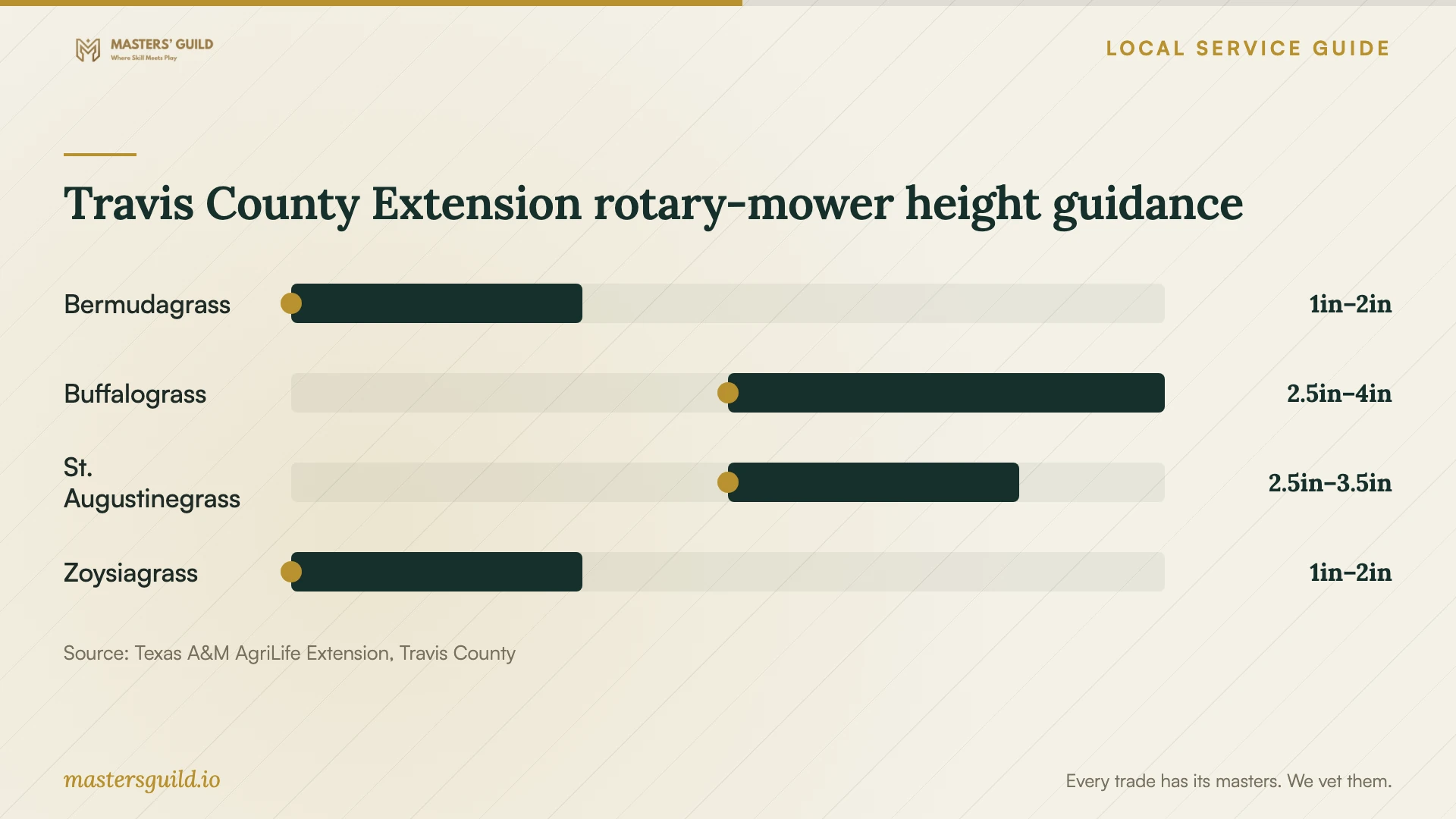
Travis County Extension recommends rotary-mower heights of 1 to 2 inches for Bermudagrass and Zoysiagrass, 2.5 to 4 inches for Buffalograss, and 2.5 to 3.5 inches for St. Augustinegrass. Its guidance advises using the high end of the range in summer. Ask the provider to identify your turf and account for its cultivar, shade and condition before selecting a setting. [4] [5]
Discuss mower type if you want a short cut. AgriLife cautions that rotary mowing below 1.5 inches can injure or scalp turf, particularly on uneven ground. Its broader guidance supports adjusting height for the species, equipment and growing conditions rather than treating one setting as suitable for the whole property. [5]
For an October service agreement, discuss how the provider will handle the transition toward dormancy. AgriLife recommends raising mowing height in fall and says dormant warm-season grass does not need winter mowing. Active winter weeds may still need attention, so distinguish turf mowing from weed maintenance in the agreement. [5]
Compare quotes for the same work
Give each provider the same description: the areas to mow, current grass height, gate width, slopes, obstacles and access instructions. Request separate prices for the first visit and recurring care. Confirm whether edging, fence-line trimming, bagging, leaf removal and hauling belong in the quoted scope or require extra approval.
Specify how the crew should handle clippings. AgriLife supports recycling clippings when the crew disperses them across the turf without piles. It advises keeping clipping debris off streets and sidewalks and considering bagging when weed seeds, disease or insect problems create concerns. [5]
Discuss blade sharpening and equipment cleaning, especially if you have a known lawn disease. AgriLife explains that dull blades injure grass and contaminated equipment can spread pests, diseases and weeds. Have the provider describe their procedure for moving between affected and unaffected areas. [5]
Request proof of liability insurance and a written process for reporting property damage. Mark irrigation heads, shallow lines and objects the crew might miss. Agree on how the crew will confirm completion, secure gates and handle pets before the first visit.
Coordinate mowing, watering and wet-weather delays
Avoid arranging a cut while the grass is damp from irrigation or dew. AgriLife advises mowing after excess water drains and the ground can support equipment; wet soil increases the risk of compaction. Have the provider define their delay policy and the next available service window. [5]
For Austin Water customers, use the current address-based irrigation schedule when planning visits. The utility's page, retrieved October 12, 2026, lists Conservation Stage restrictions. Residential automatic and manual irrigation systems may run one day per week: Thursday for even addresses and Wednesday for odd addresses. Allowed hours are midnight to 10 a.m. or 7 p.m. to midnight. [3]
Travis County Extension rotary-mower height guidance
Local details that affect your job
Overgrowth and equipment noise
Austin requires grass and weeds to stay below 12 inches. If your lawn approaches that height, tell the provider its current condition and request a cleanup plan. The city also regulates mechanical noise by equipment, sound level and time of day; its guidance gives a general limit below 70 decibels at the property line. Agree on service hours rather than assuming any start time is acceptable. For code questions, the city lists Code Connect at 512-974-2633. [1]
Brush disposal now carries a city fee
Since October 1, 2026, Hornsby Bend charges $9.80 per cubic yard for accepted material, with a six-cubic-yard daily limit. The facility at 2210 FM 973 opens Monday through Saturday, 8 a.m. to 3 p.m.; visitors need government-issued photo ID and must pay without cash. Accepted materials include limbs, branches, shrubs and leaves. If your cleanup includes these materials, ask the hauler to separate disposal fees from labor and transport. Austin Resource Recovery also offers qualifying residential customers on-demand large-brush collection at no extra cost; check eligibility before paying for hauling. [2]
Check your irrigation method as well as your address
Austin Water lists a different residential schedule for hose-end sprinklers and drip irrigation: Thursday and Sunday for even addresses, Wednesday and Saturday for odd addresses. Allowed hours are midnight to 10 a.m. or 7 p.m. to midnight. If you bundle irrigation with mowing, ask the provider to use the schedule for your equipment. Confirm current restrictions with your water supplier before changing the controller. [3]
Match the service plan to your lawn
| Situation | Service to discuss | Reason or question |
|---|---|---|
| Grass grows past the one-third threshold between visits | Shorten the interval | AgriLife bases mowing frequency on growth; peak summer growth may require twice-weekly mowing. |
| Grass is overgrown | Initial recovery cuts, then recurring maintenance | Ask how the provider will lower height over time without excessive removal in one cut. |
| Warm-season grass is dormant | Pause turf mowing and assess weeds | AgriLife says dormant grass needs no mowing, while active winter weeds may need attention. |
| Rain or irrigation leaves wet ground | Delay the visit until the ground supports equipment | AgriLife advises avoiding wet-soil mowing to reduce compaction risk. |
| Cleanup includes large branches | Compare paid hauling with eligible city collection | Austin offers qualifying residential customers on-demand brush pickup at no extra cost. |
Your hiring checklist
- Send photos of the lawn and identify the areas included in service.
- Measure gate clearance and flag slopes, obstacles and irrigation heads.
- Agree on grass type, cutting height and the process for changing visit frequency.
- Separate the initial cleanup price from the recurring mowing price.
- Confirm trimming, edging, clipping handling and any disposal charges in writing.
- Set wet-weather rescheduling terms and acceptable service hours.
- Arrange pet containment, gate access and completion confirmation.
Frequently Asked Questions
Should I choose weekly or biweekly mowing?
Choose the interval that lets the provider follow the one-third rule at your agreed cutting height. Reassess a biweekly plan if growth requires removing too much green tissue in one cut. Agree on authorization and pricing terms for additional visits before signing. [5]
Should the crew bag the clippings?
AgriLife supports recycling clippings when the crew spreads them across the lawn without piles. It recommends considering removal when clippings contain reproductive weed material or when disease or insects create concerns. Agree on the approach and any bagging charge before work begins. [5]
How much should I budget for mowing?
Request written quotes for the same lawn area, visit frequency and cleanup scope. Keep the first overgrown-lawn visit separate from recurring maintenance, and confirm any extra charges before choosing a plan. Hornsby Bend's $9.80-per-cubic-yard fee covers accepted disposal material; ask the contractor to quote labor, transport and mowing charges separately. [2]
Sources and scope
This guide combines the sources below with practical planning guidance. Figures apply to the stated geography and period; request a written quote for your property.