
Local service guide
Plan concrete work in Austin: permits and hiring
For concrete work in Austin, choose a contractor who can define the construction scope and handle the requirements for your site. Start with the right-of-way boundary and nearby trees. Austin exempts private-property sidewalks and driveways from building and driveway/sidewalk permits, but requires permits and a city ROW contractor license for driveway/sidewalk work in the public right-of-way. Agree on drainage, demolition, finish, and a complete written price before hiring. [1] [2] [3]
Choose a repair or replacement scope
Give bidders dimensions, photos, and a description of the problem or intended use. For an existing slab, ask each contractor to explain whether their proposal addresses the surface, uneven sections, drainage, or support beneath the concrete. Request repair and replacement alternatives if you have not chosen an approach, including what each option leaves untouched.
For new work, request written specifications for excavation, base preparation, slab thickness, reinforcement, joints, and finish. Ask for proposed elevations where the concrete meets doors, the house, and existing paving. Have the contractor explain where water will flow. Compare proposals using the same footprint and finish rather than choosing from total prices alone.
Identify the permit route
Austin’s residential guidance exempts sidewalks and driveways outside the public right-of-way from building and driveway/sidewalk permits. Owners must still comply with applicable codes and ordinances. That specific exemption does not establish the requirements for foundations, structural work, or other concrete projects. Confirm those scopes with Development Services. [2]
Austin uses the Driveway/Sidewalk permit, or DS, for ROW driveway approaches, sidewalks, walkways, curbs, and gutters, including repair and removal. The contractor performing DS work there needs a city ROW Contractor’s License. Subcontractors who impact the ROW must appear on the permit and hold the required license. [1]
Without a building permit, applicants use Austin Build + Connect for a stand-alone DS permit. With a building permit, Austin creates one DS permit with the same number and directs applicants to the applicable residential application route. Confirm which route applies before accepting a start date. For questions about the ROW scope, the city directs applicants to its Right of Way Management office. [1]
Check trees and drainage before choosing the layout
Austin identifies residential trees below 19 inches in diameter as unregulated, with an important program exception: trees enrolled in the Small Tree Fee Credit program must receive the same construction protection as regulated trees. That program applies to qualifying new-residence projects on single-family lots. Check enrollment if your flatwork forms part of such a project. [3]
For regulated trees, Austin requires a Tree Ordinance Review Application when an activity may impact the tree or disturb its critical root zone. Equipment-related soil compaction and changes in grade count as potential impacts. Consider the demolition route and material-storage area along with the slab itself. The city measures trunk diameter at 4.5 feet above grade and gives separate instructions for slopes and unusual trunks. [3]
A storm inlet within 10 feet of a driveway curb cut triggers Grading and Drainage review under Austin’s residential guidance. Flag that condition during the site visit so the contractor can account for review before committing to a driveway layout or construction schedule. [2]
Agree on the price and construction sequence
Request a price that accounts for demolition, hauling, base work, concrete, finish, delivery access, and restoration. Identify allowances and exclusions. If the truck cannot reach the forms, ask how the contractor plans to deliver the concrete and whether that method appears in the price. Record how you will approve and pay for changes after excavation.
Austin inspects permitted ROW projects at critical milestones. For driveway and sidewalk work, the city checks preparation and construction against plans and applicable standards, including subgrade compaction, elevations, forms, reinforcement, and joints. Its residential pre-pour requirements, except paving patching, specify a city-compliant concrete mix from an approved vendor. Have the contractor coordinate inspection with concrete delivery. [4]
Before signing, request proof of insurance, references for similar work, and written warranty terms. Agree on payment milestones, cleanup, and protection of adjacent surfaces. Get project-specific instructions for curing, weather protection, and reopening the surface to pedestrians or vehicles rather than relying on a general completion date.
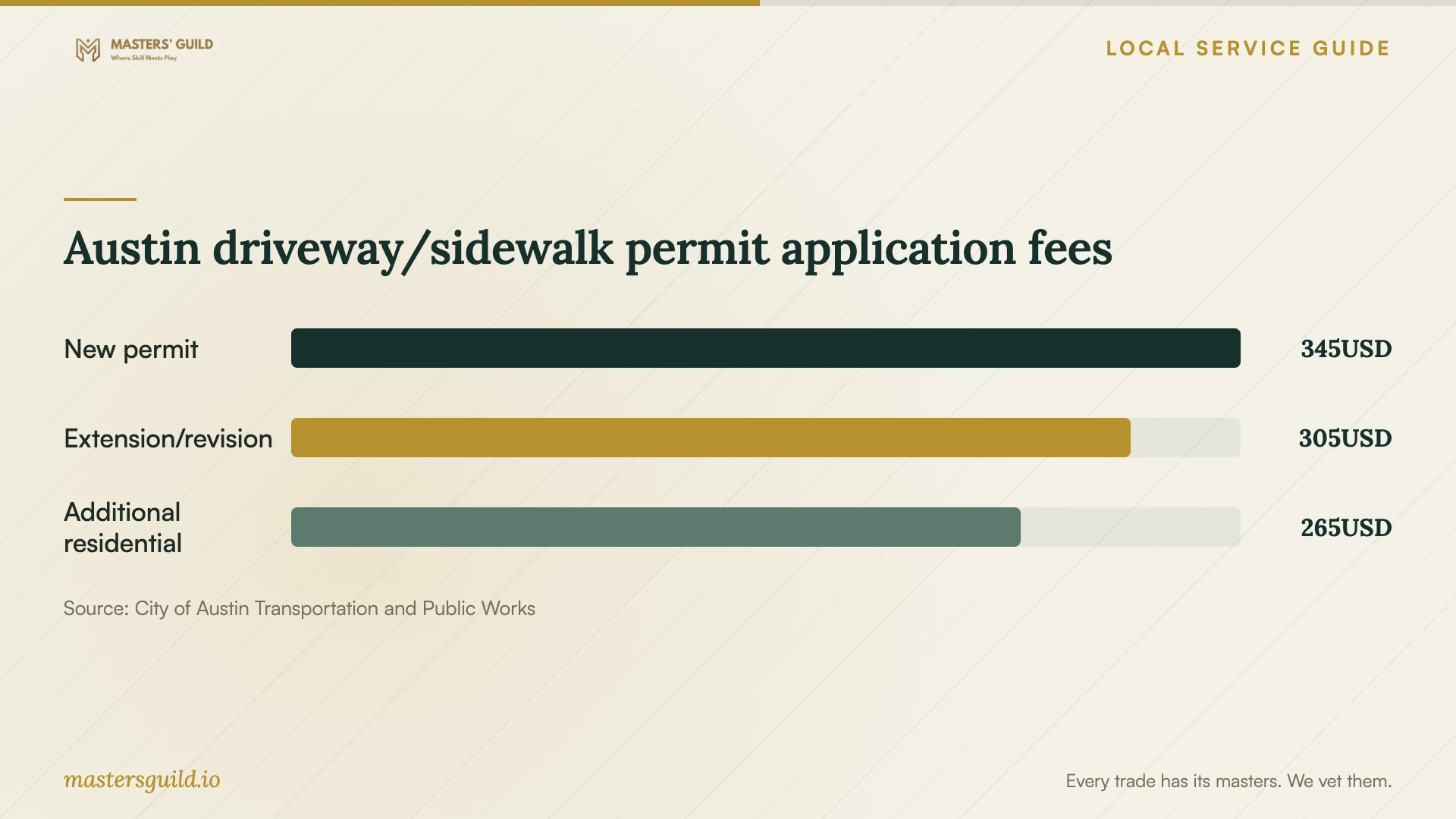
Austin driveway/sidewalk permit application fees
Local details that affect your job
Public access can require a separate closure permit
For ROW closures, Austin requires a Temporary Use of Right-of-Way permit, or TURP, unless an EX excavation permit or DS driveway/sidewalk permit already approves the closure. This includes closing a public sidewalk or driveway to work on private property. Traffic control placed in city ROW also requires a TURP when construction occurs on private property. Map equipment and barricade locations before assuming a private pour has no ROW requirements. [1]
Root-zone restrictions can change excavation plans
Austin allows no impacts within the quarter critical root zone, limits cut or fill to no more than 4 inches within the half critical root zone, and requires preservation without impact of 50% of the full zone. Account for those restrictions around regulated trees and trees enrolled in the Small Tree Fee Credit program. For otherwise permit-exempt work affecting regulated trees, Austin provides a stand-alone tree application route. [3]
Application and inspection charges are separate
The city schedule effective October 1, 2026 lists a $345 new DS application fee. For residential Type I and III driveway approaches, Austin lists a separate inspection base rate of $577.51 plus $97.28 per additional driveway. Confirm the applicable charges and who pays them; the application amount alone does not cover those inspections. [1]
Match the site condition to the next step
| Site condition | City requirement | Planning action |
|---|---|---|
| Private-property sidewalk or driveway | No building or DS permit required for this flatwork; code compliance still applies. | Confirm the boundary and check for tree impacts. |
| Driveway approach or sidewalk in the ROW | DS permit and city ROW contractor license required. | Include the permit route and inspection sequence in the schedule. |
| ROW closure for private-property work | TURP required unless an EX or DS permit already approves the closure. | Identify equipment positions and pedestrian arrangements. |
| Work affecting regulated trees | Tree review required for potential tree or critical-root-zone impacts. | Resolve excavation and equipment routes before fixing the layout. |
| Storm inlet within 10 feet of a driveway curb cut | Grading and Drainage review required. | Confirm review before agreeing to the curb-cut design. |
Your hiring checklist
- Photograph damage, drainage concerns, and connections to existing paving.
- Mark the proposed footprint, nearby trees, and delivery route on one dimensioned sketch.
- Confirm the company performing ROW work holds the required city license.
- Name the person responsible for applications, activation, and inspection bookings.
- Record allowances, exclusions, and your change-order approval process.
- Agree on temporary access, cleanup, payment milestones, and reopening instructions.
Frequently Asked Questions
Does an approach repair avoid the DS permit process?
No. Austin includes repairing driveway approaches in the ROW within the DS process. For residential repairs or replacements, the city says no further documentation is needed under that application guidance; it does not waive the permit. [1]
What should I submit for a stand-alone tree review?
Austin requests a sketch of the proposed work and a photo of the impacted tree from roots to canopy. Include enough detail to show possible impacts. For regulated-tree work that needs no other permit, use the stand-alone Tree Ordinance Review Application through Austin Build + Connect. [3]
How does the contractor book a DS inspection?
Austin accepts DS inspection bookings through the telephone system listed on the permit or through Austin Build + Connect. Online scheduling is available 24 hours in advance. Ask the contractor how they will adjust delivery if the inspection schedule changes. [4]
Do the published fees show what installation should cost?
No. These figures cover selected city application charges. They exclude concrete construction and separate inspection charges. Use site-specific quotes to budget the installation, with consistent dimensions and specifications. [1]
Sources and scope
This guide combines the sources below with practical planning guidance. Figures apply to the stated geography and period; request a written quote for your property.