
Local service guide
Business Plan Consulting in Austin, TX
Arrange Business Plan Consulting around the decision you need to make: opening a business, testing an expansion, or preparing a funding application. Before paying for a full plan, consider Austin’s no-cost, confidential coaching, which includes business-plan review and development after a required BizAid orientation. For paid help, agree on the intended reader, research scope, financial model, revisions, and delivery dates before work starts. [1]
Choose the help you need before buying a full plan
Write a brief naming your business, the decision you face, the person who will read the plan, and your deadline. Obtain a prospective lender’s or investor’s requirements before commissioning a document. For internal planning, focus the assignment on questions you cannot yet answer, such as whether sales can cover rent or how much cash you need before opening.
Austin’s coaching program offers business and marketing plan reviews and development, financial readiness assessments, and general business management support. The City describes coaching as no-cost and confidential. Use a coaching session to identify gaps, then decide whether to commission research, projections, or help preparing a specific submission. [1]
Put deliverables and fees in writing
Request a proposal that separates the written plan, market research, financial projections, and presentation materials. Specify the forecast period and detail you want. Include an editable spreadsheet with visible formulas and assumptions, an editable narrative, and a review meeting where you can question the numbers before accepting the work.
Have candidates explain a redacted sample relevant to your business model. Discuss how they would estimate demand, account for owner pay, and test weaker sales or a delayed opening. Obtain comparable written quotes against one brief, including who supplies records, who researches competitors, how many revisions the fee covers, and what triggers extra charges.
Set milestones for reviewing assumptions, draft projections, the narrative, and final files. Assign an owner to each piece of information the consultant needs. Leave room before your submission deadline to answer the recipient’s questions and revise the plan. Include follow-up support in the proposal if you want the consultant to handle those questions.
Check the premises before forecasting opening revenue
Austin Development Services says a small business may need a change of use to obtain an updated Certificate of Occupancy reflecting its planned use. The process may include a Site Plan Exemption and Building Plan Review. For change-of-use questions, the City directs owners to Land Use Assistance through the Commercial and Multi-Family Zoning appointment type. [2]
Provide your consultant with the proposed address, intended use, lease terms, and improvement quotes before approving an opening date. Separate confirmed costs from allowances and model a delayed opening. Include rent, payroll, deposits, and expenses you expect before customers arrive. Confirm the reviews for your project with Development Services before using a published typical timeline in your forecast. [2]
For a home business, confirm current rules with the City and review homeowners’ association restrictions. Austin’s permitting page links its pending regulatory updates to HB2464, which the Texas Legislature passed in June 2025. The page still describes those updates as forthcoming; that wording does not establish whether the City has completed implementation. The City also states that homeowners’ associations can enforce their own rules. Give your consultant the restrictions you confirm for your property. [2]
Prepare for your intended funding route
Austin Kiva Hub describes business loans from $1,000 to $15,000 with no interest, fees, or collateral. The City lists designated ZIP codes for location eligibility, including some areas beyond city limits, and describes application review and community fundraising. Confirm your eligibility and the current terms before paying a consultant to prepare an application. [3]
For this route, prepare an itemized use of funds, accurate financial information, business proof documents, and personal and business stories you can stand behind. The City’s guidance asks applicants to name specific purchases and says the first repayment falls one month after receipt of the loan. Confirm that repayment schedule and include it in your cash forecast. [3]
The City’s published eligibility guidance contains errors: it contradicts itself about eligible business types and omits the criminal-history lookback period. Confirm those affected requirements with program staff. The City attributes its fundraising guidance to Kiva.org; confirm current stage deadlines before building a funding schedule around the published limits. Question any consultant who promises approval and require a clear description of the work and follow-up support you are buying. [3]
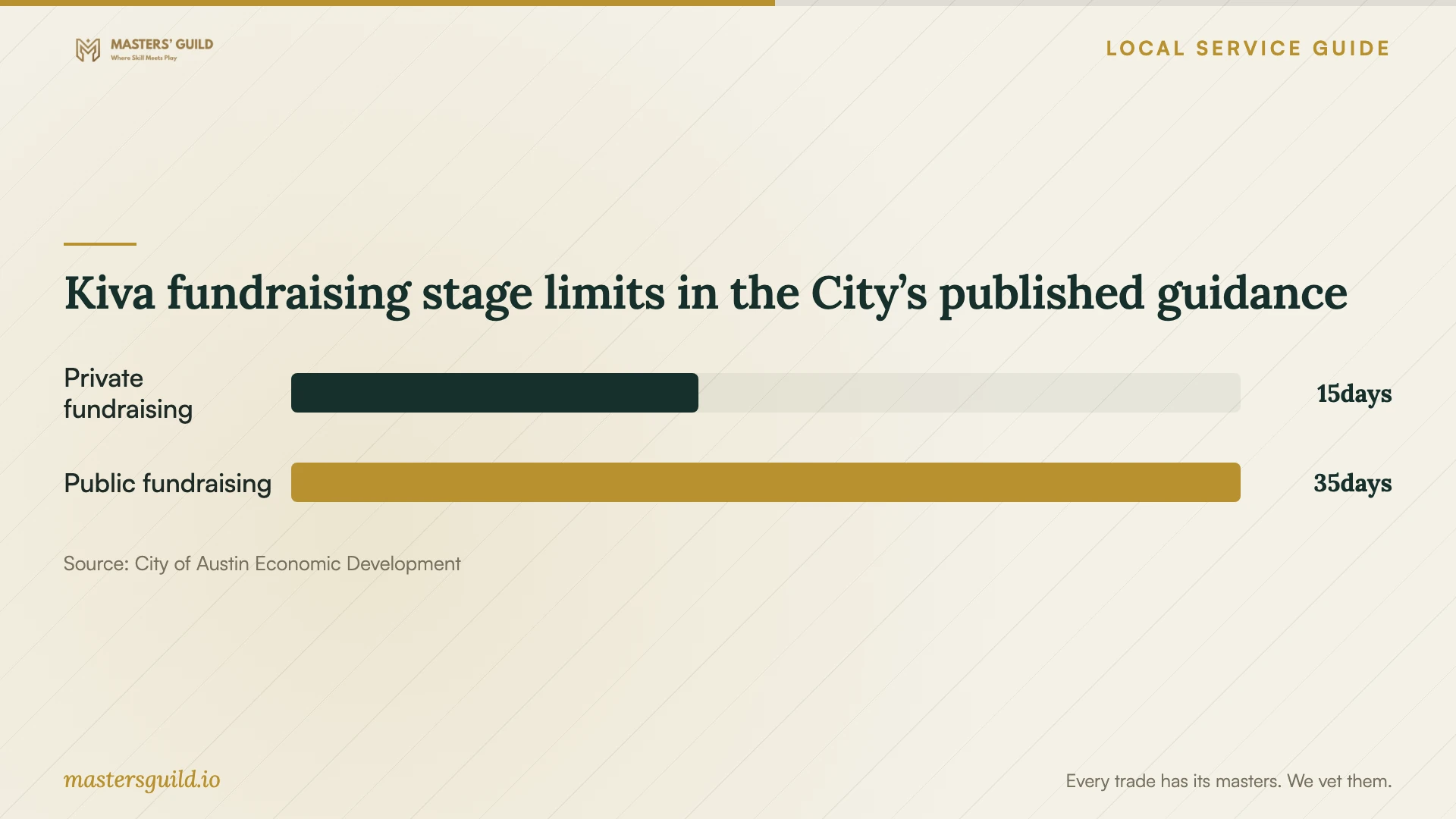
Kiva fundraising stage limits in the City’s published guidance
Local details that affect your job
City limits affect coaching access
The City lists for-profit businesses within Austin city limits as qualifying for coaching. It limits nonprofits and businesses outside city limits to six hours and requires BizAid orientation first. Confirm your location and business status when arranging help. The City offers virtual and in-person orientation options, so choose a format you can attend before scheduling coaching. [1]
Choose the right premises appointment
Austin’s Development Process Team offers 20-minute appointments for high-level questions about proposed business improvements. For change-of-use questions, the City directs owners to Land Use Assistance instead. Take your address and intended use to the appropriate appointment, then share the guidance with your consultant before approving opening assumptions. [2]
Kiva uses a different location boundary
Austin Kiva Hub considers applicants in designated eligible ZIP codes, including portions extending beyond city limits. Check that location requirement separately from the city coaching boundary. Before commissioning application help, confirm your ZIP eligibility with program staff and prepare a plan for recruiting initial supporters. [3]
Choose a starting point for your plan
| Your situation | Suggested starting point | Scope to confirm |
|---|---|---|
| You need help shaping the business | Consider BizAid and City coaching | Required orientation, eligibility, and any coaching limit |
| You need a lender submission | Obtain the lender’s requirements, then request a proposal | Documents, projections, revisions, and submission date |
| You plan to open in a commercial space | Check the proposed use with Development Services | Possible change of use, occupancy review, and opening-cost assumptions |
| You want an Austin Kiva Hub loan | Confirm current eligibility and fundraising deadlines with staff | Fund uses, business proof, community support, and repayment forecast |
| You have a plan but doubt the numbers | Request a focused financial-model review | Assumption testing, editable formulas, and cash needs |
Your hiring checklist
- Name the plan’s intended reader and obtain submission requirements.
- Gather financial records, sales assumptions, and an itemized use of funds.
- List premises costs and flag any unconfirmed opening date.
- Review a relevant redacted sample and discuss the research method.
- Specify editable files, visible spreadsheet formulas, meetings, and revisions.
- Compare written fees, milestones, exclusions, and additional-work charges.
- Challenge any final assumption you cannot explain yourself.
Frequently Asked Questions
Can I get business-plan help without paying a consultant?
Austin offers no-cost, confidential one-on-one coaching that includes business-plan review and development. Complete BizAid orientation first. The City limits nonprofits and businesses outside city limits to six hours of coaching. [1]
How much should I budget for a consultant?
Obtain comparable written quotes using one brief. Compare research, projections, editable files, meetings, and revisions, then check exclusions and additional-work charges. For a limited budget, request a separate quote for the specific task you need, such as reviewing assumptions or building a cash-flow model.
Should I check permits before the consultant finishes my plan?
Confirm premises assumptions before approving the opening forecast. Austin says your planned use may require a change of use and an updated Certificate of Occupancy, potentially including a Site Plan Exemption and Building Plan Review. Confirm the process for your address with Development Services. [2]
Does Kiva fundraising have a fixed completion date?
The City’s published guidance describes private fundraising lasting up to 15 days and public fundraising allowing up to 35 days, with public fundraising operating on an all-or-nothing basis. Confirm current deadlines with program staff before scheduling. These stage limits do not promise approval or a date when you will receive money. [3]
Sources and scope
This guide combines the sources below with practical planning guidance. Figures apply to the stated geography and period; request a written quote for your property.