
Local service guide
Aurora tree cutting: Hiring an Arborist
Arrange tree cutting in Aurora by requesting a site assessment and a written recommendation for pruning, preservation, or removal. Obtain site-specific quotes and confirm ownership and any required approval with the responsible authority before work. If ComEd serves your property, contact it about assistance with trees near energy equipment before fixing the cutting date. Check Illinois pesticide licensing if you choose treatment. [1] [2]
Decide what you want to accomplish
Start with your goal: clear branches from a roof, investigate declining foliage, preserve a valued tree, or make room for another project. Describe the problem rather than prescribing cuts. If you want to retain the tree, request preservation options and the reasons behind the recommendation before approving removal.
Send photographs from a safe position showing the whole tree, its base, and nearby structures. Identify the tree on a simple property sketch if several stand together. Point out overhead wires, fences, sheds, and shared boundaries. Ask the arborist to inspect the site before you accept the final proposal, and keep people away from hanging branches or damaged sections.
Coordinate work near energy equipment
If ComEd serves your property, use its tree and vegetation assistance route to describe proposed removal or trimming near energy equipment. ComEd publishes a request form for that purpose. Ask what assistance applies to your situation and keep its response with the contractor’s agreement. [1]
ComEd’s page displayed a technical-error notice when retrieved on October 12, 2026, and directed customers with questions to Customer Care. If ComEd serves your property and you cannot use the form, contact Customer Care about the request. The published instructions identify a route for assistance; confirm that someone has received your request before relying on it for scheduling. [1]
Assign responsibility for utility contact and confirmation before the crew starts. Ask the contractor how a coordination delay affects your appointment or deposit. Avoid attempting cuts near electrical equipment yourself.
Verify the people assessing and treating the tree
Request credential details from the person recommending the work and current insurance documentation from the contracting business. Ask the insurer or agent to confirm coverage for the proposed operation, and discuss workers’ compensation coverage for the crew. Identify subcontractors who will cut the tree or bring lifting equipment.
Illinois requires a license for people applying general-use or restricted-use pesticides in the course of employment. The Department of Agriculture licenses outdoor pesticide applications. Its applicator categories determine the areas in which a company may apply pesticides, and an applicator may supervise licensed operators. [2]
Before accepting treatment, request the diagnosis, proposed product, application method, and follow-up plan. Ask the arborist to explain the intended result and how you will judge progress. Keep treatment and cutting as separate decisions so you can approve the work you want.
Compare the finished job and prepare access
For pruning, ask the contractor to identify the purpose and areas to address. For removal, define the finish: hauling logs and brush, grinding the stump, handling grindings, and restoring disturbed ground. Request separate prices for optional work. Ask bidders to explain differences in their proposed methods instead of choosing from totals alone.
Walk through the equipment route with the contractor. Measure gate openings, identify surfaces you want protected, and discuss permission before crossing neighboring land. Agree on parking and who moves vehicles or furniture. Request photographs of existing damage and a written process for reporting damage during the job.
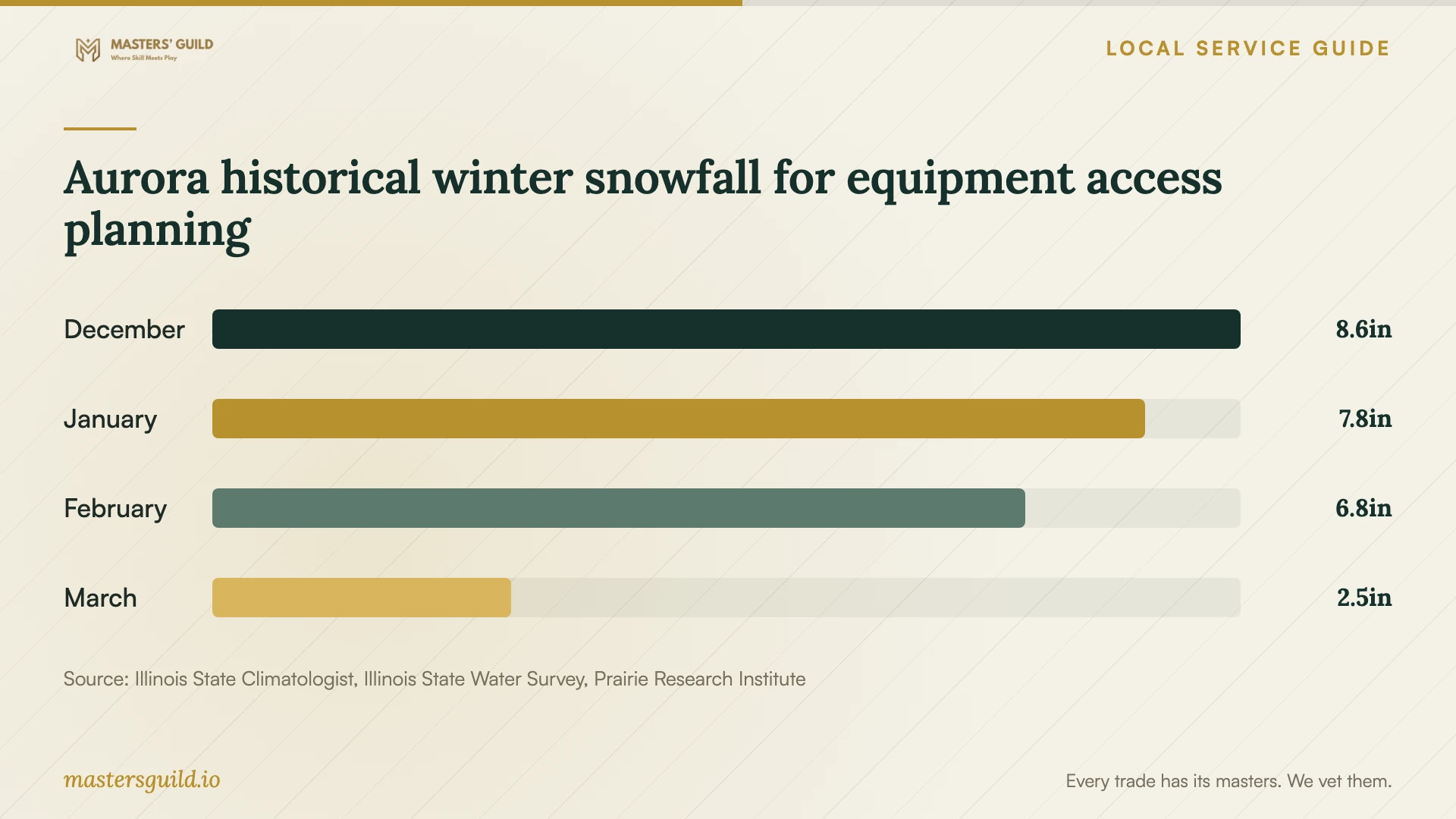
The Illinois State Climatologist publishes Aurora snowfall normals for 1981–2010. Use the historical winter figures below to discuss snow-covered access and rescheduling with the crew. Ask the arborist to choose pruning timing based on the tree and the proposed work; the snowfall averages do not establish a suitable pruning date. [3]
Before signing, record payment stages, exclusions, and who authorizes changes. Ask how the contractor will handle a condition discovered during work that changes the method or price. Require your agreement to the revised scope before additional work proceeds.
Aurora historical winter snowfall for equipment access planning
Local details that affect your job
Give the utility the actual work location
If ComEd serves your property, prepare your account and contact information for its vegetation request. The form includes comments for a work location that differs from the address entered on the form. Identify that location when relevant, especially if your contact address and the tree’s location differ. Use this field to describe the affected tree before asking what coordination you need. [1]
Check Illinois treatment categories and license records
For outdoor tree pesticide treatment, use the Illinois Department of Agriculture’s certification page, which includes licensed applicator and operator search options. Its ornamental pest control category covers trees, shrubs, and ornamental plantings. Obtain the responsible applicator’s name and category, plus the operator’s details if an operator will apply the product. Check those details against the proposed treatment site. [2]
Choose your next step
| Situation | Next step | Question to resolve |
|---|---|---|
| You want to preserve the tree | Request an assessment and preservation options | What outcome does the arborist expect from each option? |
| Proposed work is near energy equipment | If ComEd serves your property, request assistance through its vegetation service route | Who will confirm utility coordination before the crew starts? |
| The proposal includes pesticide treatment | Verify Illinois pesticide licensing and applicable categories | Who will apply the product and who will supervise? |
| You have chosen removal | Define the completed job in writing | What will remain at the stump location and who restores the surface? |
Your hiring checklist
- Label the tree in photographs or a property sketch.
- Write down your desired outcome and questions for the site assessment.
- Confirm ownership and assign responsibility for approval and utility checks.
- Collect credential and insurance details from the people doing the work.
- Record the agreed debris handling and stump finish.
- Clear the agreed access route and identify surfaces to protect.
- Review payment stages, weather delays, and written change approval before signing.
Frequently Asked Questions
Can I schedule cutting before hearing from the utility?
For work near energy equipment, resolve coordination before committing to the cutting date. If ComEd serves your property, its published vegetation assistance route covers requests about removal or trimming near that equipment. Ask the utility and contractor to confirm the next step. [1]
Does an arborist credential cover pesticide treatment?
Check pesticide licensing as a separate step. Illinois requires commercial applicator or operator licensing for pesticide use for hire, including general-use products. The applicator’s categories determine the areas in which the company may apply pesticides. [2]
How should I discuss a shared or boundary tree?
Identify the boundary concern during the assessment. Confirm ownership and any required consent or approval with the responsible authority before authorizing work. Ask the contractor to include agreed access across neighboring land in the written plan.
How can I evaluate a quote without a local price range?
Request site-specific quotes for the same outcome. Review the proposed method, equipment, finish, and exclusions. If one bidder recommends different work, ask for the reason and decide whether that recommendation meets your goal before comparing prices.
Sources and scope
This guide combines the sources below with practical planning guidance. Figures apply to the stated geography and period; request a written quote for your property.