
Local service guide
Lighting Installation in Aurora, IL
Arrange Lighting Installation by defining the fixture locations and wiring changes, then confirming the installer’s Aurora registration and your project’s permit requirements. Aurora’s replacement exception applies to an existing piece of utilization equipment. Have the contractor or city confirm whether your proposed fixture replacement falls within that category before checking the remaining conditions: matching voltage and current requirements and an independent testing laboratory listing suitable for the application. For permit-required electrical work, choose an appropriately registered electrical contractor, subject to the city’s code exemptions. [2]
Define the installation before requesting quotes
Give each contractor the same description: fixture count, room, existing light locations, ceiling height, and whether you want to keep or move the switches. Include photographs of the room and the fixture’s product information. Identify which fixtures you will supply and which you want the contractor to purchase.
Separate the work into replacement fixtures, added light locations, and changes to controls. Ask the installer to assess the existing box, fixture support, wiring, and proposed controls before agreeing to a final scope. For a chandelier or another substantial fixture, provide its weight and mounting instructions with your quote request.
Request a written breakdown for installation labor, fixtures, controls, electrical alterations, permit administration, and wall or ceiling repairs. Discuss how the contractor will price work discovered after removing the old fixture. Agree on a point at which the installer must pause and obtain your approval for additional work.
Resolve registration and permits before work starts
Aurora requires registered electrical contractors for electrical work requiring a permit, subject to the code’s exemptions. Its registration categories include unlimited registration for industrial, commercial, and residential work, and limited registration for one-family and two-family residential work. Ask for the business’s Aurora registration details and confirm that the category covers your property. [2]
Aurora’s permit exception starts with replacement of an existing piece of utilization equipment. Have the contractor or city confirm whether your proposed fixture replacement falls within that category. Within that scope, the replacement must have the same voltage and current requirements, and an independent testing laboratory must list the new equipment as suitable for the application. Ask the installer to identify the specifications supporting that determination. [2]
For added wiring or relocated lights, have the contractor confirm the requirements for that work. Do not extend the exception for replacing an existing piece of utilization equipment to the whole project without a scope-specific determination. [2]
Aurora’s eTRAKiT portal includes permit applications, fee payment, permit searches, a fee estimator, and inspection scheduling. The portal instructs homeowners to set up an account before applying for licenses, registrations, or permits. Agree with your contractor who will handle these steps, and keep the permit information with your project records. [3]
Choose brightness and controls together
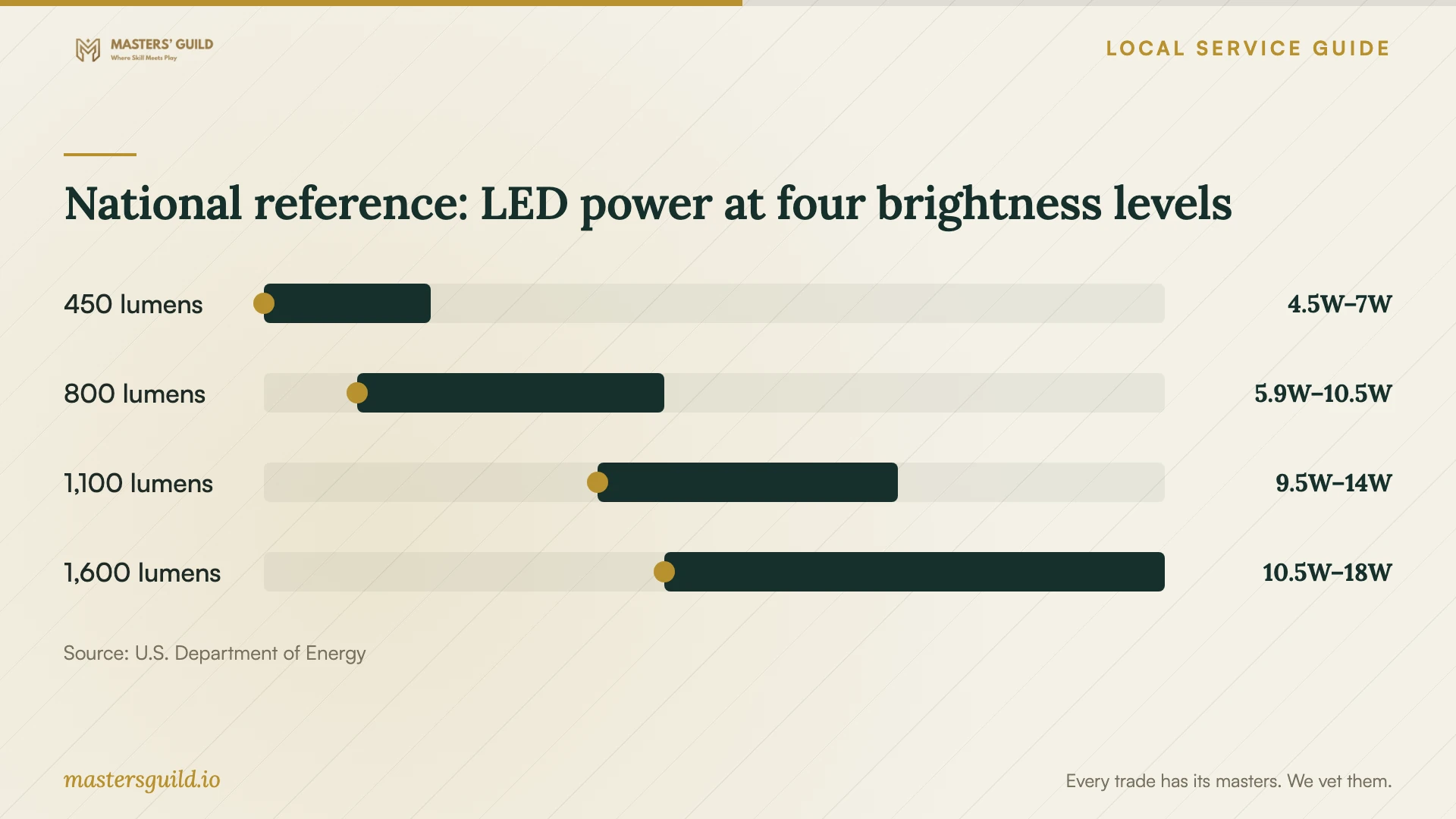
Compare lumens when choosing brightness. The Department of Energy distinguishes lumens, which measure visible light output, from watts, which measure power input. Its national reference table lists LEDs using 5.9 to 10.5 watts for 800 lumens, compared with a 60-watt incandescent bulb at that brightness. Use the chart as a bulb-selection reference, then check the specifications of the product you intend to buy. [1]
Choose the light’s color appearance before ordering a roomful of fixtures. DOE describes 2,700 K as warm and 3,000 K as soft, with both listed for home applications. It warns that a large change in color temperature can cause dissatisfaction. Try your preferred color in the room and ask the installer to match that choice across the proposed fixtures. [1]
DOE advises buyers to confirm that an LED supports dimming and works with the intended dimming system. For enclosed fixtures, check the bulb packaging or technical specifications for suitability for that application; DOE explains that trapped heat can affect LED performance and life. Have the contractor record the agreed bulb and dimmer models in the quote. [1]
Agree on access and completion checks
Before the appointment, clear furniture from the work area and discuss how the contractor will reach high ceilings. Decide who will protect surfaces, remove old fixtures, and repair any openings. Ask the installer to explain the planned power interruption so you can arrange your household’s day.
Before accepting completion, operate each light and switch with the installer present. For dimmed lights, try the agreed brightness range and discuss any flicker or noise. Check fixture placement against the agreed layout, collect product information, and record any unfinished repairs or inspection steps.
National reference: LED power at four brightness levels
Local details that affect your job
Residential registration has a property limit
Aurora limits its residential electrical-contractor registration to one-family and two-family residences. If your home is in a larger multifamily building, do not assume that a contractor’s residential credential covers the job. Ask the city to confirm the appropriate registration category before hiring. [2]
New contractor registration follows a separate route
Aurora’s eTRAKiT portal directs new contractors and registered design professionals to submit the contractor registration form by email to the city’s development-services administration. A contractor new to Aurora should address registration before you rely on a proposed start date. Homeowners use the portal’s account setup before making their own applications. [3]
The homeowner exemption restricts hired assistance
Aurora’s owner-occupied single-family registration exemption requires occupancy documentation and an affidavit, plus continued residence for at least six months after completion. The city prohibits hired assistance under that exemption unless the assistant becomes licensed in the appropriate trade. If you plan to pay someone to install the lights, do not use the owner exemption as a substitute for checking that person’s credentials. This provision concerns registration; it does not establish a permit exemption. [2]
Match the project to the next step
| Your project | Next step | Point to resolve |
|---|---|---|
| Replace an existing light | Have the contractor or city confirm whether this replaces an existing piece of utilization equipment | Only within that category, check matching voltage and current requirements and a suitable independent testing laboratory listing |
| Add lights or move locations | Request a defined wiring scope and permit determination | Assess the added work separately from the exception for replacing an existing piece of utilization equipment |
| Install in a larger multifamily building | Confirm the contractor’s registration category with the city | Limited residential registration covers one-family and two-family residences |
| Add LED dimming | Specify the bulb and dimmer together | DOE advises checking dimmability and compatibility with the dimming system |
| Use bulbs inside enclosed fixtures | Check packaging or technical specifications before buying | DOE advises confirming suitability for enclosed use |
Your hiring checklist
- List fixture counts and mark each location as replacement, added, or moved.
- Send room photographs, ceiling heights, and fixture specifications with your quote request.
- Confirm the contractor’s Aurora registration category for your property.
- Ask for a scope-specific permit determination and agree who handles applications and inspections.
- Record bulb brightness, color temperature, fixture compatibility, and dimmer models.
- Agree on electrical alterations, surface repairs, cleanup, and approval of extra work.
- Test lights and controls with the installer and collect the completion records.
Frequently Asked Questions
Does replacing a light fixture require an Aurora permit?
Aurora’s exception concerns replacement of an existing piece of utilization equipment. First have the contractor or city confirm whether your fixture replacement falls within that category. The replacement must then meet the same voltage and current requirements and have an independent testing laboratory listing suitable for the application. Ask for a separate determination for added wiring or other changes. [2]
Can I hire someone registered in another Illinois municipality?
Aurora may grant reciprocal registration if its electrical code compliance officer accepts the other municipality’s testing procedure. The contractor must still pay for Aurora registration and meet its insurance requirements. Ask for confirmation of Aurora registration before relying on the outside credential. [2]
How should I compare installation quotes?
Give each contractor the same fixture list and layout. Ask each to identify supplied materials, electrical alterations, permit administration, access arrangements, and surface repairs. Resolve exclusions and the approval process for extra work before comparing totals.
Which LED bulb should I buy for a dimmed light?
Choose the brightness and color appearance you want, then check that the bulb supports dimming and matches the proposed dimming system. DOE advises checking both points. If the fixture encloses the bulb, confirm suitability for enclosed use in the packaging or technical specifications. [1]
Sources and scope
This guide combines the sources below with practical planning guidance. Figures apply to the stated geography and period; request a written quote for your property.