
Local service guide
Bricklaying and Masonry in Aurora, IL
For Bricklaying and Masonry in Aurora, hire a contractor who will diagnose the damage before quoting cosmetic repairs, explain the mortar choice, and confirm city requirements for your scope. Aurora requires general-contractor registration for work requiring a permit, subject to owner exemptions. Ask the Division of Building and Permits whether your proposed work needs a permit; the supplied ordinance does not establish a blanket rule for repointing. [1] [2]
Choose the repair after a diagnosis
Ask the mason to distinguish deteriorated mortar from damaged bricks and movement in the wall. The National Park Service identifies settlement, thermal and moisture movement, freeze-thaw action, and failing supports among possible causes of masonry cracks. A stair-step crack alone does not establish which repair you need. [2]
Show the contractor cracks around windows and doors, areas where brick faces have broken away, and any wall that appears to bulge or lean. NPS guidance links cracking or displacement around openings with possible lintel or arch problems. Ask whether the contractor needs a structural assessment before preparing the repair proposal. [2]
Take dated photographs from the same position and include a wider view of the wall. Tell the contractor when you first noticed the damage, whether you have seen a change, and where you notice water indoors. Keep your observations separate from your guesses about the cause.
Specify the mortar and finished appearance
For historic masonry, choose a contractor who can explain compatibility with the existing brick and mortar. NPS guidance calls for matching mortar color, hardness, and permeability. It warns that hard mortar with high concentrations of portland cement can accelerate deterioration of surrounding historic masonry. [2]
Ask for a small sample area before approving the appearance of a larger repair. Include joint width, tooling, mortar color, and cleanup in the written scope. NPS guidance calls for matching the historic joint appearance and keeping mortar off brick faces. [2]
Discuss cleaning and coatings as separate decisions. NPS warns that abrasive cleaning can remove brick’s hard outer surface and that impermeable coatings can trap moisture and accelerate decay in historic masonry. Ask the contractor to explain the condition of the brick and the reason for any proposed coating. [2]
Resolve city requirements before signing
Give Aurora’s Division of Building and Permits a specific description of the project: joint repair, brick replacement, rebuilding around an opening, or new masonry construction. Ask for a scope-specific permit determination and which contractor registration applies. The city’s general-contractor rule covers installing, supervising, maintaining, or repairing work for which its code requires a permit. [1]
Name the person responsible for the permit application and any required inspections in your agreement. Ask the contractor to identify permit fees separately from labor and materials. Do not treat the city’s annual contractor-registration fee as your project’s permit price. [1]
Compare complete quotes and weather plans
Ask each bidder to price the same repair area and describe what they will remove, replace, and retain. Request separate allowances for access equipment, brick matching, cleanup, and concealed damage. For a new wall or rebuilt section, ask the contractor to describe the proposed support and connections, then confirm the city’s review requirements for that design.
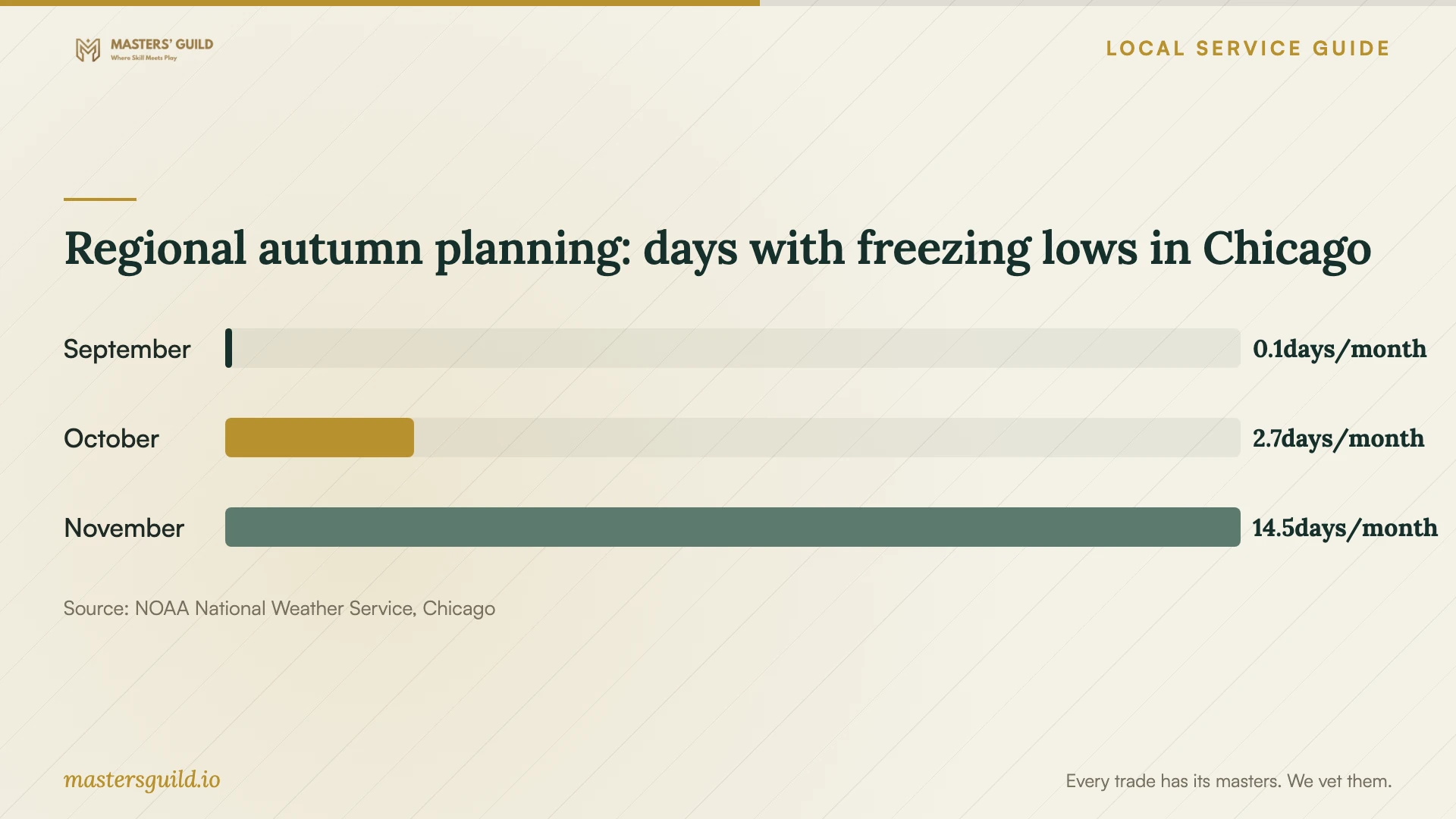
Use regional climate data to start a scheduling discussion. The National Weather Service reports an average of 2.7 October days and 14.5 November days with lows at or below 32°F in Chicago during 1991–2020. Those figures describe Chicago, not your property or this year’s forecast. Ask for the contractor’s temperature limits, protection method, and delay policy for the chosen mortar. [3]
Request a proposed work sequence and a written process for approving extra work. Agree on where the crew can place equipment, how they will protect nearby surfaces, and who will remove debris. Tie payment stages to described work and document the final walkthrough.
Regional autumn planning: days with freezing lows in Chicago
Local details that affect your job
Aurora registration and insurance checks
For work requiring a permit, Aurora’s ordinance requires general-contractor registration, subject to specified exemptions. The city requires contractors to submit liability coverage of at least $500,000 per occurrence and $1,000,000 general aggregate, plus workers’ compensation and employer’s liability coverage meeting statutory limits. Ask the Division of Building and Permits to confirm the registration relevant to your project, and request the contractor’s current insurance certificate. [1]
Owner exemptions have different conditions
Aurora exempts a property owner acting as general contractor on their own buildings from that registration requirement when the work does not exceed $40,000. A separate exemption for personally performing work on an owner-occupied single-family dwelling requires occupancy documentation, an affidavit, and continued residence for at least six months after completion. That personal-work exemption prohibits hired assistance unless the assistant becomes licensed in the appropriate trade. Ask the city which provision applies before arranging help or completing an owner application. [1]
Choose the next step for your masonry project
| What you see or plan | Next step | Question to ask |
|---|---|---|
| Deteriorated mortar in historic brick | Discuss compatible repointing after assessment. | How will you match mortar hardness, permeability, and joint finish? |
| Cracking or displacement around an opening | Investigate the lintel or arch before cosmetic repair. | Does the support need repair or replacement? |
| Bowing or leaning masonry | Arrange an assessment before agreeing to surface repairs. | Who will evaluate the wall’s stability and repair sequence? |
| Work the city determines needs a permit | Verify applicable Aurora contractor registration. | Who will obtain the permit and arrange inspections? |
| Owner-performed work with hired help | Clarify the applicable owner exemption with the city. | Which registration or licensing conditions apply to my helpers? |
Your hiring checklist
- Photograph the full wall and close views of damaged joints, bricks, and openings.
- Write down when you noticed damage and whether you have observed movement or water entry.
- Ask each contractor to explain the cause and the proposed repair boundaries.
- Confirm the permit determination and applicable contractor registration with the city.
- Request current insurance documentation and examples of comparable masonry work.
- Approve the mortar specification and a sample of the joint finish.
- Agree on access, weather delays, extra-work approval, cleanup, and payment stages.
Frequently Asked Questions
Does every repointing job require an Aurora permit?
The supplied ordinance does not answer that question for every repointing scope. It establishes general-contractor registration requirements for work requiring a permit. Describe the repair to the Division of Building and Permits and ask for a determination before work begins. [1]
Can a mason fill a crack without investigating it?
Ask for a diagnosis first. NPS guidance identifies several possible causes of cracking and says structural repairs should precede cosmetic work. It also distinguishes active cracks from inactive cracks when discussing repair, so ask how the contractor has assessed movement. [2]
Should I waterproof an older brick wall?
Have the contractor assess the deterioration before approving a coating. NPS warns that impermeable paint or waterproofing can trap moisture and accelerate decay in historic masonry. Ask how the proposed treatment addresses the diagnosed problem and permits moisture to escape. [2]
How much should I budget?
Request an itemized site-specific quote. The supplied sources do not establish Aurora masonry repair prices. Define the repair area, access arrangements, material matching, permit responsibility, and treatment of concealed damage so you can compare bids on the same basis.
Sources and scope
This guide combines the sources below with practical planning guidance. Figures apply to the stated geography and period; request a written quote for your property.