
Local service guide
Aurora tax preparation and accounting
For tax preparation and accounting in Aurora, choose a professional who can handle your business return and the city filings you need. Ask for a written scope covering bookkeeping cleanup, return preparation, local sales and use tax, and notice support. Confirm the paid preparer’s PTIN and ask about relevant business experience. If you need IRS representation, enrolled agents, CPAs, and attorneys have unlimited representation rights. Before requesting quotes, identify your business address, filing periods, and missing records. [1] [2] [4]
Choose the scope before choosing the professional
Describe the work you want completed: an annual business return, your owner’s individual return, overdue bookkeeping, payroll review, or recurring city filings. For each task, name the period, records available, and result you expect. Ask whether the professional will prepare the work, review it, file it, or advise you while you file.
If you sell goods or provide taxable services, ask about Aurora sales-tax experience. The city taxes retail sales and rentals of tangible personal property and certain listed services. Give the accountant a description of what you sell and where you deliver it, rather than asking them to infer your obligations from an industry label. [1]
For ongoing accounting, request a monthly work plan that names who reconciles bank accounts, reviews purchases for use tax, prepares city returns, and authorizes payments. Keep annual income-tax preparation as an explicit item in the agreement. This gives you a way to compare offers with different service bundles.
Check credentials and notice support
The IRS requires anyone preparing a federal tax return for compensation to have a PTIN and enter it on the return filed with the IRS. A PTIN alone does not establish a preparer’s education or business-tax expertise. Ask about their training and experience with your entity type and accounting records. [4]
Enrolled agents, CPAs, and attorneys have unlimited representation rights before the IRS, including audits, collection matters, and appeals. A preparer with only a PTIN and no other qualifying credential or Annual Filing Season Program participation has no IRS representation authority for current returns. Some other preparers have limited rights. Match the professional’s authority to any unresolved notice. [4]
Ask who will answer questions after filing and whether notice responses require a separate fee. If you already have a notice, provide the complete document and response date when requesting help. Confirm whether the engagement covers federal, Colorado, or Aurora matters; do not assume IRS representation includes city-tax work.
Compare fees against the same records and deliverables
Request a written quote after sharing your entity type, number of accounts, outstanding filing periods, and record condition. Ask the professional to separate bookkeeping cleanup, return preparation, recurring accounting, and notice work. For hourly work, request an estimate and a point at which they must obtain your approval for additional charges.
Confirm whether the quote includes the owner’s return, state returns, city filings, amendments, and a review meeting. Ask about charges for missing documents or changes after preparation begins. The official sources used here do not establish local accounting fees, so compare written offers rather than treating an unsupported price range as an Aurora benchmark.
Agree on a document handoff date and a review date before engaging the professional. Ask how they handle incomplete records and who confirms filing acceptance. Keep copies of the engagement, submitted records, finished returns, and payment confirmations.
Prepare a useful first appointment
Gather prior returns, bank and credit-card statements, income records, expense receipts, payroll reports, and any tax notices. Include your bookkeeping export and explain which accounts you have reconciled. Flag personal transactions in business accounts and unresolved balances so the accountant can scope cleanup.
Add your Aurora filing-status information and purchase invoices for equipment, furniture, and supplies. The city assigns monthly, quarterly, or annual sales and use tax filing periods and directs businesses to contact its Tax Section if they do not know their assigned status. Ask the accountant to confirm that status before planning recurring work. [1] [2]
For construction work, bring permit documents, material invoices, deposit records, and the final inspection or certificate-of-occupancy date. Aurora requires a project report detailing actual tax liability within 90 days of the final certificate of occupancy or final inspection. Ask who will prepare that reconciliation and remit any additional amount due. [2]
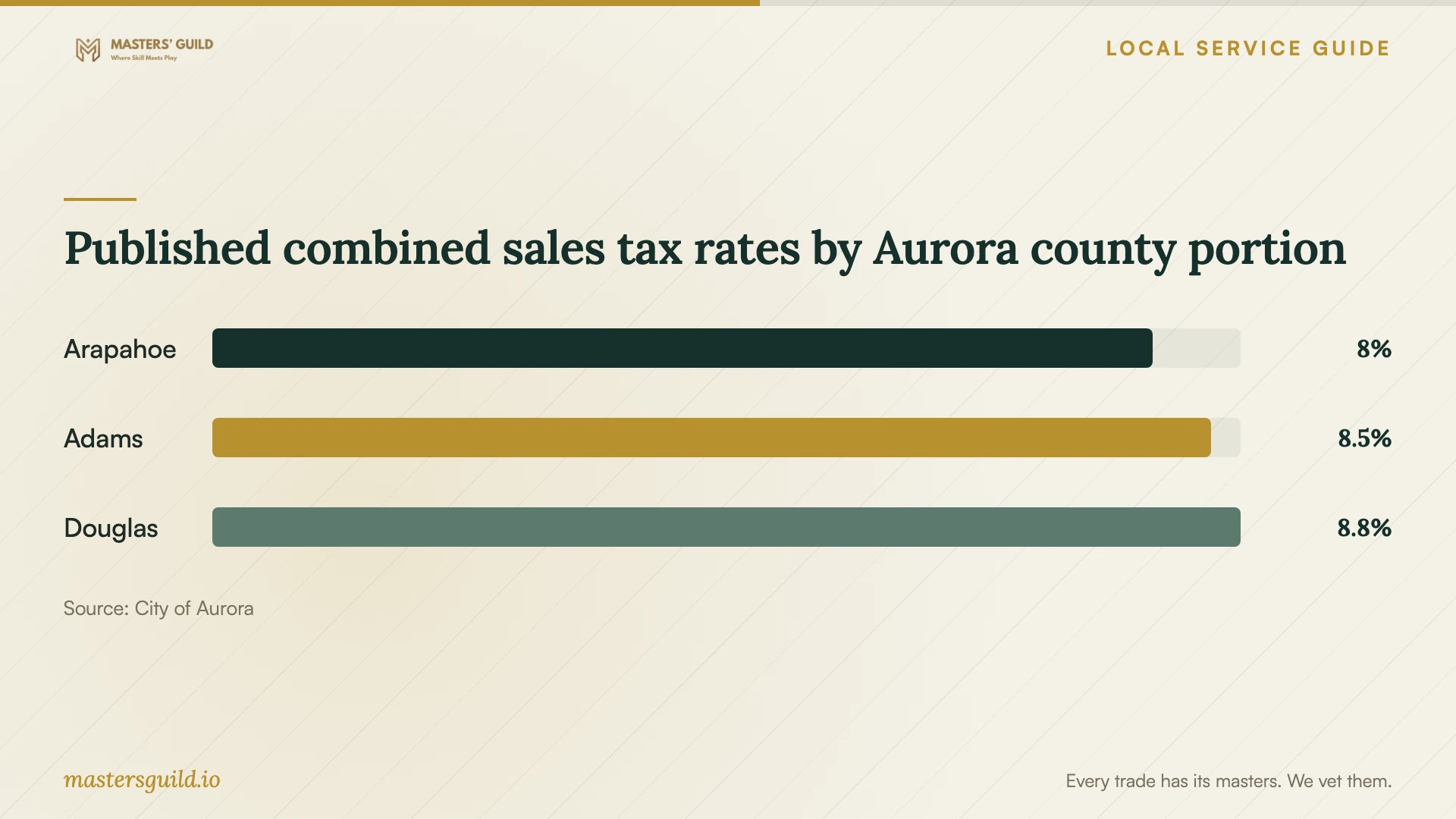
Published combined sales tax rates by Aurora county portion
Local details that affect your job
Verify the county portion and filing calendar
Aurora’s sales-tax table, reviewed January 1, 2026, lists combined rates of 8.00% in its Arapahoe County portion, 8.50% in Adams County, and 8.75% in Douglas County. The city also provides an address-check resource. Sales and use tax returns are due on the 20th of the month following the assigned taxable period, with the next business day applying when the date falls on a weekend or holiday. Ask your accountant to verify the address, applicable treatment, and assigned filing frequency. [1]
Review purchases from outside Aurora
Aurora lists a 3.75% general use tax on qualifying property or taxable services when the applicable local tax was not paid. For purchases from outside vendors, the city places responsibility on the Aurora business to verify the vendor’s authority to collect Aurora tax when the invoice includes it. Ask for an invoice-level review of equipment and supplies, including which local tax the seller collected. [2]
Separate current payroll from historical OPT cleanup
Aurora repealed its Occupational Privilege Tax effective January 1, 2025. The city continues to accept returns for periods before January 2025, amendments, and refund claims. If your payroll system still deducts Aurora OPT, ask for a configuration review. If you have older unresolved periods, include them as a separate cleanup task. The city page retains historical rules below its repeal notice; those rules do not describe a current Aurora OPT obligation. [3]
Match the engagement to your business task
| Your task | Work to request | Question before hiring |
|---|---|---|
| Annual business tax preparation | Return preparation with an explicit bookkeeping review | Which entity and owner returns does the quote include? |
| Recurring Aurora sales and use tax | Address and taxability review, filing-status confirmation, and recurring returns | Who prepares, files, and authorizes payment for each period? |
| Equipment or supply purchases | Invoice review for Aurora use-tax liability | How will you check local tax paid and the seller’s collection authority? |
| IRS audit, collections, or appeal | An enrolled agent, CPA, or attorney with unlimited IRS representation rights | Does your engagement cover this specific notice and proceeding? |
| Older Aurora payroll-tax issues | Pre-2025 OPT returns, amendments, or refund-claim review | Which historical periods need work, and have you reviewed current payroll settings? |
Your hiring checklist
- List each return, accounting task, and filing period you want covered.
- Confirm the preparer’s PTIN, credentials, and experience with your entity type.
- Identify your business address and ask for a local-tax applicability review.
- Gather prior returns, notices, statements, payroll reports, and bookkeeping exports.
- Flag equipment and supply invoices for a use-tax review.
- Request separate prices for cleanup, annual returns, recurring filings, and notice work.
- Agree on document deadlines, review dates, payment authorization, and post-filing support.
Frequently Asked Questions
Do I need a CPA to prepare my business taxes?
The IRS allows tax professionals with a PTIN to prepare federal returns. CPAs, enrolled agents, and attorneys have unlimited IRS representation rights. Choose based on the work you need, relevant experience, and whether you need representation. The IRS notes that some CPAs specialize in tax preparation and planning, so ask about the individual’s practice. [4]
Does an annual business return cover Aurora sales and use tax?
Ask for separate scope confirmation. Aurora requires sales and use tax returns according to an assigned monthly, quarterly, or annual filing status. Have the agreement name those city filings and identify who prepares them, submits them, and approves payment. [1]
Can I owe use tax when an outside vendor charged sales tax?
Aurora says that paying sales tax to a vendor without authority to collect Aurora tax does not pay the city tax. The purchaser remains responsible for Aurora use tax. Ask your accountant to review the invoice and collection authority before deciding whether you owe additional tax. [2]
Should my payroll still withhold Aurora OPT?
Aurora repealed OPT effective January 1, 2025. Ask your payroll professional to review any continuing Aurora OPT deductions and determine the correction needed. The city still accepts earlier-period returns, amendments, and refund claims, so retain historical payroll records. [3]
Sources and scope
This guide combines the sources below with practical planning guidance. Figures apply to the stated geography and period; request a written quote for your property.