
Local service guide
Tax Preparation and Accounting in Augusta, GA
Arrange Tax Preparation and Accounting in Augusta by choosing an accountant who can address your business records, required returns, and work locations. Request written quotes for your records and required services. Include a local occupation-tax review and, if you or employees work in South Carolina, a review of state withholding and resident tax-credit eligibility. [1] [2] [3]
Choose an accountant for the work you need
Describe your ownership, entity type, employees, and business activities before the first meeting. Explain whether you need someone to prepare returns from completed books, resolve unexplained balances, manage recurring accounting, or discuss a planned purchase or expansion. Ask the accountant which parts they would handle and which they would refer to another professional.
Ask who will prepare and review your work. Request their credentials and experience with circumstances like yours, then ask them to walk through a representative problem from your records. For ongoing accounting, choose the reports you want to discuss, such as a profit-and-loss statement, balance sheet, and list of unresolved transactions.
Compare quotes against the same records
Give each prospective accountant the same description of your needs and a representative set of records. Ask for the price of annual preparation, any initial cleanup, and recurring services. Confirm whether the proposal includes your personal return, business return, and relevant state returns. Ask what would trigger an additional charge and how you would approve it.
Discuss support after filing before choosing a firm. Ask who answers notices, how the accountant handles preparation errors, and how you can retrieve your records if you change providers. Request a secure method for exchanging documents and identify the person you should contact when something needs attention.
Review work across the state line
For employees working in South Carolina, bring payroll reports and records of where they performed their work. South Carolina identifies employers with employees earning wages there who must file an IRS withholding return as state withholding agents. These employers generally file quarterly state returns; ask the accountant to confirm whether an annual-filing exception applies. Confirm payment frequency as a separate question because South Carolina publishes distinct filing and remittance schedules. [2]
For your personal return, bring residency dates, the other state's return, and tax-payment details. Georgia allows a credit for tax paid to another state on income taxable in both states. Full-year and part-year residents use its prescribed worksheets; nonresidents cannot claim the credit. Ask the preparer to assess eligibility and calculate the amount for your circumstances. [3]
Prepare records for a useful review
Request a document list before your appointment. Gather prior returns, income records, bank and credit-card statements, payroll reports, loan details, and records of business assets purchased or sold. Label transfers between your accounts and flag transactions you cannot explain. Leave questions visible instead of guessing expense categories.
Agree on a document deadline and review appointment. Ask the accountant to explain proposed treatments you do not understand and identify missing information before completing the work. Keep copies of completed returns and reports, and confirm how you can export your books.
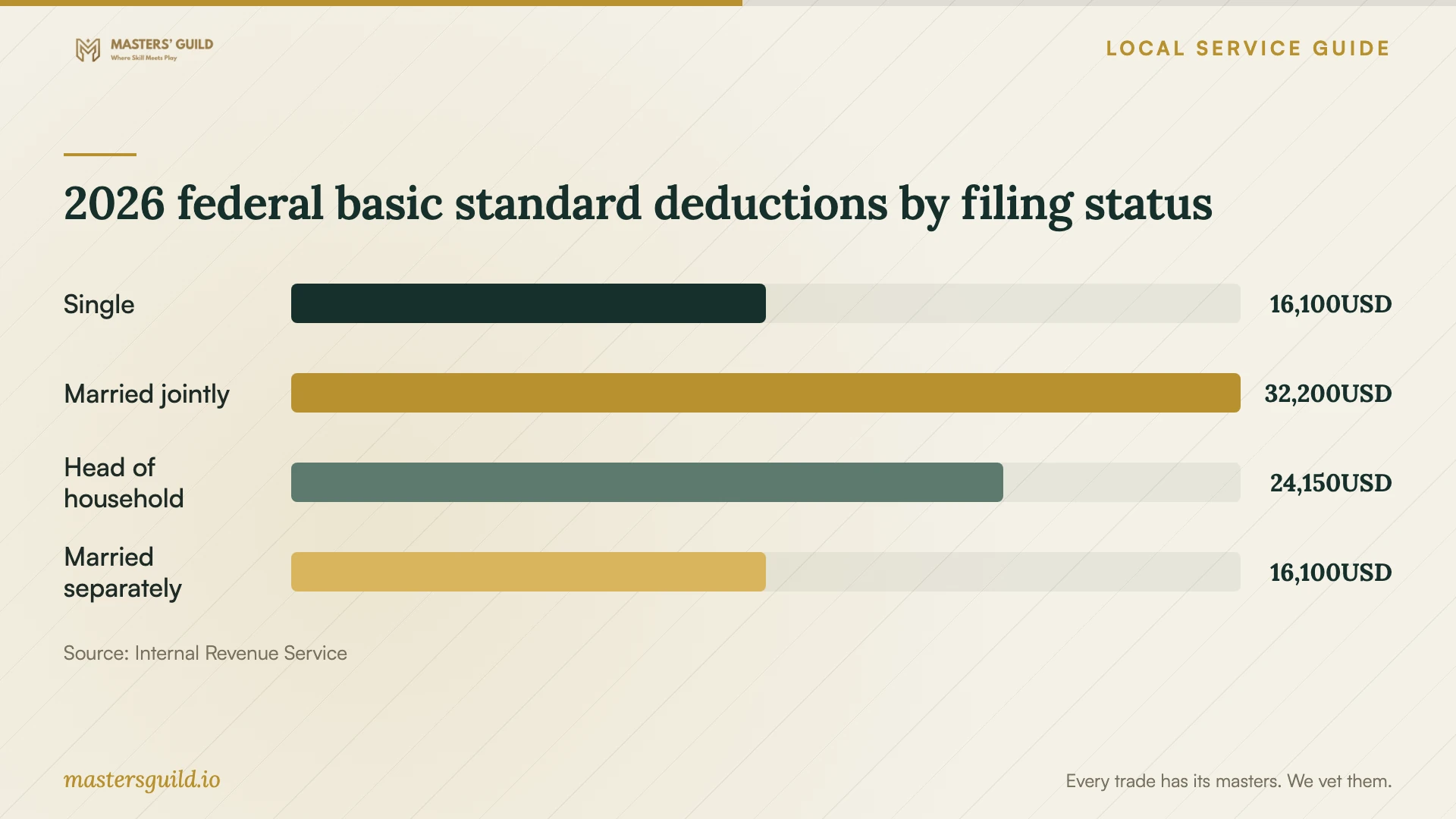
Use the chart to frame questions about your personal filing status and whether to itemize. The IRS publishes these basic standard deductions for tax years beginning in 2026. Revenue Procedure 2025-32 reflects provisions as of October 9, 2025 and directs taxpayers to consult additional guidance for subsequent legislative changes. Ask the preparer to confirm the rules for the year you are filing. [4]
2026 federal basic standard deductions by filing status
Local details that affect your job
Plan for Augusta's occupation tax
Augusta-Richmond County bases its occupation tax on gross receipts combined with a profitability ratio for the business or profession, excluding Hephzibah and Blythe from the jurisdiction described on its page. The county requires payment of the tax and applicable fees on January 1 each year. After 30 days without payment, it imposes a 10% penalty and charges 1.5% monthly interest on delinquent amounts. Ask the accountant to review your gross-receipts records and local payment arrangements before that obligation falls due. [1]
Check South Carolina payroll arrangements
For work performed in South Carolina, the state taxes wages regardless of the employee's residence. Its withholding-agent duties apply to employers with employees earning wages there who must file an IRS withholding return. Qualifying employers generally file quarterly state returns, with an annual-filer exception acknowledged in the guidance. Ask your accountant to confirm the applicable filing schedule and payment frequency, then compare those findings with your payroll provider's setup. [2]
Bring records for Georgia's resident credit
If your income is taxable in Georgia and South Carolina, include Georgia's other-states tax credit in your personal-return discussion. Georgia provides calculation worksheets for full-year and part-year residents and excludes nonresidents. Bring the other state's return and payment records so the preparer can assess the credit instead of assuming that withholding across the border settles your Georgia liability. [3]
Choose the engagement that fits your situation
| Your situation | Work to request | Useful question |
|---|---|---|
| Completed books and annual filing needs | Return preparation and a review meeting | What information would you need before accepting the work? |
| Unexplained balances or missing records | Bookkeeping cleanup before preparation | Which accounts would you reconcile first? |
| Employees working in South Carolina | Withholding and payroll setup review | Does an annual-filing exception apply, and what payment schedule applies? |
| Resident income taxable in Georgia and another state | State-return and Georgia credit review | Which residency and payment records should I bring? |
| Business in Augusta's occupation-tax jurisdiction | Gross-receipts and local tax review | What information do you need for the January 1 obligation? |
Your hiring checklist
- Describe your entity, ownership, business activities, and work locations.
- Provide representative records and identify unresolved balances.
- Gather prior returns, payroll reports, and asset purchase or sale records.
- Record residency changes and where employees performed their work.
- Prepare questions about planned purchases, borrowing, or expansion.
- Agree on document delivery and a review appointment.
- Confirm secure document exchange and access to completed work.
Frequently Asked Questions
Should I choose annual preparation or ongoing accounting?
Choose based on the help you want between filings. If you maintain completed books, discuss annual preparation and a review meeting. If you want help reconciling accounts, interpreting reports, or resolving transactions during the year, discuss recurring accounting. Show the accountant your records before deciding.
Does an Augusta business address settle South Carolina withholding?
South Carolina taxes wages earned there regardless of residence. Tell the accountant where employees work so they can assess withholding-agent requirements. Ask them to confirm any annual-filing exception and review payment timing apart from return filing frequency. [2]
Can a Georgia resident claim credit for South Carolina income tax?
Georgia allows a credit for tax paid to another state on income taxable in both states. Its guidance provides worksheets for full-year and part-year residents and excludes nonresidents. Have the preparer determine your eligibility and calculate the credit. [3]
How should I use the standard-deduction chart?
Use these federal basic deductions for tax years beginning in 2026 to prepare questions about your personal return. Ask the preparer to assess filing status and deduction treatment. The amounts do not establish your eligibility, tax savings, or professional service price. [4]
Sources and scope
This guide combines the sources below with practical planning guidance. Figures apply to the stated geography and period; request a written quote for your property.