
Local service guide
Augusta snow removal: Booking and Ice Treatment
For snow removal in Augusta, GA, get a written quote covering your driveway, steps, walking route, ice treatment and return visits. Agree on separate snow and ice service triggers, an arrival window and delay updates. Include an ice-only response option: National Weather Service reports from January 10, 2025 documented snow near Augusta Daniel Field and trace freezing rain near Augusta Bush Field. [1]
Define the areas you need cleared
Start with the entrance and walking route you need during the storm. Mark steps, landings, gates and the path to your vehicle. Tell the provider whether anyone needs a ramp or room for a mobility aid. Send photos taken from a safe position and approximate dimensions so the provider can quote a defined area.
Ask which clearing method the provider proposes for each surface. Identify gravel, pavers, existing cracks, low lights and edging. Request hand clearing around steps and objects you want protected. Agree on a place to pile snow that preserves your walking route, gate access and view of traffic at the driveway exit.
Treat roof work as a separate request. Ask for an assessment, proposed equipment and insurance covering that work before authorizing it. Keep the ground-clearing agreement specific about which areas the crew may enter and what they may clear.
Agree on separate snow and ice responses
Include an ice-only response option in your booking discussion. For January 10, 2025, the National Weather Service reported 0.5 inch of snow two miles west of Augusta Daniel Field and trace freezing rain two miles west of Augusta Bush Field. Those separate observations support planning for both hazards; they do not describe conditions at your home. [1]
A service trigger is the condition that starts the agreed work. Write down whether snow clearing begins at a specified accumulation, after your call or after the storm ends. For ice, specify who decides treatment is needed and whether the provider must obtain your approval. Ask where the provider measures accumulation and how they handle sleet.
The National Weather Service Columbia winter page offers separate snow/sleet and ice-accumulation forecasts. Its expected snowfall amount includes sleet. Check the forecast location and valid period before authorizing treatment or another visit. Discuss alternate scopes with the provider rather than treating a regional amount as a measurement at your property. [4]
Ask the provider to name the treatment product and check its instructions against your surface and the expected temperature. Agree on whether they inspect the walking route after clearing or wait for you to request a return visit. Put the approval process and follow-up charge in writing.
Compare written quotes and booking terms
Ask each provider to list the clearing charge, treatment materials, call-out minimum and return-visit charge for the same areas. For an hourly quote, request the minimum billable period and a spending limit that requires your approval to exceed. Compare the total for your agreed scope before choosing.
For a seasonal proposal, ask what you pay if no work occurs, which visits the agreement includes and what counts as extra work. For an on-call proposal, ask whether the provider reserves capacity or accepts requests according to crew availability. Choose terms that fit how urgently you need access and what you are willing to pay to reserve service.
Ask for insurance documentation covering the proposed work and a contact for reporting damage. Confirm the payment schedule and completion record. Request photos of the cleared areas and a record of treatment products so you can review the work without stepping onto a questionable surface.
Plan for road delays and household needs
Discuss the provider’s approach roads before relying on a promised arrival time. Georgia DOT prioritizes interstates, then state routes from the most heavily traveled to the least traveled. It excludes local roads and roads leading into subdivisions. Ask how the provider will notify you if access prevents arrival and what cancellation or rescheduling terms apply. [2]
Check travel conditions apart from the work at your home. Georgia DOT warns that roadway moisture can form black ice when temperatures drop below freezing, including moisture from runoff or sprinklers. Follow Augusta’s advice to use local officials’ driving directions during snow and ice storms. [2] [3]
Augusta recommends a household communication plan and a Ready kit for at least three days of self-sufficiency. Prepare for a delay in service or travel and arrange check-ins with household members who need help. Share your provider’s contact details with the person who will authorize work if you cannot answer. [3]
Before arrival, remove loose objects and share gate instructions. Move vehicles only if you can do so safely. Ask the crew to contact you before substituting treatment materials or adding work. Review the completion photos against your quote and use the agreed contact method to request corrections.
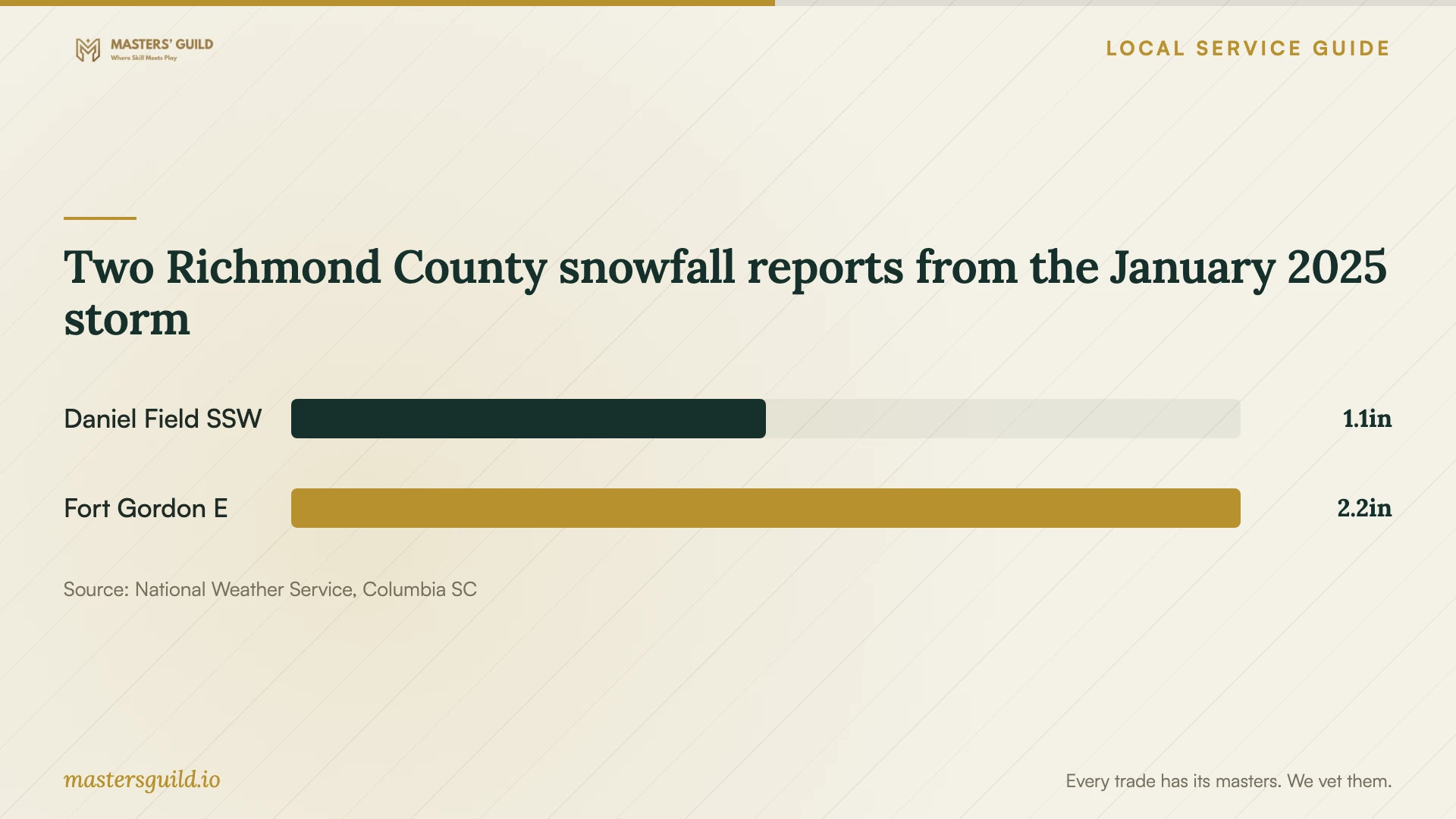
Two Richmond County snowfall reports from the January 2025 storm
Local details that affect your job
Subdivision approach roads affect the booking
Georgia DOT states that it does not clear local roads or roadways leading into subdivisions. If the provider must use those roads, discuss access delays before paying to reserve a time. Confirm responsibility and road status with the relevant local authority or subdivision manager, and agree on what happens if the crew cannot reach your address. [2]
Include a response for ice without a snow trigger
The National Weather Service’s January 10, 2025 reports included 0.5 inch of snow two miles west of Augusta Daniel Field and trace freezing rain two miles west of Augusta Bush Field. These separate locations illustrate why you should discuss ice service alongside snow clearing. Ask whether the provider will respond to an icy entrance when snow accumulation remains below your agreed threshold. [1]
Choose a scope for your access needs
| Your situation | Scope to request | Confirm before booking |
|---|---|---|
| You need a route from the door to a vehicle | Driveway access plus hand clearing of steps and the walking route | Priority entrance, cleared area and snow placement |
| You want treatment when ice forms below the snow threshold | An ice-only response with named treatment materials | Who authorizes treatment and any follow-up visit |
| You need access by a particular time | A proposal that states whether the provider reserves capacity | Arrival window, delay notification and backup arrangements |
| You prefer to request help for each event | A written on-call quote | Crew availability, minimum charge and payment terms |
Your hiring checklist
- Send photos, approximate dimensions and the entrances you need to use.
- Identify steps, ramps, surface materials and objects that need protection.
- Agree on separate triggers for snow clearing and ice treatment.
- Confirm the arrival window, delay updates and cancellation terms.
- Get an itemized total with material charges and return-visit terms.
- Request insurance documentation and a damage-reporting contact.
- Agree on snow placement, completion photos and who can authorize extra work.
Frequently Asked Questions
Should I buy a seasonal plan or pay for each visit?
Compare the proposed terms against your access needs. Ask a seasonal provider what you pay when no work occurs and whether they reserve capacity. Ask an on-call provider whether they can decline a request when crews are occupied. Get included areas, treatment and extra-visit charges in writing.
Does driveway clearing include steps and sidewalks?
Name each area in your quote: the walking route, steps, landings and gates. Ask whether treatment materials cost extra and request a separate price for any area the provider excludes from the driveway service.
Will Georgia DOT clear the road into my subdivision?
Georgia DOT says it does not clear local roads or roads leading into subdivisions. Its winter response covers interstates and state routes. Confirm responsibility for your approach road with the relevant local authority or subdivision manager, then discuss access limits with your provider. [2]
Can I use the historical snowfall chart to set a service threshold?
The chart contains two selected reports from one January 2025 storm. Different reporting locations, times and observer types limit comparison, and the figures do not establish snowfall at your home. Set the threshold around your access needs and agree on how the provider handles ice below it. [1]
Sources and scope
This guide combines the sources below with practical planning guidance. Figures apply to the stated geography and period; request a written quote for your property.