
Local service guide
Tree Cutting in Atlanta: Arborist Hiring Guide
Arrange Tree Cutting in Atlanta by asking an arborist to assess the tree, explain the proposed work, and quote access, hauling and stump work in writing. If the job involves Georgia Power wires, contact the utility before fixing the cutting date. Georgia Power offers limited service-wire trimming and asks for at least 72 hours of advance scheduling when a service-wire disconnection is needed. [1]
Choose an assessment, pruning or removal scope
Start by describing your concern: a limb over the roof, a damaged tree, blocked access or a tree you want assessed before deciding on removal. Ask the arborist to explain the options and identify which trees and branches belong in the proposal. Request a written explanation if you need advice before authorizing cutting.
For pruning, ask the contractor to describe the intended cuts and the result you should expect. Avoid approving a vague instruction to shorten the whole crown. Georgia Power's guidance says topping is not a professionally recognized pruning method and associates it with weak branching, disease and other tree-health problems. [2]
Before authorizing removal, confirm the applicable tree permissions with the authority responsible for your property. Ask who will obtain any required approval and request documentation before work begins. Keep this step separate from the contractor's assessment and from utility coordination.
Resolve power-line concerns before scheduling
Keep away from fallen trees touching wires and report them to Georgia Power. The utility warns that downed lines may remain energized and says not to touch or drive over them. It also warns against climbing trees near power lines. [2]
For planned work around a service wire, ask Georgia Power which part it will handle. Its contact page describes limited trimming, such as limbs that substantially rub against a wire or deflect its path. In that service-wire context, the utility assigns tree removals and limb removals over 3 inches in diameter to the property owner. [1]
Georgia Power also has a separate vegetation-management role: it may remove trees that threaten electrical service or public safety. Ask the utility to clarify its intended work before paying a private contractor for the same scope. Have the contractor and utility agree on the sequence before you confirm a work date. [2]
Compare complete quotes without guessing a local price
Request a site-specific written price. Give each bidder the same tree list and ask them to separate assessment, pruning or removal, hauling and stump work. Have each contractor describe the equipment they propose to use and where they plan to place it. Compare the total for the agreed scope before choosing an offer.
Ask for current liability insurance documentation and confirmation of coverage for the crew doing the work. If someone advertises an arborist credential, request the credential name and number for verification. Ask who will supervise the job and whether another company will perform any part of it.
Define cleanup in concrete terms. Decide whether the crew should remove logs, branches, chips and stump grindings, or leave specified material in a location you approve. Ask the contractor to state the proposed grinding depth and whether the price includes filling the hole or restoring the surface.
Plan equipment access and weather contingencies
Walk the proposed access route with the contractor. Point out gates, steps, fences, irrigation and surfaces you want protected. Ask where the crew will park, lower branches and load debris. Agree on any fence removal, access through neighboring property and restoration work before the crew arrives.
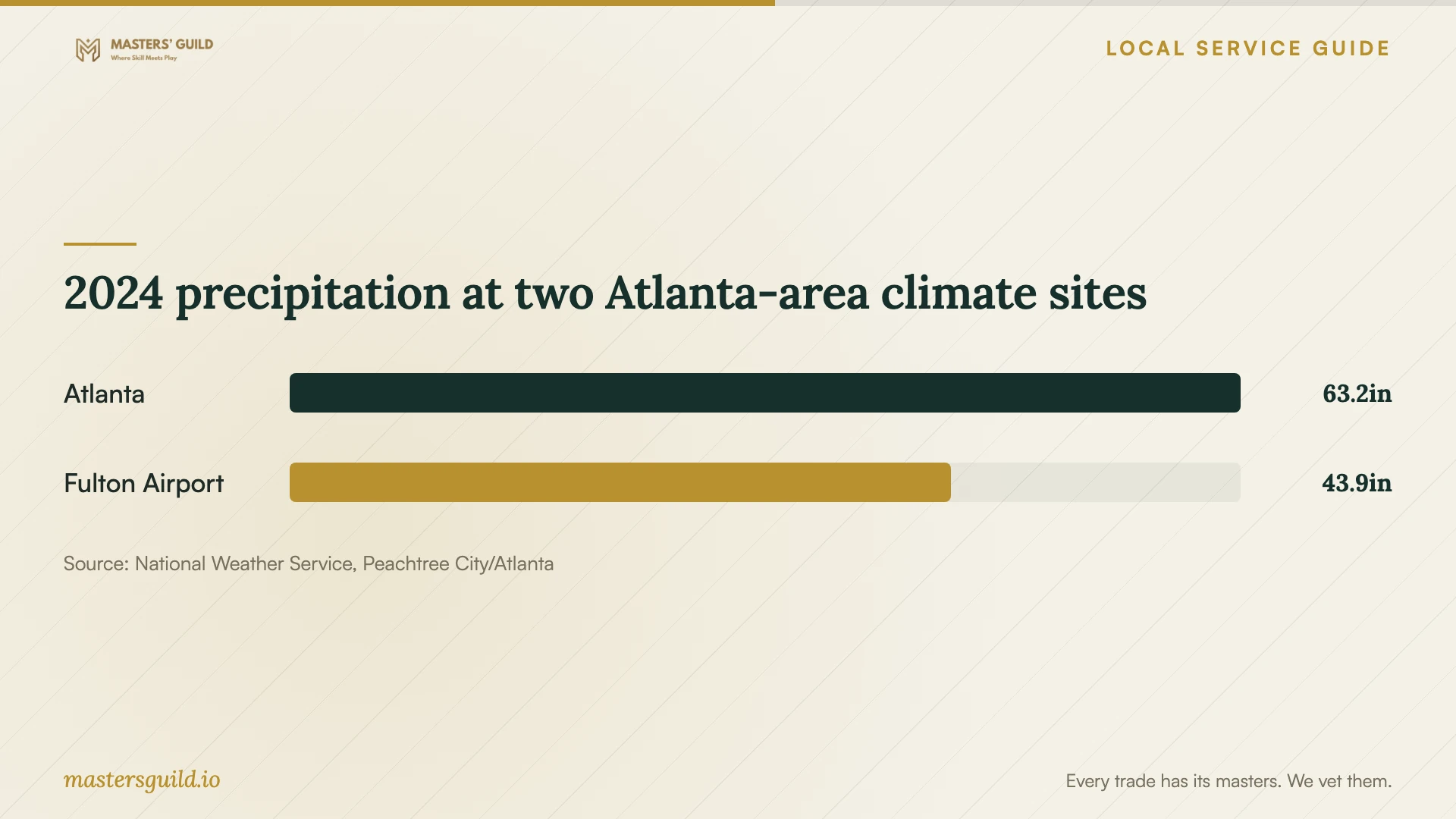
NWS recorded 63.18 inches of precipitation at its Atlanta climate site in 2024 and 43.93 inches at Fulton County Airport that year. Those separate station observations provide historical context, not a reading of your yard. Ask the contractor to inspect current ground conditions and explain when it would postpone equipment access. [3]
Put the weather plan in the agreement: who decides to postpone, how you receive notice and how the contractor reschedules. Before work, clear the agreed access route and arrange for children and pets to remain away from the work area. Afterward, inspect the agreed cleanup and surface restoration with the contractor.
2024 precipitation at two Atlanta-area climate sites
Local details that affect your job
Georgia Power service-wire disconnection
If private tree work requires a service-wire disconnection, Georgia Power asks customers to call 1-888-660-5890 and schedule at least 72 hours in advance. Confirm the utility appointment before committing to the contractor's cutting date, and ask who will coordinate the work. [1]
Cleanup after utility storm restoration
Georgia Power cuts fallen trees away from power lines to restore service after storms, but assigns the resulting vegetation debris cleanup to the property owner. Arrange a separate cleanup scope with your contractor rather than assuming the restoration crew will haul away the wood and branches. [2]
Trees blocking outdoor lighting
Georgia Power says property owners handle pruning or removal of vegetation that blocks outdoor lighting. The utility handles necessary repairs if vegetation damages a Georgia Power service light or its supply wire. Describe whether you need vegetation clearance, equipment repair or both when arranging the job. [2]
Choose the next step for your tree job
| Situation | Next step | Scope to clarify |
|---|---|---|
| Fallen tree touches a power line | Stay away and contact Georgia Power | Utility response before private cutting or cleanup |
| Planned cutting needs a service-wire disconnection | Schedule with Georgia Power at least 72 hours ahead | Utility appointment and contractor work sequence |
| Debris remains after utility storm restoration | Arrange property-owner cleanup | Logs, branches, hauling and disposal |
| Vegetation blocks outdoor lighting | Arrange owner-directed pruning or removal | Ask Georgia Power about damage to its light or supply wire |
| You are unsure whether to prune or remove | Request an arborist assessment before authorizing cutting | Written recommendations and a defined work scope |
Your hiring checklist
- Identify each tree and describe the concern or desired pruning result.
- Confirm applicable permissions and assign responsibility for obtaining them.
- Resolve utility involvement before agreeing to a cutting date.
- Request insurance documentation and verify any advertised arborist credential.
- Compare written quotes with the same hauling and stump-work scope.
- Walk the equipment route and agree on surface protection and restoration.
- Record weather postponement terms and inspect cleanup before closing the job.
Frequently Asked Questions
Will Georgia Power remove any tree near a wire?
Ask the utility about the specific tree. Georgia Power describes limited service-wire trimming and assigns substantial tree work in that context to the owner. Separately, it may remove trees that threaten electrical service or public safety under its vegetation-management program. [1] [2]
Who removes branches after Georgia Power restores storm-damaged service?
The property owner handles storm vegetation debris cleanup. Ask your contractor to quote hauling and disposal, and specify any wood you want to keep. [2]
Should stump grinding be part of the removal quote?
Ask the contractor to state whether it is included. Specify grinding depth, removal of grindings, filling and surface restoration so you can compare the same work across quotes.
Can I choose an equipment date from the rainfall chart?
Use the chart as historical context. Ask the contractor to inspect your access route and ground conditions before using equipment, and agree on postponement terms.
Sources and scope
This guide combines the sources below with practical planning guidance. Figures apply to the stated geography and period; request a written quote for your property.