
Local service guide
Moving Services in Atlanta: Hiring and Move Planning
Arrange Moving Services in Atlanta by checking the carrier’s authorization, getting a written on-site estimate and confirming access at both addresses before booking. For a household move within Georgia, verify the mover’s certificate with the Department of Public Safety. If you plan to place a container in the public right-of-way or affect a sidewalk or street, ask Atlanta’s transportation department which approval applies and assign responsibility before delivery. [1] [3] [4]
Check who will transport your household goods
For a move within Georgia, ask for the carrier’s certified business name and certificate number. The Georgia Department of Public Safety provides a licensed-mover list and asks consumers to contact the department to verify carrier status. Match the company you hire to the carrier named on your paperwork. [1] [3]
Georgia requires the household-goods bill of lading to identify the transporting carrier, its contact information and its DPS-assigned MCA number. Carriers must operate under the name on their certificate and cannot appoint another operator to carry goods under their authority. Ask who will arrive, who owns the transportation contract and whom you should contact during the move. [2]
Separate an in-state move from a move crossing state lines before comparing contracts. Georgia’s Attorney General directs consumers with interstate moving complaints to the Federal Motor Carrier Safety Administration. Ask an interstate mover for its valuation choices and dispute-resolution information rather than assuming the Georgia estimate and billing rules apply. [1]
Compare written estimates by scope and billing
Request a written on-site estimate, as Georgia’s consumer guidance recommends. Walk the estimator through the rooms, storage areas and items that need special handling. Give each company the same inventory, pickup and delivery addresses, packing requirements and access information so you can compare equivalent work. [1]
Georgia rules distinguish binding from non-binding estimates. A binding estimate covers the listed goods and services at charges no higher than the estimate, with provisions for additional work. Under a non-binding estimate, the carrier must release the shipment upon payment of no more than 110% of estimated charges and defer demand for the remaining balance for 30 days. That delivery-payment limit does not cap the final bill. [2]
For hourly transportation covered by these rules, the carrier starts charging when its vehicle and personnel arrive at pickup and stops when it completes services at the final destination. It may also charge up to one hour of travel time to a service location. Ask the estimator to show the crew size, vehicles, minimum hours, travel charge and any overtime charges in writing. [2]
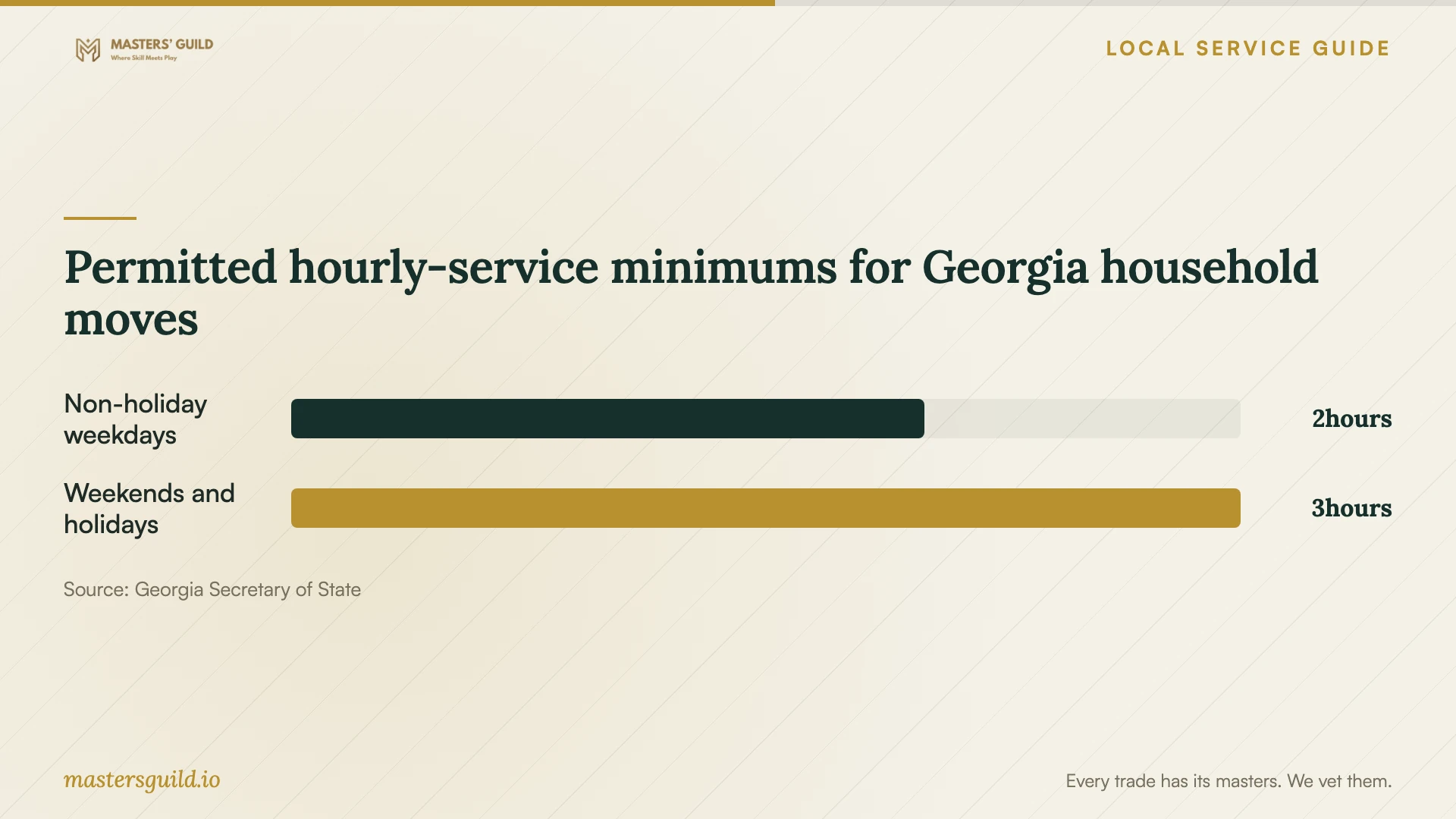
Request an estimate for your inventory, services and access conditions. Ask the mover to explain each separate charge. Georgia sets maximum tariff rates; the permitted billing minimums in the chart are booking terms, not estimates of how long your move will take. [1] [2]
Resolve truck, container and building access
Before reserving a container or moving truck, decide where it will stand and how the crew will reach the door. Atlanta requires a permit for work in the public right-of-way. Its permit page identifies POD-placement checklists, parking applications and routes for non-construction temporary lane or street closures. Confirm the approval for your proposed setup rather than assuming a moving reservation grants curb access. [4]
Ask your building manager about loading areas, elevator reservations, move hours and required insurance documents. Give the mover photographs and measurements of tight entrances, stairs and the route from truck to door. Agree on who will secure access at each address and what happens if the reserved loading area is unavailable.
Georgia requires carriers to assess accessibility and the labor needed before estimating and performing a move. Where access makes loading or delivery impractical, the rules allow specified alternatives, including agreed ancillary handling in qualifying circumstances. Show the estimator difficult items and entrances before accepting a quote, and document the handling plan. [2]
Choose protection and prepare your belongings
For a Georgia intrastate household move, choose valuation protection in writing before the carrier accepts your goods. Released value protection provides $0.60 per pound per damaged or lost article at no additional charge. Full value protection uses current replacement value up to your declared valuation, and the carrier may charge for it within tariff limits. Ask about the declared amount and applicable terms before signing. [2]
Identify valuable items on the paperwork. Georgia’s rules exclude certain extraordinary-value articles from carrier liability unless you list them on the bill of lading, including articles worth more than $100 per pound. Ask the mover how it will document and handle those belongings, and decide which personal valuables you will carry yourself. [2]
Agree on who will pack fragile items and prepare appliances. Georgia’s rules assign customers packing and preparation duties unless another agreement applies, while requiring carriers to provide ordinary protective furniture wrapping for qualifying surfaces within transportation rates. Ask which items need separate boxing or crating and which protective materials the carrier includes. [2]
Inspect delivery and preserve a claim
Compare the delivered goods with the inventory and inspect them before signing. Note missing items and damage, photograph the affected areas and keep the estimate, bill of lading, valuation selection and payment records together. Georgia’s consumer guidance tells readers to inspect the shipment before signing the inventory. [1]
For claims governed by Georgia’s intrastate household-goods rules, submit an overcharge, loss or damage claim to the carrier in writing within 90 days after delivery or the applicable scheduled delivery if goods never arrive. Give the carrier a reasonable opportunity to inspect claimed damage. Keep proof of when you sent the claim. [2]
Permitted hourly-service minimums for Georgia household moves
Local details that affect your job
Atlanta public-right-of-way planning
For a container, sidewalk impact or proposed lane closure within the City of Atlanta, start with ATLDOT’s Right-of-Way Permits guidance. The department lists POD-placement and closure resources and gives 404-330-6501 for additional information. Describe the address, placement and dates, then confirm who will obtain any required approval. Confirm any required fee and processing time before scheduling delivery. [4]
Same-city complaint exception
Check the actual municipal boundaries of both addresses if a Georgia moving dispute remains unresolved. The Attorney General says DPS cannot assist when both origin and destination are within the city limits of the same incorporated municipality; after an unsuccessful carrier claim, it directs consumers to magistrate court or a private attorney. For two addresses within Atlanta city limits, this changes the escalation route. [1]
Choose the next step for your move
| Situation | Next step | Rule or planning issue |
|---|---|---|
| Household move within Georgia | Verify the carrier with DPS and compare written estimates. | Georgia requires intrastate household-goods carrier certification. |
| Small move with flexible dates | Compare weekday and weekend quotes using the same scope. | Covered hourly moves permit two-hour non-holiday weekday minimums and three-hour weekend or state or federal holiday minimums. |
| Container or street-access impact | Confirm the relevant approval with ATLDOT before scheduling placement. | Atlanta requires permits for public-right-of-way work and lists POD and closure resources. |
| Move crossing state lines | Ask for interstate valuation and dispute-resolution information. | Georgia consumer guidance directs interstate complaints to FMCSA. |
| Unresolved move between two Atlanta city addresses | Confirm municipal boundaries before choosing an escalation route. | The Attorney General identifies a DPS assistance exception for moves entirely within one incorporated municipality. |
Your hiring checklist
- Write one inventory for all estimators, including storage contents and specialty items.
- Ask for the transporting carrier’s certified name and authorization details.
- Request a written estimate that identifies its type and itemizes the planned services.
- Confirm loading access, building reservations and responsibility for any required city approval.
- Ask the mover to explain minimum hours, travel time and proposed overtime charges.
- Choose valuation protection after reviewing the declared amount and terms.
- Keep personal essentials and copies of moving documents with you.
- Inspect delivery, record discrepancies and retain photographs and correspondence.
Frequently Asked Questions
How do I check a Georgia moving company?
Get the transporting carrier’s certified name and certificate number. Use the Georgia DPS household-goods page to find its licensed-mover resources, then contact DPS to verify the carrier’s status. Check that your contract identifies the same carrier. [2] [3]
Does a binding estimate cover extra packing or added items?
A Georgia binding estimate covers the goods and services it describes. The rules permit additional charges for qualifying additional transportation or services. Tell the estimator about the full shipment and request written details before changing the scope. [2]
Can I place a moving container on an Atlanta street?
Confirm approval with ATLDOT before arranging placement in the public right-of-way. Its permit page includes POD-placement resources. Ask which approval applies to your address and confirm the fee and lead time. [4]
How long do I have to report damaged belongings?
Georgia’s intrastate rules require a written claim to the carrier within 90 days after delivery or the applicable scheduled delivery for undelivered goods. Georgia’s consumer guidance gives nine months after delivery for interstate damage claims. Document damage at delivery and retain proof of submission. [1] [2]
Sources and scope
This guide combines the sources below with practical planning guidance. Figures apply to the stated geography and period; request a written quote for your property.