
Local service guide
Lawn Mowing in Atlanta, GA: Choose a Service Plan
Arrange Lawn Mowing in Atlanta by choosing a provider who can match the cutting height and schedule to your turf, then request a property-specific quote. UGA recommends removing no more than one-third of the grass height per cut. Use that limit to assess the proposed service interval before agreeing to recurring visits. [1]
Evaluate the proposed mowing schedule
Have the person quoting the job identify the grass in each lawn area. If you have a different lawn behind the house, include it in the assessment. Photograph areas you want them to inspect, including patches you recently seeded or sodded.
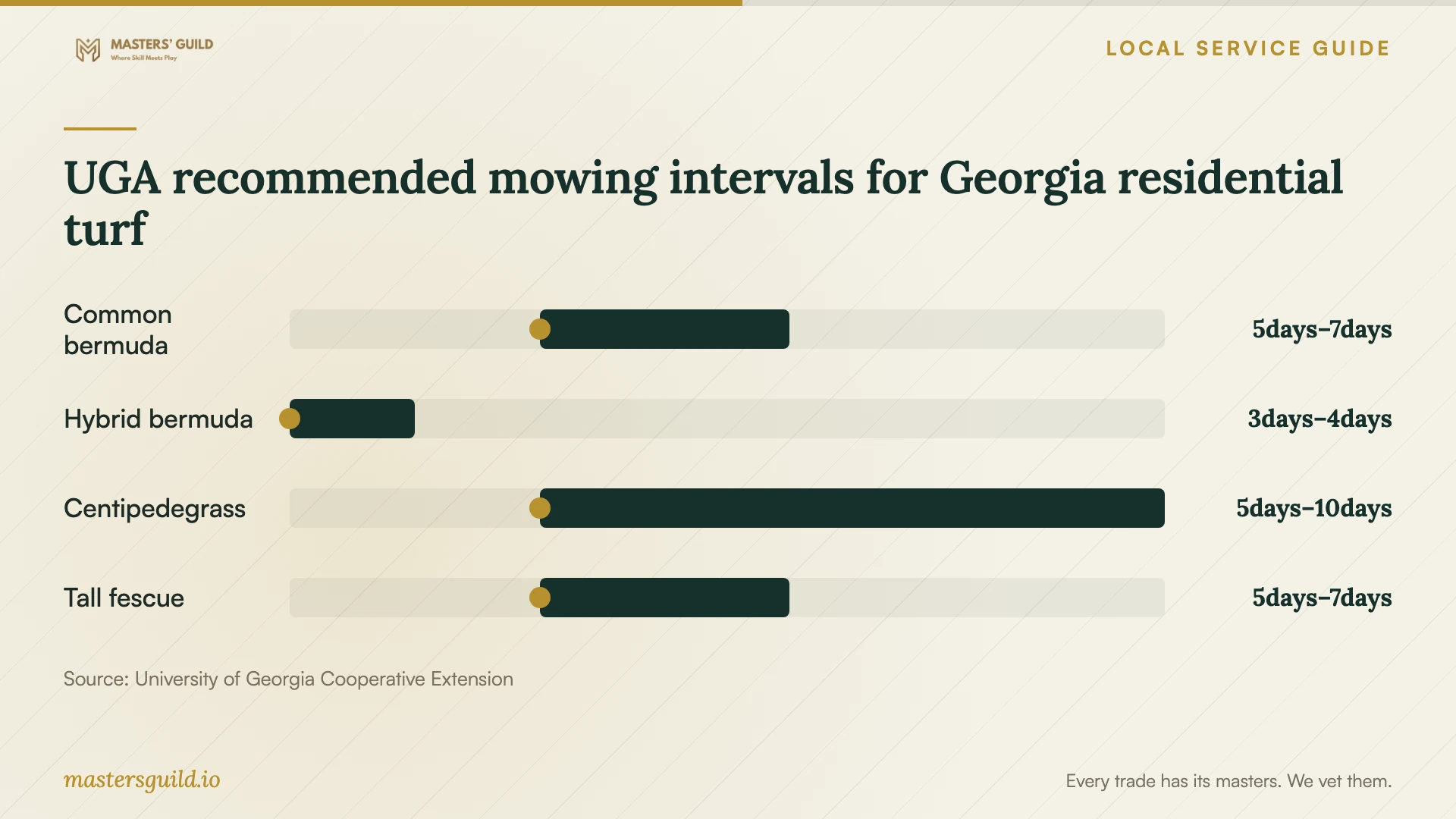
UGA’s Georgia mowing table recommends intervals of 5 to 7 days for common bermudagrass and tall fescue, compared with 3 to 4 days for hybrid bermudagrass. These recommendations give you a concrete way to question a weekly or biweekly offer. They describe turf management, not the schedules that companies sell. [3]
For an overgrown lawn, request an initial recovery plan and its price before discussing routine maintenance. Have the provider explain how many cuts they propose and how they will respect the one-third removal limit. Agree on who authorizes additional visits. [1]
Check cutting height and mower suitability
Fulton County Extension recommends mowing bermudagrass and zoysiagrass to 1 to 2 inches and St. Augustinegrass to 2 to 3 inches. Its tall fescue guidance also recommends approximately 2 to 3 inches. The county advises adding about half an inch to the mowing height during hot weather. [1] [2]
UGA’s detailed statewide table lists hybrid bermudagrass at 0.5 to 1.5 inches and zoysiagrass at 0.5 to 2 inches with a reel mower. Have the provider explain which recommendation fits your lawn and how their mower will maintain that height. Avoid selecting the lowest setting just because it appears in a published range. [3]
Discuss equipment access during the estimate. Give the provider the gate opening measurement and point out steps, slopes, narrow passages, and areas where you want smaller equipment. Have them include any access-related charge in the quote.
Compare prices for the same work
Request quotes for your property and compare prices for the same scope. Give each provider the same mowing boundaries, including any grass outside the fence. Specify trimming around obstacles, edging along hard surfaces, and cleanup of walks and driveways.
Separate the recurring visit price from optional work such as leaf removal, aeration, seeding, fertilizer, and weed treatments. For a seasonal package, request the expected visits, billing terms, and charges when the crew skips a cut. Compare the total commitment before choosing a plan.
Include clipping handling in the estimate. UGA recommends returning clippings to recycle nutrients, but says collection may reduce viable seed spread when annual bluegrass produces seedheads. If the provider proposes bagging, have them explain the reason, disposal arrangement, and added charge. [3]
Prepare for dependable visits
Set the access arrangements before the first visit: gate entry, parking, and who secures the property afterward. Mark irrigation heads and objects hidden in the grass. Remove toys and pet waste, and keep pets away from the work area.
Agree on how the crew will report a rain delay or missed visit and when they will return. Name a contact who can approve extra work. Include cancellation notice and payment terms in the service agreement so you can change the arrangement without guessing what you owe.
UGA recommended mowing intervals for Georgia residential turf
Local details that affect your job
Coordinate October fescue establishment
Fulton County Extension’s October 5, 2026 guidance identifies September and October as ideal months to establish tall fescue in Georgia and October as a best month for core aeration. If you plan to repair thin areas this month, coordinate the mowing visit with aeration and overseeding. Review proposed weed treatments with the person doing the seeding: some herbicides interfere with establishment or damage young turf, and the product label determines the waiting period. [2]
Separate warm-season aeration from fall packages
Fulton County Extension identifies May through August as a good core-aeration window for warm-season lawns. Its fall guidance says those grasses slow as temperatures cool, while tall fescue enters an important growth period. For bermudagrass or zoysiagrass, discuss aeration as a separate warm-season job before accepting an October package designed around fescue. [1] [2]
Resolve these points before accepting an offer
| Your situation | Relevant guidance | Decision to make |
|---|---|---|
| Hybrid bermudagrass with a weekly offer | UGA lists a 3 to 4 day mowing interval. | Discuss whether the provider can offer the needed cadence. |
| Zoysiagrass with a low cutting target | UGA’s detailed table lists a reel mower and 0.5 to 2 inches. | Confirm equipment suitability before agreeing to the target. |
| Fescue repair planned this October | Fulton County Extension recommends September and October establishment. | Coordinate the mowing and seeding contractors. |
| Warm-season lawn offered fall aeration | Fulton County Extension identifies May through August for core aeration. | Request a turf-specific seasonal proposal. |
Your hiring checklist
- Send the property address, lawn photos, and mowing boundaries for the estimate.
- Measure the gate opening and flag access obstacles.
- Request separate prices for initial recovery work and recurring visits.
- Name the person who can approve extras or schedule changes.
- Mark irrigation heads and remove loose objects before arrival.
- Confirm gate security, delay notices, cancellation, and payment terms.
Frequently Asked Questions
Can mowing alone deal with annual bluegrass?
UGA reports that annual bluegrass can produce viable seed even under close mowing. Have the provider identify suspected weeds before adding treatment work, and separate weed management from the mowing quote. [3]
Should I keep watering newly seeded fescue like an established lawn?
Fulton County Extension recommends keeping the upper 1 to 2 inches of soil moist but not saturated after seeding, then moving toward deeper, less frequent watering as seedlings develop. Tell the crew which areas you are establishing and coordinate access with the seeding contractor. [2]
How should I check the first completed visit?
Walk the agreed mowing areas, inspect trimming and cleanup, and check that the crew secured the gate. Photograph any concern and describe the correction you want before the next visit. Confirm that the invoice matches the approved work.
Sources and scope
This guide combines the sources below with practical planning guidance. Figures apply to the stated geography and period; request a written quote for your property.