
Local service guide
Data recovery and backup in Atlanta, GA
For data recovery and backup in Atlanta, choose a provider by the work you need: retrieving missing files, restoring a known backup, or responding to a suspected cyberattack. Ask for a written diagnostic scope, approval limit, data-handling terms, and a demonstration that your priority files open. For ransomware, arrange incident-response help before reconnecting systems or restoring business data; CISA recommends isolation and recovery on a clean network. [1]
Choose the right recovery scope
Tell prospective providers what happened before discussing a recovery package. Record whether you deleted files, lost access after an outage, saw a ransom message, or noticed damage to the device. List the files you need first, such as current invoices, appointment records, or the accounting database. Ask the provider to explain the proposed assessment and obtain your approval before making changes to the original media.
For a damaged device, ask whether the business performs the required recovery work at its premises or transfers your media to another facility. Request the receiving facility's identity, a handoff record, and a named contact. Confirm collection, shipping, and return arrangements before surrendering a device containing customer records.
Treat a ransom message or suspected unauthorized access as an incident-response job. CISA advises isolating affected systems from the network. It recommends powering devices down only when network isolation is not possible, because shutdown loses potential evidence in volatile memory. Ask your responder to direct containment and evidence preservation. [1]
Get a quote you can approve
Request separate prices for assessment, recovery work, return storage, transport, and any urgent service. These sources do not establish Atlanta recovery prices or turnaround times, so obtain a device-specific quote. Ask what you owe if the provider retrieves only some files, retrieves unusable files, or cannot recover your priority data. Have the provider define any success-based payment terms in writing.
Set an approval limit and separate the diagnostic deadline from the delivery deadline. Ask which stage the provider can commit to before assessment and who will contact you if the scope changes. For an office or shop, identify the person authorized to approve additional work so the technician can reach the right decision-maker.
Define acceptance around usable business information. Ask to open representative documents, check relevant dates, and test the required application or database with your IT contact. Agree on the review period before the provider deletes working copies or returns the original media.
Specify access, custody, and disposal
Ask who can view recovered files, whether subcontractors receive them, where the provider stores working copies, and how you will receive the result. Request a device receipt with its identifier and condition. Arrange an approved method for sharing credentials or encryption keys, and agree on how the provider will remove its access after completion.
Georgia's Consumer Protection Division explains that state law regulates disposal of business records containing personal information. Its examples include medical information, account information, and tax-return information. Businesses must take reasonable action to prevent unauthorized access and dispose of covered material by shredding, erasing personal information, or making it unreadable. Ask your provider to document its retention and disposal process for applicable records. [2]
Commission a backup service with a restore test
Start with the information your business needs to operate. Name the folders, applications, and systems to include, then decide how much recent work you could afford to lose and how long you could operate without access. Ask the installer to explain how its proposed backup schedule and restoration process address those requirements.
CISA recommends offline, encrypted backups of critical data and regular testing of their availability and integrity. It explains that ransomware can delete or encrypt accessible backups. Require the provider to identify the protected copy, explain who can access or delete it, and demonstrate restoration of an agreed sample before you accept the installation. [1]
If you choose cloud storage, ask about retention, version history, deletion protection, account ownership, and the cost of retrieving your data. CISA discusses cloud-to-cloud backups and immutable storage, while cautioning that immutable storage needs careful configuration and may not meet certain compliance requirements. Have the provider explain the proposed configuration for your business. [1]
Request a handover document naming the person who checks backup failures, the contact for restoration, and the location of recovery instructions. Schedule a future restore exercise and retain an offline copy of the instructions. CISA recommends keeping incident-response plans available in hard copy and offline. [1]
Plan for power interruptions
Ask your installer to assess power protection alongside the backup plan. Georgia Power advises matching surge protection to the connected equipment and protecting a networked computer's electrical and network connections. Include the computer, storage equipment, and connected communications equipment in the assessment. [3]
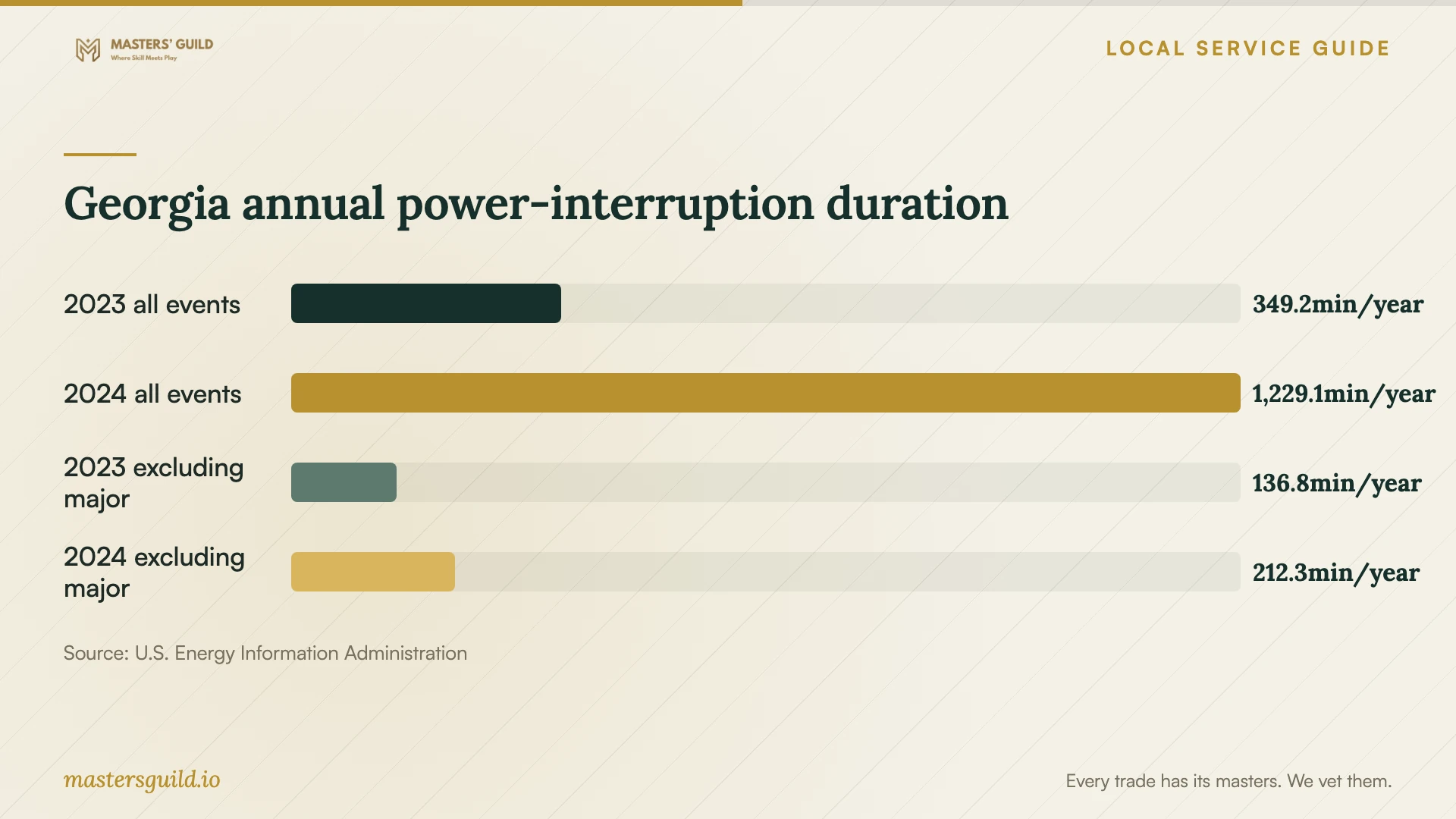
Use the Georgia outage-duration chart as regional planning context. EIA reports statewide averages for non-momentary interruptions, with separate values including and excluding major events. These measurements do not describe your Atlanta address or establish how long a battery should run. Ask the installer to specify any proposed battery runtime for your actual equipment and demonstrate the shutdown procedure. [4]
Georgia annual power-interruption duration
Local details that affect your job
Georgia record-disposal rules affect the handover
For an Atlanta business recovering customer tax, account, or medical records, include temporary recovered copies in the disposal discussion. Georgia's Consumer Protection Division identifies these as examples of covered records. Agree on the acceptance period, return of original media, and a written record of disposal after you approve the recovered files. [2]
A suspected breach needs a Georgia notification assessment
Consumer Ed explains that Georgia law requires businesses collecting, transmitting, or maintaining unencrypted digital personal records to notify affected individuals when they know or reasonably believe their system has been breached. It notes that a third-party company may provide the notification. If unauthorized access may have occurred, involve legal counsel and ask the recovery provider who will preserve evidence and support the notification assessment. [5]
Local utility guidance expands the protection scope
Georgia Power advises protecting network connections as well as electrical connections for networked computers. Ask the backup installer to record those connections during its site assessment. If the proposed work includes changes to building wiring or grounding, ask who will arrange that work and confirm its scope before approval. [3]
Match the job to the provider's scope
| Your situation | Scope to request | Before approval |
|---|---|---|
| Missing files without signs of a cyberattack | A scoped file-recovery assessment | Name priority files and require approval before changes to original media. |
| You have a backup you want to restore | A restoration assessment and supervised test | Agree on the destination and verify required files and applications. |
| You suspect ransomware | Incident response, containment, and recovery | Follow CISA's isolation guidance and arrange evidence preservation. |
| You need ongoing backups | Backup installation, monitoring, and restore exercises | Require offline encrypted copies and regular restore testing, as CISA recommends. |
| Recovered files contain sensitive customer records | Recovery with documented access, retention, and disposal | Address Georgia's applicable record-disposal requirements in the agreement. |
Your hiring checklist
- Record the device identifier, symptoms, incident time, and changes you made afterward.
- List priority files and applications, with the person who can verify them.
- Identify the last backup you know you can use and where it resides.
- Request an itemized quote, approval limit, and terms for partial or unsuccessful recovery.
- Confirm the recovery location, subcontractors, device receipt, and return arrangements.
- Agree on secure delivery, acceptance checks, working-copy retention, and disposal.
- Require a demonstrated restore and written backup-management responsibilities.
Frequently Asked Questions
How much should I budget for recovery?
Obtain a quote after describing the device and failure. The supplied evidence does not establish local recovery prices. Ask for assessment fees, transport, return storage, urgent-service charges, and the amount due if the provider cannot retrieve usable priority files.
Should I switch off a computer showing a ransom message?
CISA recommends isolating affected devices from the network first. It advises powering down only if you cannot disconnect them, because shutdown loses potential evidence in volatile memory. Contact an incident responder to guide the next steps. [1]
What should a backup installer demonstrate?
Ask the installer to restore agreed files, open them, and explain how you request a larger recovery. Require written instructions and a schedule for future tests. CISA recommends regular testing of backup availability and integrity. [1]
Does recovering files resolve a suspected data breach?
Arrange a separate assessment of unauthorized access and notification obligations. Consumer Ed explains Georgia's notification requirements for breaches involving unencrypted digital personal records. CISA also recommends addressing the compromise before restoring data to clean systems. [1] [5]
Sources and scope
This guide combines the sources below with practical planning guidance. Figures apply to the stated geography and period; request a written quote for your property.