
Local service guide
Arlington carpet cleaning: Quotes and Planning
Arrange carpet cleaning in Arlington by comparing written totals for the same rooms, stairs, furniture responsibilities, and treatments. Include sales tax in your budget: Texas taxes residential carpet cleaning. Report any leak, persistent dampness, or musty odor when you contact the provider so you can discuss whether the job needs moisture investigation before cleaning. [1] [3]
Give the cleaner a defined job
Send a room list, approximate dimensions, stair count, and photographs. Identify the areas you want cleaned beneath furniture and the pieces you want left in place. Have the provider explain how they count hallways, closets, and combined living areas before you compare offers.
Describe stains and odors by location and history. Mention pet accidents, spills, previous cleaning products, and any leak near the affected area. Request an explanation of the proposed treatment, its limitations, and the cost before approving it. Avoid accepting a promise to remove every mark without an inspection.
Share the manufacturer's care instructions if you have them. Discuss the cleaning method and any testing the technician proposes. For a move-out job, obtain the landlord's requirements and agree on the receipt or other documentation you need.
Compare the full price and control changes
Request an itemized quote that identifies the base cleaning charge, minimum visit charge if any, stairs, furniture moving, and optional treatments. Include access charges and tax in the total you compare. Agree that the technician will obtain your approval before adding work or changing the price.
The Texas Comptroller directs providers to collect 6.25 percent state sales tax plus applicable local sales tax on taxable charges. Carpet cleaning in homes and businesses qualifies, as do protective chemical applications and chemicals for odor control. Have the provider state the applicable rate and tax amount rather than assuming an advertised price includes tax. [1]
For unresolved spots or accidental damage, agree on a follow-up process before booking. Request proof of liability insurance and identify whom you should contact after the visit. Keep the approved scope and take photographs of existing damage so you can explain any concern with specific details.
Prepare access and room reopening
Confirm the arrival window, parking location, and route for equipment. Mention gates, stairs, and any distance between the vehicle and the rooms. Establish who moves furniture and whether the technician needs your water or electrical supply. Remove small belongings and arrange a place for pets during the work.
Get a drying estimate for the proposed method and your home. Request instructions for walking on the carpet, returning furniture, and using ventilation or drying equipment. Leave time before a move-in or gathering, and plan a household route around the treated rooms.
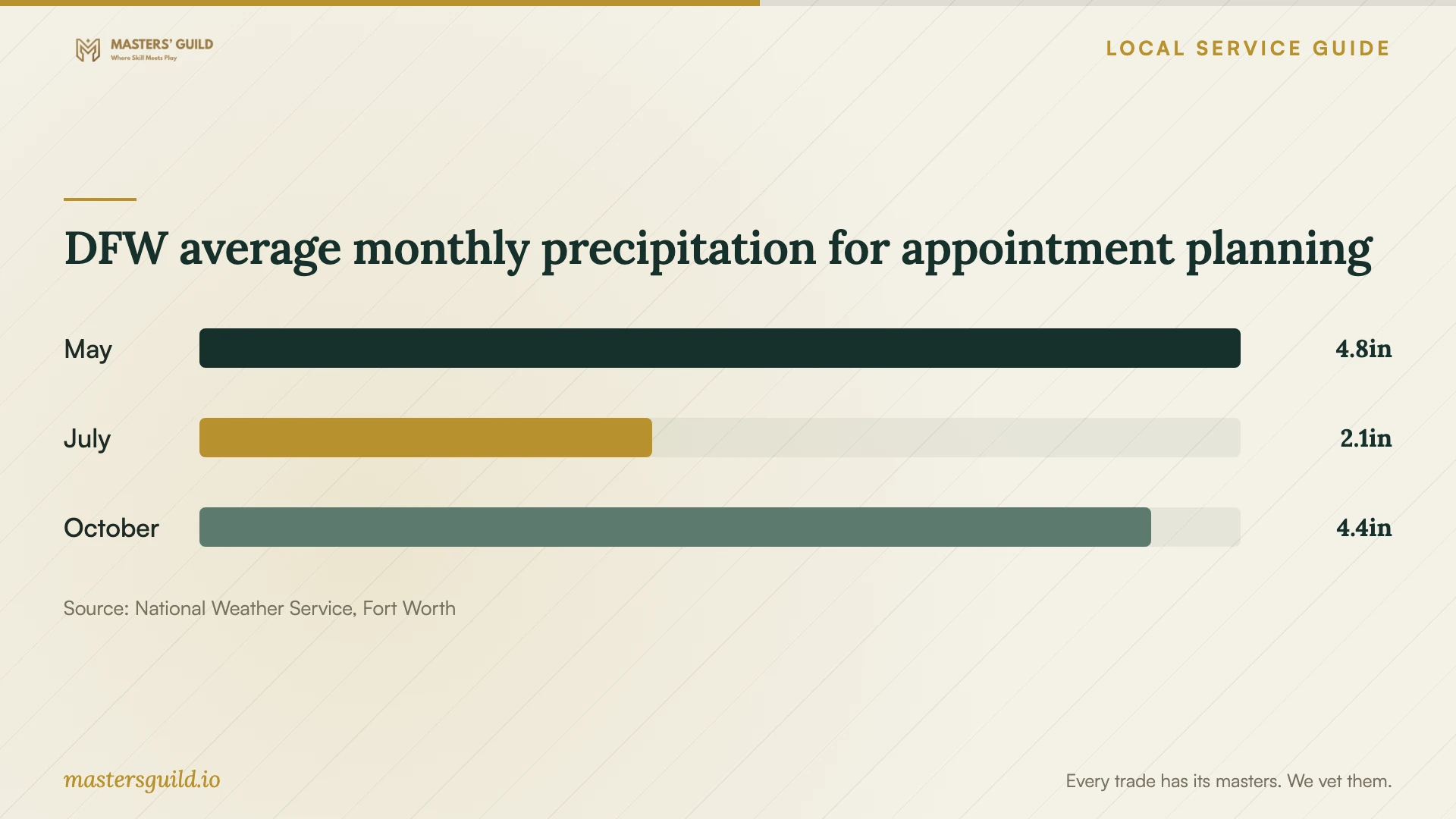
The National Weather Service publishes regional DFW precipitation normals, including an October average monthly total of 4.37 inches for 1991–2020. Use the chart to prompt a forecast check and a discussion about equipment access and wet shoes. Those outdoor monthly averages do not establish indoor drying conditions. [2]
Respond to water damage before scheduling cleaning
For soaked carpet, contact a water-damage professional and report when the damage occurred, when you discovered it, and the suspected water source. EPA's guide for schools and commercial buildings recommends drying clean-water-damaged carpet and backing within 24–48 hours of the damage. It also calls for cleaning and drying the subfloor. Discuss this material-specific guidance with the professional handling your home; its original scope is schools and commercial buildings. [4]
An uncertain discovery time does not restart that response window. Tell the professional that the duration is unknown. EPA directs readers to its mold-remediation guidance when materials show mold or have remained wet for more than 48 hours. The agency also cautions that drying within 48 hours does not rule out mold growth, and that mold does not necessarily grow after that point. [4]
If sewage or other contamination may be involved, consult an experienced restoration professional. EPA's clean-water table does not cover contaminated-water cleanup and warns against using fans until someone determines that the water is clean or sanitary. [4]
TDLR advises investigating visible mold or a musty odor, fixing the underlying moisture problem, and removing moldy absorbent materials, including carpet. For an affected home, discuss the condition of the carpet and underlying materials before approving deodorizing. If you rent, notify the landlord about moisture or mold verbally and in writing, and retain a copy. [3]
DFW average monthly precipitation for appointment planning
Local details that affect your job
Separate mixed residential services on the bill
For an Arlington home that needs extraction and cleaning, request distinct charges. The Texas Comptroller lists residential water extraction and carpet repairs as nontaxable, while cleaning, deodorizing, and hauling away ruined carpet or pad are taxable. Providers can apply tax to the taxable portion when they separately bill reasonable, identifiable charges. A lump-sum bill combining services carries a presumption of taxability when the taxable portion exceeds 5 percent of the total. [1]
Verify the Texas credential for mold work
Texas regulates mold assessment and remediation through TDLR, with exemptions that depend on the property and work. For a paid mold assessment, request the individual or company's assessment credential and verify it with TDLR. The agency prohibits licensees from conducting both assessment and remediation on the same project, except for its stated school-district exception. If someone proposes an exemption, request an explanation of how it applies to your home and the proposed work. [3]
Match the service to the carpet's condition
| Situation | Service to discuss | Information to provide |
|---|---|---|
| Dry carpet with soil or isolated stains | Routine carpet cleaning | Measured areas, stain history, and requested furniture moving |
| Wet carpet after a known clean-water leak | Water extraction and drying | Time of water damage; discuss EPA's 24–48-hour window from that event, not arrival |
| Unknown wet duration or more than 48 hours wet | Water-damage evaluation using applicable mold guidance | Known timeline and uncertainty; discovery does not restart the response window |
| Sewage or suspected contaminated water | Experienced restoration professional | Suspected source; determine cleanliness before using fans |
| Visible mold or a persistent musty odor | Moisture investigation and appropriate mold specialist | Affected locations, leak history, and proposed Texas credentials or exemptions |
Your hiring checklist
- Send dimensions, photographs, stair counts, and furniture responsibilities.
- Describe stains, previous products, pet accidents, and any moisture history.
- Approve the itemized scope and total before the technician starts.
- Confirm parking, equipment access, and household preparations.
- Plan room use around the provider's drying and furniture instructions.
- Inspect the completed work with the technician and identify any follow-up.
- Retain the invoice, instructions, and contact information.
Frequently Asked Questions
How much should I budget?
Request a quote for your measured rooms and chosen treatments. Compare the total for the same scope, including stairs, furniture moving, minimum charges, optional products, and tax. Set an approval requirement for extra work discovered during inspection.
Does Texas tax carpet cleaning in a home?
Yes. The Texas Comptroller classifies residential carpet cleaning as taxable and directs providers to collect state sales tax plus applicable local sales tax. Residential water extraction and carpet repairs appear on its nontaxable list. [1]
What should I do if carpet stays wet after a visit?
Contact the provider and describe the location and duration of the dampness. Request an inspection and corrective plan. TDLR advises addressing moisture problems and drying affected areas; tenants should also notify their landlord if carpets stay wet. [3]
Can I pay one company to assess and remove mold?
TDLR allows qualified people or companies to hold both types of license, but prohibits them from conducting both assessment and remediation on the same project, apart from a school-district exception. Clarify each participant's role before approving the work. [3]
Sources and scope
This guide combines the sources below with practical planning guidance. Figures apply to the stated geography and period; request a written quote for your property.