
Local service guide
Pet Sitting and Walking in Anchorage: Hiring Guide
Arrange Pet Sitting and Walking in Anchorage by agreeing on care location, visit times, handling permissions, and a backup caregiver before booking. For ordinary paid boarding, check the municipal commercial facility license; veterinary facilities are exempt under section 17.15.060. Ask walkers to explain their route and moose-avoidance plan. Meet with your pet present and request an itemized quote for the agreed schedule. [2] [5]
Choose the care arrangement before comparing quotes
Write down the hours your pet needs someone present. For a walk, specify time outdoors and any feeding or water refill afterward. For drop-ins, list feeding, litter cleaning, medication instructions, and arrival windows. For overnight sitting, ask when the caregiver arrives, leaves, and plans to be away during the day.
For care at another home or facility, ask who supervises your pet and how the provider separates animals during feeding and rest. Anchorage requires a commercial facility license for ordinary paid boarding of dogs, cats, rabbits, ferrets, or horses, for any period. Veterinary facilities are exempt under section 17.15.060. For a non-veterinary boarder, request the license associated with the care premises. [5]
Request an itemized quote using the same dates, pet count, visit lengths, and tasks for each candidate. Resolve transport charges, extra-pet charges, medication fees, cancellation terms, and the cost of extending care if your return changes. Ask whether travel time counts toward the advertised visit length.
Test handling and supervision at the meet-and-greet
Show the caregiver your harness, door routine, feeding setup, and your pet’s hiding places. Ask them to secure the leash before opening the door. Describe reactions to dogs, visitors, food, and handling, including past incidents. Consider a paid trial visit while you remain available to answer questions.
Request references, insurance information, and the name of the backup caregiver. Confirm who may enter your home and whether you must approve substitutes. Provide your veterinarian’s medication instructions and ask how the caregiver will record doses and respond if your pet refuses medication.
Visit boarding premises to inspect sleeping spaces, barriers, and cleaning arrangements. Anchorage’s animal-facility standards require appropriate shelter, sanitary conditions, timely necessary veterinary care, and space for normal movement. Ask the operator to explain supervision and animal separation for your pet. [4]
Approve a walking route and park permissions
Anchorage generally requires leashes in public places and a person capable of restraining the animal, with exceptions including designated off-leash areas. Tell the walker whether you authorize transport, group walks, or off-leash activity. Record the intended route and an alternative before the first visit. [4]
For an approved off-leash outing, check your dog’s municipal license and current rabies vaccination. The municipal parks guidance requires both, leashes on entry and exit, and a custodian who stays with the dog and maintains control. Classified dogs and female dogs in heat cannot use these areas. [1]
Agree on how the caregiver should change an outing when weather or your pet’s condition makes the planned walk unsuitable. Specify an alternative and ask for an update after any change. Municipal care standards require weather protection appropriate to the animal’s breed, size, age, and species. [4]
Plan for moose on walks and in the yard
Ask the walker how they would respond to a moose blocking the driveway or trail. Alaska Fish and Game advises giving moose an extremely wide berth with dogs, preventing chasing, and finding another route or waiting when a moose obstructs the way. Approve route changes rather than expecting the walker to pass close. [2]
Show the sitter the outside-light switches and request a yard scan before letting your dog out in poor light. Fish and Game recommends this precaution because dogs can surprise moose. Its Alaska guidance identifies late September and October as the rut, when bull moose may act aggressively toward people. [2]
Leave a written handover and emergency plan
Put food quantities, care times, medication instructions, behavior notes, and contacts on one handover sheet. Identify your regular veterinarian, preferred emergency veterinary facility, and a local person who can help if you cannot answer. Discuss treatment permission, transport, and how the caregiver should obtain your approval for expenses.
Test keys, lock codes, and alarms together. Show the caregiver spare leads, carriers, towels, and cleanup supplies. Agree on visit updates covering arrival, completed tasks, and changes in appetite, toileting, or behavior. Leave a backup access method with someone you authorize.
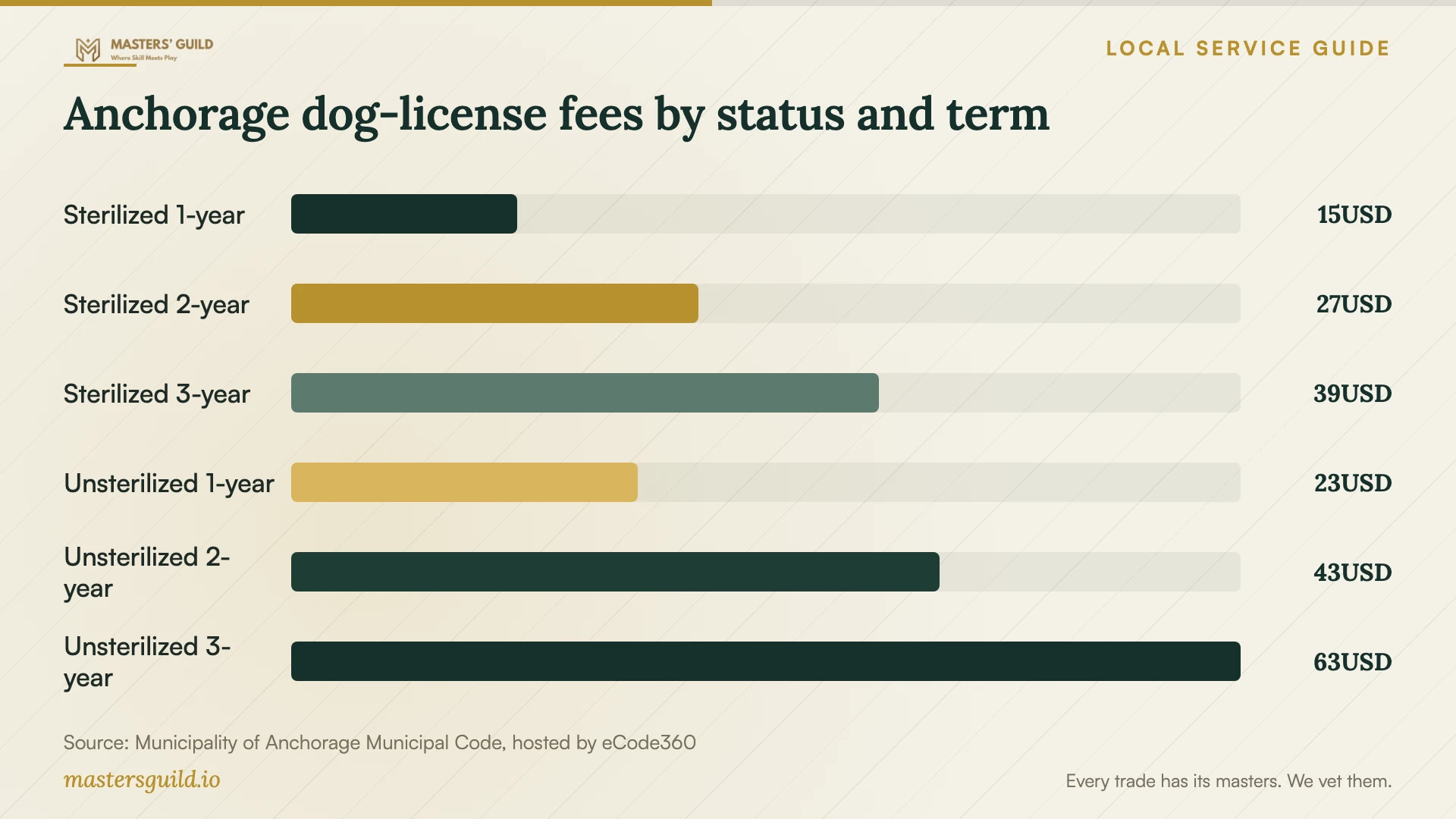
Anchorage dog-license fees by status and term
Local details that affect your job
Set a no-swimming agreement for University Lake
Anchorage prohibits swimming by dogs and people at University Lake to protect nesting birds and beavers. Specific trails may have posted seasonal closures to off-leash use. If your walker proposes this park, agree on no swimming and ask them to check signs and choose an alternate route. [1]
Choose the enclosure for a small dog
The municipality identifies Chanshtnu Muldoon Park and Whisper Faith Kovach Park as fenced off-leash areas with separate enclosures for dogs under 25 pounds and for all dogs. If you approve park exercise, specify the enclosure and discuss when the walker should leave or skip the outing. [1]
Check the premises for ordinary paid boarding
For ordinary paid boarding of dogs, cats, rabbits, ferrets, or horses, Anchorage requires a commercial facility license; veterinary facilities are exempt under section 17.15.060. Applications identify where animals stay, and the municipality requires an inspection before issuing a new license. Ask a non-veterinary home-boarder for the license covering that care address. [5]
Match the arrangement to your care needs
| Your need | Arrangement to discuss | Resolve before booking |
|---|---|---|
| Exercise while you are away | Scheduled dog walk | Route, leash handling, group permissions, and moose avoidance |
| Feeding and household pet care | Drop-in visits | Arrival windows, food, water, litter cleaning, and updates |
| Someone present overnight | Sitting in your home | Arrival and departure times, daytime absences, and backup access |
| Care at another premises | Boarding | Commercial facility license for ordinary paid boarding; veterinary facilities are exempt under section 17.15.060. Discuss supervision and separation. |
Your hiring checklist
- Write the dates, arrival windows, tasks, and expected hours of presence.
- Meet with your pet and demonstrate the harness, doors, and feeding routine.
- Request references, insurance information, and a named backup caregiver.
- For ordinary paid boarding, check the commercial facility license for the care address; veterinary facilities are exempt under section 17.15.060.
- Approve the route, alternate route, transport, and any group or off-leash activity.
- Leave veterinary instructions, emergency contacts, and treatment permissions.
- Test access and agree on visit updates before handing over keys.
Frequently Asked Questions
How much should I budget for a sitter or walker?
Request an itemized quote for your dates and care schedule. Compare visit lengths, hours of presence, transport, extra tasks, and cancellation terms. Ask each candidate to price the same arrangement so you can compare total charges.
Can my walker take my dog off leash?
Agree on permission and a specific park before booking. Anchorage generally requires leashes in public places, with exceptions including designated off-leash areas. Those areas require licensed dogs with current rabies vaccinations, custodian control, and leashes on entry and exit. [4]
Does a home-boarder need a municipal facility license?
Ordinary paid boarding of dogs, cats, rabbits, ferrets, or horses requires an Anchorage commercial facility license, for any period. Veterinary facilities are exempt under section 17.15.060. Ask a non-veterinary home-boarder for the license covering the premises where your pet will stay. [5]
Does my dog need a municipal license before care?
Anchorage requires a municipal license for dogs over four months old, except dogs brought into the municipality for less than 30 days. The selected license term requires rabies coverage for that period. Check the license, vaccination proof, and tag before handing over your dog. [5]
Sources and scope
This guide combines the sources below with practical planning guidance. Figures apply to the stated geography and period; request a written quote for your property.