
Local service guide
Junk removal in Anchorage: plan your pickup
For junk removal in Anchorage, send the hauler photos, an item list and access details, then request a written total covering loading, transport and disposal. Identify refrigerators, hot tubs and hazardous materials before booking because Solid Waste Services restricts their disposal by facility. Ask the crew to confirm its destination and the items it will take. [1] [2]
Get a quote for the complete cleanout
Photograph the whole pile and each bulky item. Describe whether the crew must carry items from inside the home, a garage or an outdoor staging area. Include stairs, narrow doorways, parking and the carrying distance to the truck. For a refrigerator, give its dimensions and flag any tight openings.
Request a written scope covering loading, transport, disposal and appliance preparation. For a truck-space quote, ask for the truck capacity and how the crew will measure your load. For a weight-based quote, ask how the hauler will document the weight. Agree on who pays for a second trip or an item the facility rejects.
SWS and the municipal code publish disposal charges, but their refrigerator-related figures differ. SWS lists $28.50 for refrigerant removal plus $20 for disposal, while the code lists a $27 refrigerant-removal charge. Confirm the applicable appliance fee with SWS at 907-343-6250 and ask the hauler to include it in the total. [1] [3]
Choose self-haul or a removal crew
Consider self-haul if you can lift the items, fit them into your vehicle and secure the load. Request crew removal if you need help carrying bulky items or clearing rooms. Compare options using the same item list, including any separate trips for special materials.
SWS lists the Central Transfer Station residential entrance at 1310 E. 56th Avenue and the commercial entrance at 1050 E. 56th Avenue. For residential vehicles, SWS recommends approaching through International Road, Homer Drive and E. 56th Avenue because some map applications give incorrect directions. [1]
The station's residential disposal hours are Monday through Saturday, 8:00 a.m. to 4:30 p.m., with Sunday closure. Check the hours for the particular service you need before arranging a vehicle. Hazardous-waste drop-off at the Anchorage Regional Landfill has a separate Tuesday through Saturday schedule, 8:00 a.m. to 5:00 p.m. [1] [2]
Separate hazardous materials before loading
Keep fuels, solvents, chemicals and batteries apart from the ordinary junk pile. SWS lists these materials in its hazardous-waste guidance and requires lithium batteries to go to household hazardous-waste facilities. Tell the hauler what you have and ask whether it will arrange accepted disposal or leave those items for you. [2] [4]
Under the municipal code, residential users may deliver up to 40 pounds per day and a maximum of 200 pounds per month of household hazardous waste, excluding electronic wastes, for free at the Central Transfer Station or Anchorage Regional Landfill hazardous-waste facilities. [3]
SWS's hazardous-waste page gives separate non-auto lithium-battery guidance of up to 40 pounds daily and 220 pounds monthly. That monthly figure differs from the code's 200-pound free household-hazardous-waste allowance. Call 907-201-8472 to confirm both acceptance limits and free-disposal limits for your batteries before loading them. [2] [3]
SWS excludes ammunition, explosives, asbestos, smoke alarms and pharmaceuticals from these hazardous-waste drop-off facilities. Leave them out of a routine cleanout scope and ask the program for disposal directions. For renovation debris that may contain asbestos, seek material-specific guidance before arranging removal. [2]
Confirm disposal and inspect the finished work
Ask the hauler to name the receiving facility for ordinary refuse and any separate special-material destinations. Anchorage Municipal Code 26.80.010 requires delivery of all solid waste generated within the municipality to state-permitted solid waste processing and disposal facilities located within the municipality, unless the director grants a written exemption. [3]
At Central Transfer Station, SWS collects metal items such as stoves, washers and dryers separately for recycling. Ask the crew whether it will separate these appliances. Request an item-specific destination rather than relying on a general promise to recycle. [1]
Before loading, walk through the agreed scope with the crew and identify anything that must stay. Confirm the total and excluded materials. After removal, inspect the rooms and staging area, then collect the invoice and any disposal documentation you agreed on. Ask the crew to record items it left behind and why.
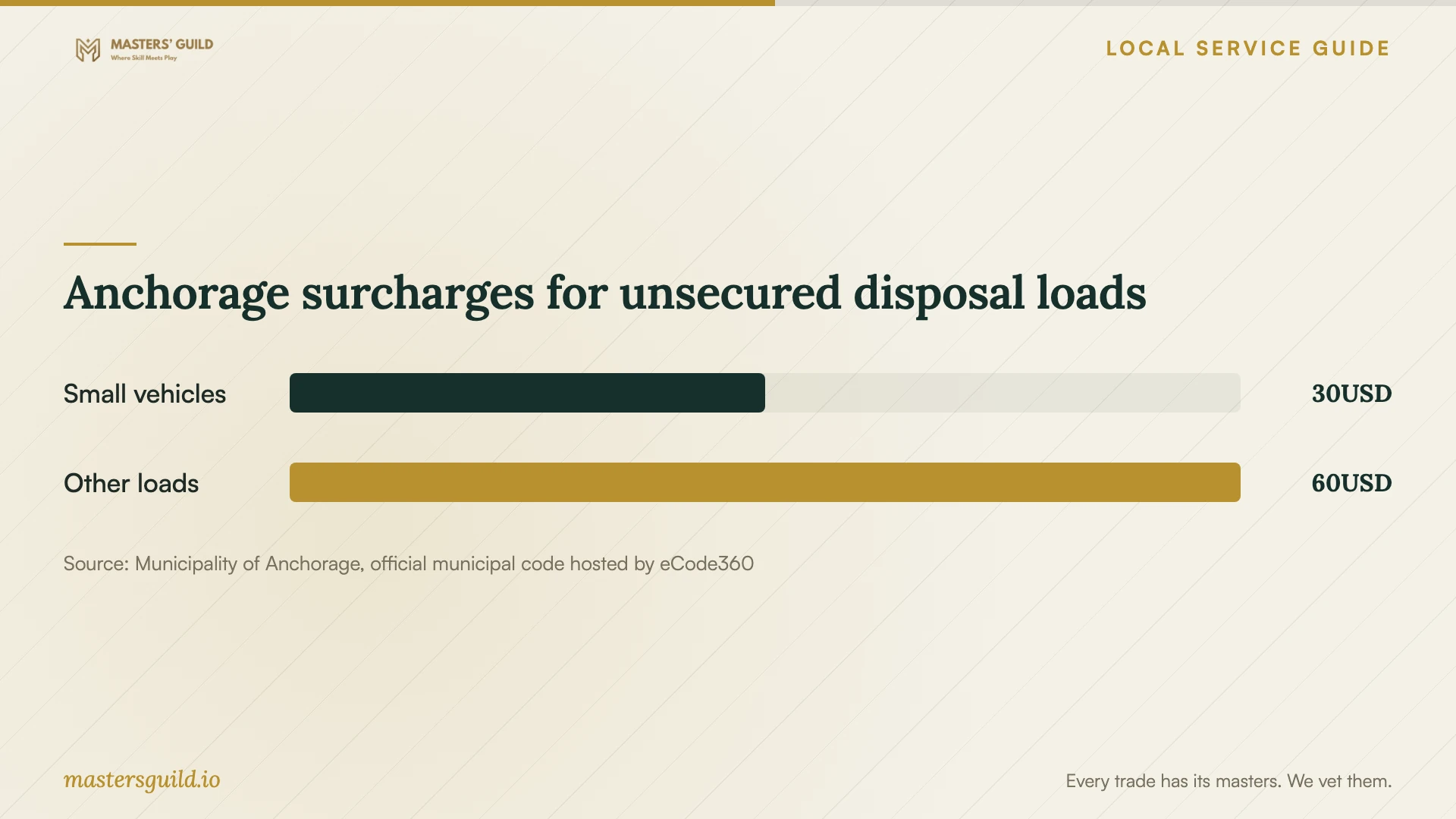
Anchorage surcharges for unsecured disposal loads
Local details that affect your job
Refrigerators and hot tubs need a destination check
Central Transfer Station excludes hot tubs and commercially collected refrigerators. Ask a hired hauler to confirm its receiving facility with SWS before booking. For refrigerator and freezer disposal, SWS instructs customers to empty the appliance and remove its doors. Agree on who will complete that preparation. [1]
Business chemicals require a different arrangement
Tell the hazardous-waste program if any chemicals came from a business. SWS directs qualifying very small quantity generator businesses to the Anchorage Regional Landfill hazardous-waste facility and does not accept their hazardous waste at Central Transfer Station. Do not combine business waste with household materials without confirming eligibility. [2]
Confirm the status of announced landfill route changes
SWS announces an upcoming temporary traffic pattern during reconstruction of the Anchorage Regional Landfill residential disposal building. It says residential disposal, metal disposal and refrigerator areas will relocate, but gives no effective date in the notice. Call 907-343-6250 to confirm current unloading arrangements before your trip, and follow posted directions on arrival. [4]
Choose a removal plan by material
| Your load | Suggested plan | Confirm before loading |
|---|---|---|
| Ordinary household junk | Compare self-haul with a crew quote. | Central Transfer Station has separate residential and commercial entrances. |
| Refrigerator or freezer | Request appliance-specific removal. | Central Transfer Station excludes commercially collected refrigerators; confirm destination and preparation. |
| Hot tub | Agree on a separate scope and destination. | Central Transfer Station does not accept hot tubs. |
| Lithium batteries or household chemicals | Arrange hazardous-waste handling. | Confirm acceptance and free-disposal limits, including the conflicting monthly lithium-battery guidance. |
| Stove, washer or dryer | Ask the crew to separate the metal appliance. | Central Transfer Station collects these metal items separately for recycling. |
Your hiring checklist
- Photograph the pile and list bulky items, appliances, batteries and chemicals.
- Describe stairs, doorways, parking and the carrying distance to the truck.
- Request a written total, exclusions and a process for approving changes.
- Ask the hauler to confirm destinations and preparation for special items.
- Request proof of insurance and agree on responsibility for property damage.
- Mark items that must stay and clear the agreed carrying route.
- For self-haul, check facility hours, confirm current access and secure the load.
- Inspect the cleared area and collect the agreed invoice and disposal documentation.
Frequently Asked Questions
How much should I budget for a pickup?
Request a written total for your item list and access conditions. Ask the hauler to itemize loading, transport, disposal and special handling, and explain how you will approve changes. SWS's published facility charges do not establish the crew's complete pickup price. [1] [3]
Can I put paint and batteries in the cleanout pile?
Arrange separate handling. SWS requires lithium batteries to go to household hazardous-waste facilities and lists paints and solvents in its hazardous-material guidance. For latex paint, SWS instructs customers to dry it before disposal. Call 907-201-8472 for material-specific directions and quantity limits. [2] [4]
Can a hired crew take my refrigerator to Central Transfer Station?
SWS excludes commercially collected refrigerators from Central Transfer Station. Ask the crew to confirm an accepted destination and include appliance preparation and disposal in its quote. Confirm the applicable fee with SWS because its disposal page and the municipal code list different refrigerant-removal figures. [1] [3]
What happens if I arrive with an unsecured load?
SWS requires covered and secured loads. The municipal code adds $30 to the secured-load charge for unsecured loads transported by cars, pickups or trailers eight feet or shorter, and $60 for all other unsecured loads. Cover and secure your load before leaving home. [1] [3]
Sources and scope
This guide combines the sources below with practical planning guidance. Figures apply to the stated geography and period; request a written quote for your property.