
Local service guide
Door and Window Repair in Anaheim, CA
Arrange Door and Window Repair in Anaheim by asking for an inspection and a written scope that separates hardware adjustment, glass work, frame repair, and full replacement. Before authorizing exterior changes, check whether your home has a Mills Act contract. If you are considering replacement windows, confirm Anaheim Public Utilities rebate eligibility and documentation before purchasing. [1] [3]
Describe the problem before choosing the repair
Prepare a separate description for each opening. Note whether the door drags, the latch misses, the window resists movement, you feel a draft, or you see moisture. Photograph the whole opening and the affected area. For moisture, explain whether you can wipe it from an accessible surface and when you first noticed it. Give the repairer observations rather than a diagnosis.
Ask the repairer to inspect operation, hardware, glass, frame condition, and the surrounding finish before recommending a scope. Request an explanation of what they propose to retain and remove. For a replacement recommendation, ask why a smaller repair would not meet your goal and whether the quoted work includes the surrounding trim and finish.
Flag broken glass, an opening you cannot secure, or a door you cannot use when arranging the visit. Ask whether the first appointment covers assessment, temporary protection, or completed work. Keep children and pets away from damaged glass, and avoid forcing a stuck opening while waiting for help.
Get a quote you can compare
Request an itemized quote for the agreed openings. Ask the contractor to identify the proposed parts or window models, labor, removal, disposal, finish work, and any exclusions. Have them distinguish the assessment visit from work that requires a later appointment. Ask who will measure and order parts and how you will approve a substitute if the specified item is unavailable.
Agree on how the contractor will handle additional damage discovered during removal. Request photographs, an explanation, and a written price change before extra work starts. Include your acceptance checks in the scope: operate each repaired opening, test its latch or lock, inspect the finish, and review the cleanup with the repairer before signing off.
For work affecting the exterior, ask the contractor to identify any city review or other approval that applies to your proposed scope. For a Mills Act property, Anaheim specifies an administrative permit process and a Zoning Plan Review Application for exterior alterations. That historic-property requirement does not establish the permit requirements for other homes. [3]
Compare replacement products beyond the pane count
The Department of Energy advises buyers to match replacement windows and doors to their installation climate using U-factor and solar heat gain coefficient, or SHGC. A lower U-factor means less heat flows through the product. A lower SHGC means less solar heat passes through it. Ask bidders to identify those ratings for the exact products they propose. [2]
Discuss daylight as well as heat. DOE distinguishes visible transmittance, which measures transmitted light, from SHGC, which measures transmitted solar heat. It also identifies air leakage, water resistance, durability, ventilation, and sound control as selection considerations. Tell the contractor which room conditions you want to improve so you can compare the proposed products against the same priorities. [2]
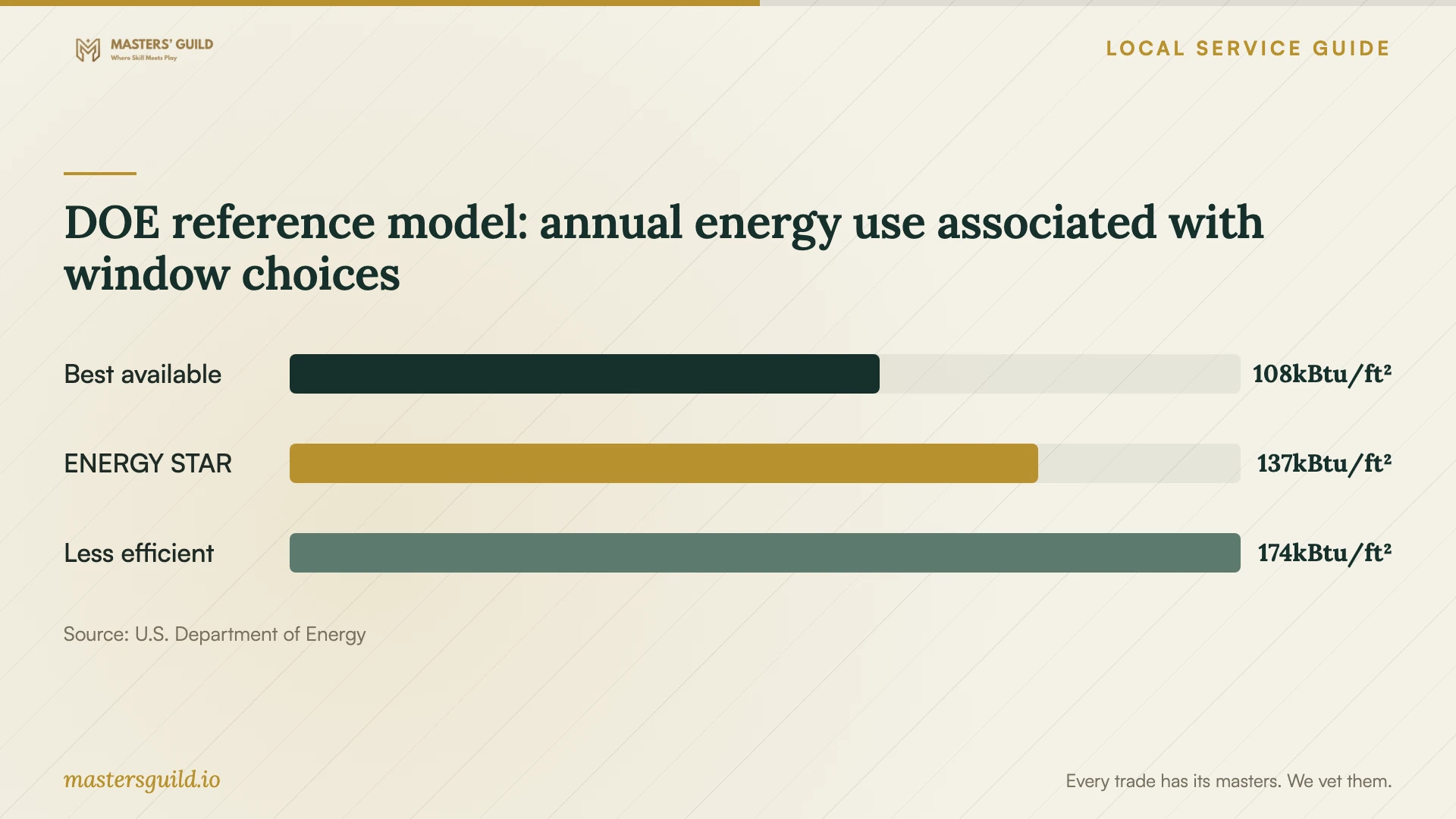
DOE's modeled energy-use comparison below provides background on product efficiency. Use it to understand why specifications matter, then ask for the proposed model's ratings. Do not use the chart to set your repair budget or predict your home's energy bill. [2]
Plan the visit and keep the paperwork
Before the appointment, agree on access to both sides of the opening, protection for nearby furnishings, and arrangements for pets. Ask whether the contractor needs blinds or curtains removed. Discuss how they will leave the opening secure if they cannot finish during the visit, and who will handle any follow-up finish work.
If you plan to seek an Anaheim Public Utilities window rebate, ask your contractor to complete the window incentive worksheet and preserve the required product labels. The utility requires paid purchase documentation and an application within one year of purchase. Confirm the current qualifying criteria before placing an order, and keep a copy of your complete submission. [1]
DOE reference model: annual energy use associated with window choices
Local details that affect your job
Mills Act status changes the approval sequence
For historical properties under a Mills Act contract, Anaheim requires Historic Preservation Staff approval for exterior alterations through its administrative permit process. Owners must submit a Zoning Plan Review Application, and fees depend on the proposed scope. If your home has such a contract, discuss the intended door or window changes with preservation staff before authorizing the exterior work. [3]
Utility service and documentation affect window rebate planning
An Anaheim address alone does not establish eligibility. APU requires an electric-service customer with accounts in good standing and installation in a fully constructed, occupied residential dwelling within its service area. Window applications require a contractor-completed incentive worksheet and the specified performance stickers. Funding operates on a first-come basis until exhausted or discontinued, so confirm availability and eligibility before including a rebate in your budget. [1]
Questions to resolve before authorizing work
| Your situation | Ask or confirm | Next step |
|---|---|---|
| Door or window resists movement | Which component needs attention, and what will the repair include? | Request a written scope before approving replacement. |
| Considering an efficiency upgrade | What are the exact model's U-factor, SHGC, and visible transmittance? | Compare climate suitability and daylight alongside the installation scope. |
| Exterior changes at a Mills Act home | Has Historic Preservation Staff approved the proposed alteration? | Resolve the administrative permit and Zoning Plan Review Application before exterior work. |
| Planning an APU window rebate | Do the customer, dwelling, and proposed product meet current requirements? | Confirm eligibility and arrange the worksheet and required labels before purchase. |
Your hiring checklist
- List each affected opening and photograph the problem.
- Describe operating, security, moisture, and appearance concerns separately.
- Ask for a component-level diagnosis and a written repair scope.
- Request exact product or part identifiers and itemized exclusions.
- Ask the contractor to identify applicable approvals before ordering.
- Agree on access, temporary security, cleanup, and finish work.
- Keep the quote, approved changes, receipts, product labels, and warranty documents.
Frequently Asked Questions
Should I authorize full replacement at the first visit?
Ask for the diagnosis and written scope first. Request an explanation of which components the contractor can retain, what replacement would address, and what finish work each option includes. Compare those proposals against your operating, security, and appearance goals.
Does Anaheim require approval for changes to historic windows?
The city's published rule covers exterior alterations to historical properties under a Mills Act contract. It requires Historic Preservation Staff approval through an administrative permit process and a Zoning Plan Review Application. Confirm how staff classify your proposed scope before authorizing exterior changes. [3]
Can I assume a replacement-window rebate will cover part of the quote?
Confirm eligibility and funding first. APU limits the program to qualifying electric-service customers and residential installations within its service area. It requires window documentation and an application within one year of purchase. The utility may inspect the installation before paying an incentive. [1]
Does a lower SHGC mean a darker room?
Compare both SHGC and visible transmittance. DOE explains that SHGC measures solar heat transmission, while visible transmittance measures daylight transmission. Ask for both ratings for the proposed model and discuss how much daylight you want to retain. [2]
Sources and scope
This guide combines the sources below with practical planning guidance. Figures apply to the stated geography and period; request a written quote for your property.