
Local service guide
Data recovery and backup in Anaheim, CA
Data recovery and backup in Anaheim should start with a defined job: retrieving missing files, restoring a working backup or responding to a suspected attack. Ask the provider for a written diagnostic scope, approval limit, data-handling terms and a way to check recovered files before accepting the work. For suspected ransomware, isolate affected equipment from the network and engage an incident-response specialist; CISA recommends isolation before recovery. Include secure disposal in your plan because Orange County's household collection centers exclude business waste. [1] [2]
Define the recovery job before handing over equipment
Give the provider a short account of what happened: a deletion, an error message, a device that stopped responding or files you can no longer open. Record any work someone has attempted. List the folders and applications you need, and identify the person who can authorize access to business records.
Ask the technician to explain the proposed diagnostic steps before you approve them. Request separate authorization for attempts that alter the original device. If you suspect an attack, tell the provider before connecting equipment or granting remote access. CISA advises responders to preserve evidence and investigate the compromise before rebuilding from backups. [2]
Set acceptance criteria in writing. For example, ask to open a sample of recovered invoices, confirm the required date range and test an application export on a separate destination. Agree on what counts as partial recovery and what you owe if the provider retrieves none of the priority files.
Compare diagnostic terms and the full quote
Request an itemized proposal covering diagnosis, recovery work, return storage, delivery and any optional priority service. Ask whether the diagnostic charge applies toward the final bill. Set a spending limit that requires your approval before the provider continues, and get the cancellation and equipment-return terms.
For a local handoff, confirm the actual receiving address and who signs for the device. Ask whether staff perform the recovery there or forward it to another facility. Record the device serial number, accessories and condition on the receipt. Require the provider to name any subcontractor who will receive your equipment or data.
Ask who may view recovered files, how staff protect transfer copies and when they delete retained data. For managed backup work, put access permissions and security responsibilities into the agreement. CISA recommends contract language that formalizes security requirements and limits third-party access to the duties they perform. [2]
Specify a backup service you can test
Tell the backup provider how much recent work you can afford to lose and how long you can operate without your systems. Use concrete examples, such as recreating one day's appointments or reopening the accounting application before the next payroll run. Ask the provider to propose a schedule and restoration process around those needs.
CISA recommends offline, encrypted backups of critical data and regular restoration testing. Its guidance explains that ransomware can delete or encrypt accessible backups. Ask the provider to identify the protected copy, explain how they separate access to it and demonstrate a restore before you accept the installation. [2]
Choose a test that reflects your work: restore a folder of documents, open the files and have the responsible employee check them. If an application matters to your operation, include it in the test scope. Agree on who checks failures, who receives alerts and who handles restoration when your usual contact is unavailable.
Arrange incident response before a ransomware restore
CISA instructs organizations to isolate affected systems from the network first. It recommends powering down only when disconnection is impossible because shutdown loses potential evidence held in memory. Contact your IT lead or incident-response provider by phone and follow your response plan before authorizing a restore. [2]
Ask the responder to define containment, investigation and clean restoration as separate parts of the assignment. CISA recommends prioritizing critical services and checking for earlier compromise before rebuilding. Restoring files alone does not address its guidance on investigating stolen data or meeting applicable breach-notification requirements. [2]
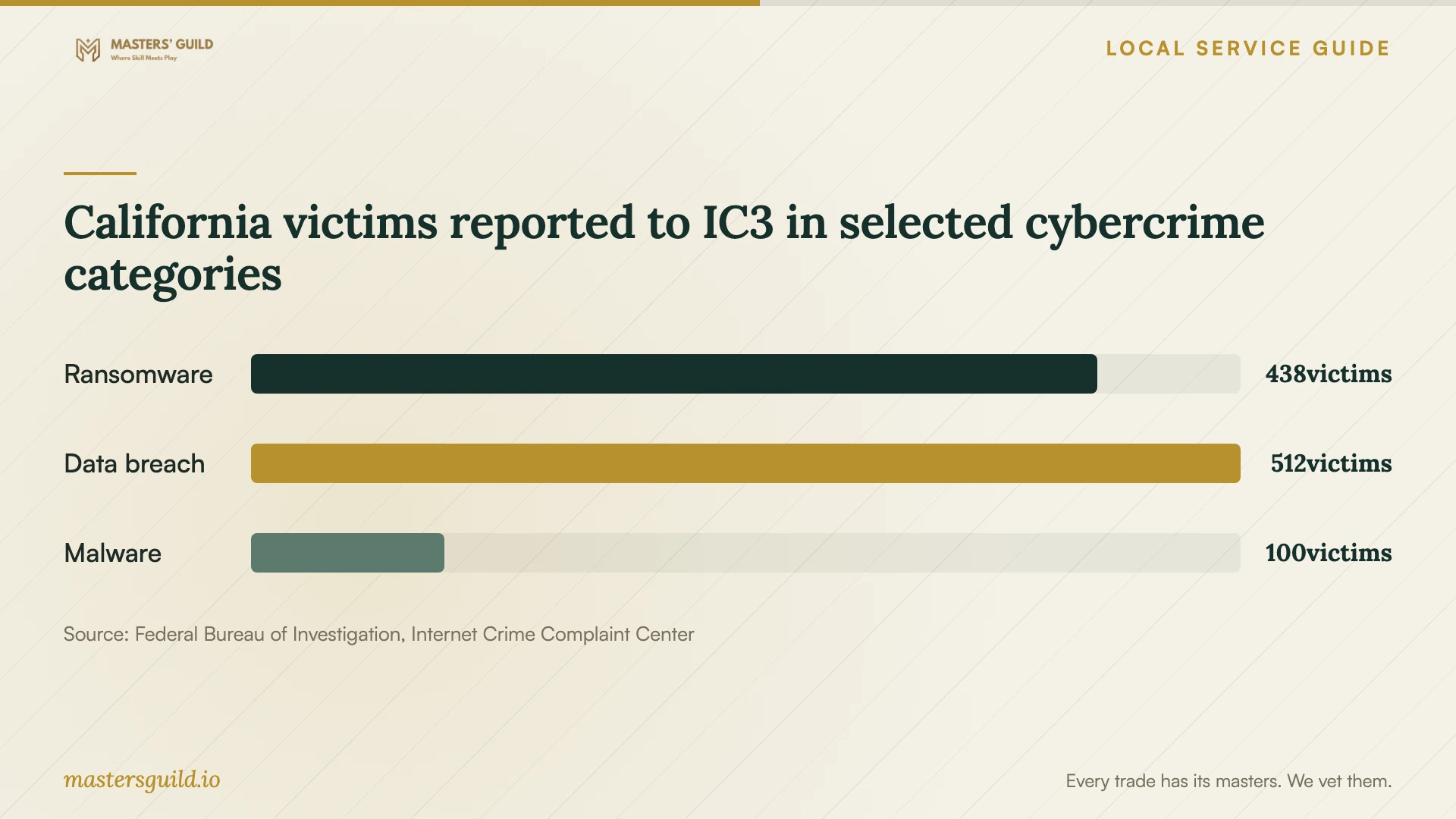
The FBI's 2025 California report lists 438 ransomware victims, 512 data breach victims and 100 malware victims in its crime-type table. These statewide reporting figures provide context for including incident response in a backup proposal. They do not establish an Anaheim incident rate or predict your business's risk. [3]
California victims reported to IC3 in selected cybercrime categories
Local details that affect your job
Business equipment needs a separate disposal arrangement
OC Waste & Recycling does not permit its household hazardous waste collection centers to accept waste from businesses, churches, schools, nonprofits or government agencies. For your office or shop equipment, ask the recovery provider to quote a business disposal route and identify the receiving recycler. Confirm acceptance before sending equipment to a collection site. [1]
County recycling does not include drive destruction
The county states that staff do not destroy computers, hard drives, phones or other electronic devices at its household collection premises. It asks residents to remove sensitive information before drop-off. Make secure erasure or documented destruction a separate service after you accept the recovered files; do not treat a recycling handoff as proof that someone removed your data. [1]
Keep personal household electronics separate
For eligible personal household equipment, Orange County residents can use the Anaheim Collection Center at 1071 N. Blue Gum Street, 92806, free of charge. The county lists hours of 9 a.m. to 3 p.m., Tuesday through Saturday, with closures on major holidays and during rainy weather. Staff may request proof of county residence. Check the schedule before travel and complete data removal before drop-off. [1]
Choose the scope before requesting offers
| Your situation | Service to request | Acceptance question |
|---|---|---|
| Missing files with no suspected attack | A diagnostic assessment and scoped recovery proposal | Can I check the priority files before accepting the recovery? |
| An existing backup you want to restore | A restoration job with a defined destination and file check | Will you demonstrate that the restored files and required applications work? |
| Suspected ransomware | Incident response covering isolation, investigation and clean recovery | Who will preserve evidence and authorize restoration? |
| A new managed backup arrangement | Backup setup with offline encrypted copies and regular restore tests | Who will run the tests and respond to failures? |
| Retiring business computers | Data sanitization and a business-appropriate recycling arrangement | Who will document data removal and confirm the recycler accepts business equipment? |
Your hiring checklist
- Record the symptoms, device model and recovery attempts already made.
- List priority files and name the person authorized to approve access.
- Get diagnostic charges, an approval limit and partial-recovery terms in writing.
- Confirm the receiving location, subcontractors and equipment-return arrangements.
- Agree on sample-file checks before accepting recovered data.
- Include a witnessed restoration test in the backup setup scope.
- Specify data retention, deletion and secure disposal responsibilities.
Frequently Asked Questions
How should I compare recovery quotes?
Compare the same priority files, diagnostic scope and acceptance criteria. Ask each provider to separate diagnosis, recovery, return storage and optional urgency charges. Get written terms for partial recovery, cancellation and returning the original equipment.
What should a backup provider demonstrate?
Ask the provider to restore a representative set of files and let you check them. CISA recommends regular testing of backup availability and integrity, alongside offline encrypted copies. Agree on a test schedule and the person responsible for failed tests. [2]
Can I take office computers to the Blue Gum Street center?
Orange County's household hazardous waste centers exclude business waste. Arrange a business disposal service and confirm its acceptance terms before delivery. Keep eligible personal household equipment separate from your business disposal job. [1]
Does the county erase a computer before recycling it?
The county says no destruction of electronic devices occurs at its household collection premises and asks residents to remove sensitive information before drop-off. Arrange data removal after you verify your recovered files and before recycling. [1]
Sources and scope
This guide combines the sources below with practical planning guidance. Figures apply to the stated geography and period; request a written quote for your property.