
Local service guide
Appliance Installation in Anaheim: Plan Your Hookup
Arrange Appliance Installation in Anaheim by defining the work before you book: identify the appliance model, document the existing connections, and ask whether the installer will change plumbing, wiring, or cabinets. California requires a licensed contractor when a project needs a building permit, uses workers, or totals $1,000 or more in labor and materials. If you plan to claim an Anaheim Public Utilities rebate, check customer and product eligibility before purchasing. [1] [2]
Define the installation before comparing quotes
Describe the work as a specific job: replace a dishwasher in the existing opening, connect a washer and dryer, or install a refrigerator with a water connection. Include the model number and photographs of the space, supply connections, drain, outlet, and any visible shutoff. Ask the installer to review the manufacturer's installation instructions before confirming the scope.
Separate appliance placement and connection from changes to the home. Ask the quote writer to identify any proposed water-line extension, electrical alteration, gas work, vent change, or cabinet modification. Request a written explanation of who will perform each task and who will resolve permit questions before work begins.
Compare quotes with the same inclusions. Ask each installer to list connection parts, removal of the old appliance, haul-away, floor protection, testing, and cleanup. Request a procedure for approving extra work if the installer discovers a connection or fit problem after removing the old unit.
Choose a contractor for the actual work
California's Contractors State License Board requires a current, valid license for contracted work on a project that requires a building permit, uses employee labor or workers, or reaches $1,000 in combined labor and materials. Do not judge license requirements from the advertised hookup price alone. Ask about the complete project and who will do the work. [2]
CSLB advises homeowners to match a single specialty job to the relevant specialty contractor. For a kitchen remodel involving plumbing, electrical, and carpentry under one contract, its guidance identifies a B General Building contractor as appropriate. Ask the contractor to explain how their license and any subcontractors cover your proposed installation. [2]
Ask for the contractor's license number and verify it through CSLB before agreeing to work that meets those licensing triggers. Have the installer identify any permit requirement for your specific changes. Avoid accepting a blanket statement that appliance installation never requires a permit. [2]
Check utility rebate eligibility before purchase
Anaheim Public Utilities requires applicants to be APU electric-service customers with all APU accounts in good standing. The appliance must serve a residential dwelling within the utility's service area. The utility includes single-family homes, condominiums, apartments, and permanently located mobile homes, but requires a fully constructed, occupied dwelling and excludes new construction. [1]
Confirm the exact product's qualifying status with the utility before including a rebate in your purchase budget. APU offers incentives until funding runs out or it discontinues the program, limits applications for each measure type at an account service address to one every five years unless it approves an exception, and caps the incentive at the purchase price. [1]
Check any applicable homeowner association restrictions before scheduling the installation. APU places responsibility on applicants to check government and association requirements before installation; rebate eligibility does not replace that review. [1]
Prepare for delivery, testing, and paperwork
Measure the appliance opening and delivery route, including doors and turns. Share stairs, parking constraints, and building access arrangements with the delivery team and installer. Confirm who will disconnect the old appliance and whether delivery, installation, and removal happen during the same appointment.
Before the installer leaves, ask them to demonstrate the checks required by the manufacturer's instructions. Request a review of leveling, connections, controls, and the appropriate operating test. Have the installer show you the accessible shutoffs and explain any unresolved issue in writing.
For an APU rebate, collect a paid receipt or invoice showing the brand, manufacturer model number, purchase price, and purchase date. Include efficiency information if available. The utility requires a delivery slip for online purchases and recommends uploading an APU bill to help process the application. Submit within one year of purchase and keep access available for possible installation verification. [1]
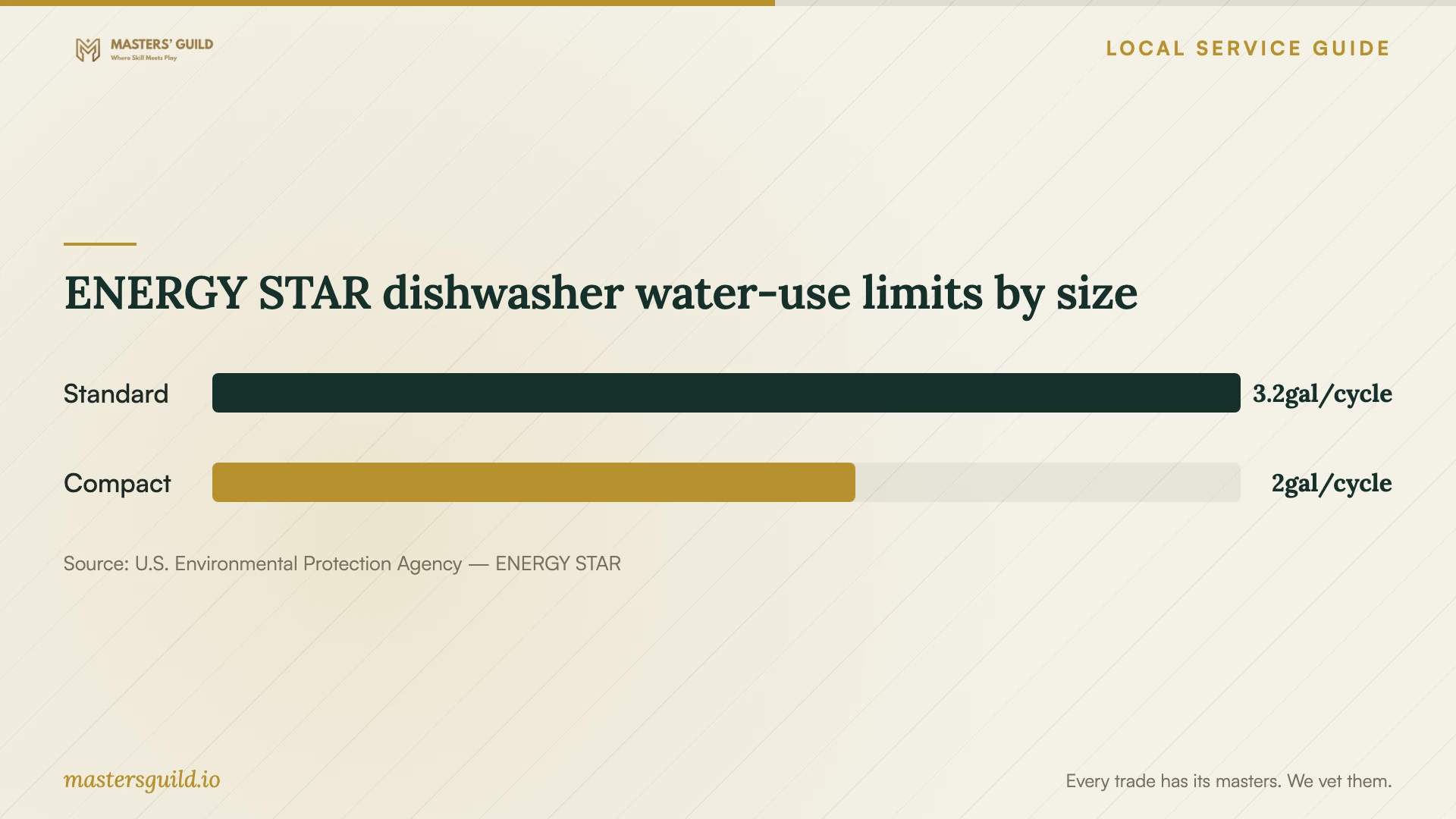
ENERGY STAR dishwasher water-use limits by size
Local details that affect your job
Verify the utility account and dwelling first
An Anaheim address alone does not establish residential rebate eligibility. Check that you hold APU electric service, that all your APU accounts are in good standing, and that the appliance will serve an occupied, fully constructed dwelling within the service area. For a new-construction installation, plan your budget without this residential incentive program. [1]
Coordinate rebate records and inspection access
Ask the seller for a receipt with the exact model and retain the delivery slip for an online order. APU may inspect the installed appliance before paying an incentive and may inspect a measure within six months after issuing a rebate check. Keep the appliance accessible and respond to application follow-ups. The rebate processing team answers questions at 714-408-4161, Monday through Friday, 8 a.m. to 5 p.m., excluding holidays. [1]
Match your installation plan to the next step
| Your situation | Next step | Question to resolve |
|---|---|---|
| Replacement using existing connections | Send model details and connection photos for a written scope. | Does the quote include all connection parts, testing, and removal? |
| Permit required, workers involved, or project totals $1,000 or more | Verify a current CSLB contractor license. | Does the contractor's license cover the proposed work? |
| Kitchen remodel with plumbing, electrical, and carpentry | Discuss coordination with a licensed B General Building contractor. | Who performs each trade and manages the installation sequence? |
| Occupied home with APU electric service | Check the product and account against residential incentive rules. | Is the model eligible, and have you used this measure's allowance? |
| New-construction dwelling | Budget without APU's residential Home Incentive Program. | What is the full purchase and installation cost without that incentive? |
Your hiring checklist
- Send the appliance model and manufacturer's installation instructions.
- Photograph the opening, existing connections, outlet, drain, and shutoffs.
- Measure the opening and delivery route; disclose stairs and access restrictions.
- Request separate descriptions for hookup work and changes to the home.
- Ask who will verify license and permit requirements for the proposed scope.
- Confirm parts, haul-away, testing, cleanup, and extra-work approval in writing.
- Check rebate eligibility with the utility before relying on an incentive.
- Save purchase and delivery records and review the completed installation with the installer.
Frequently Asked Questions
Does a small hookup price mean the installer can work without a license?
Price alone does not settle the question. CSLB also requires a license when the project requires a building permit or uses employee labor or workers. Its cost trigger is $1,000 or more for combined labor and materials. Ask the installer to assess the complete scope. [2]
Can I apply for an APU rebate after an online appliance purchase?
APU requires the delivery slip for online purchases along with the paid sales receipt. Keep records showing the brand, model number, purchase price, and purchase date. Submit the application within one year of purchase and confirm product and account eligibility. [1]
Does an ENERGY STAR dishwasher guarantee a local rebate?
Confirm eligibility with APU before purchase. ENERGY STAR publishes national product criteria, while APU sets its own customer, dwelling, documentation, and funding conditions. Use the exact model number when asking the utility about an incentive. [1] [3]
What should I ask before the installer leaves?
Ask for a demonstration of the manufacturer's required operating checks, a review of the connections and shutoffs, and a written record of any unfinished work. Confirm that the final invoice reflects the agreed scope and any extras you approved.
Sources and scope
This guide combines the sources below with practical planning guidance. Figures apply to the stated geography and period; request a written quote for your property.