
Local service guide
Tree Cutting in Allentown: Arborist Hiring Guide
Arrange Tree Cutting in Allentown by identifying whether the tree stands on private land or in the public right-of-way, then request a written scope for assessment, pruning or removal and cleanup. For shade trees on public land or in the public right-of-way, the City requires a permit. For professional right-of-way work, verify the named worker’s City arborist license before scheduling the crew. [1]
Choose assessment, pruning or removal
Ask the arborist to explain the problem before choosing removal. Describe your concern: a damaged limb, clearance above a walkway, a change in the tree’s lean or interference with a planned project. Request a recommendation that identifies the proposed cuts and explains whether you can retain the tree.
For right-of-way trees, the City requires adjacent owners to maintain branch clearance of at least 10 feet above the right-of-way and 16 feet above streets, highways or avenues, with greater clearance where necessary for sight lines. Ask the contractor to address the applicable clearance through a defined pruning scope. [1]
Photograph the tree from a safe position and identify it on the proposal. Avoid instructions such as cut it back or make it smaller. Ask which branches the crew will remove, which parts it will retain and whether the arborist recommends a later inspection. Keep people away from hanging limbs or a damaged tree while you arrange assessment.
Resolve street-tree permission before booking
Under section 597-3, you need a permit before pruning, spraying, planting, removing or cutting a shade tree on public land or in a public right-of-way. The City also lists excavation, trenching, tunneling or boring within a tree’s dripline as permit activities. Include nearby root work in your permission inquiry. [1]
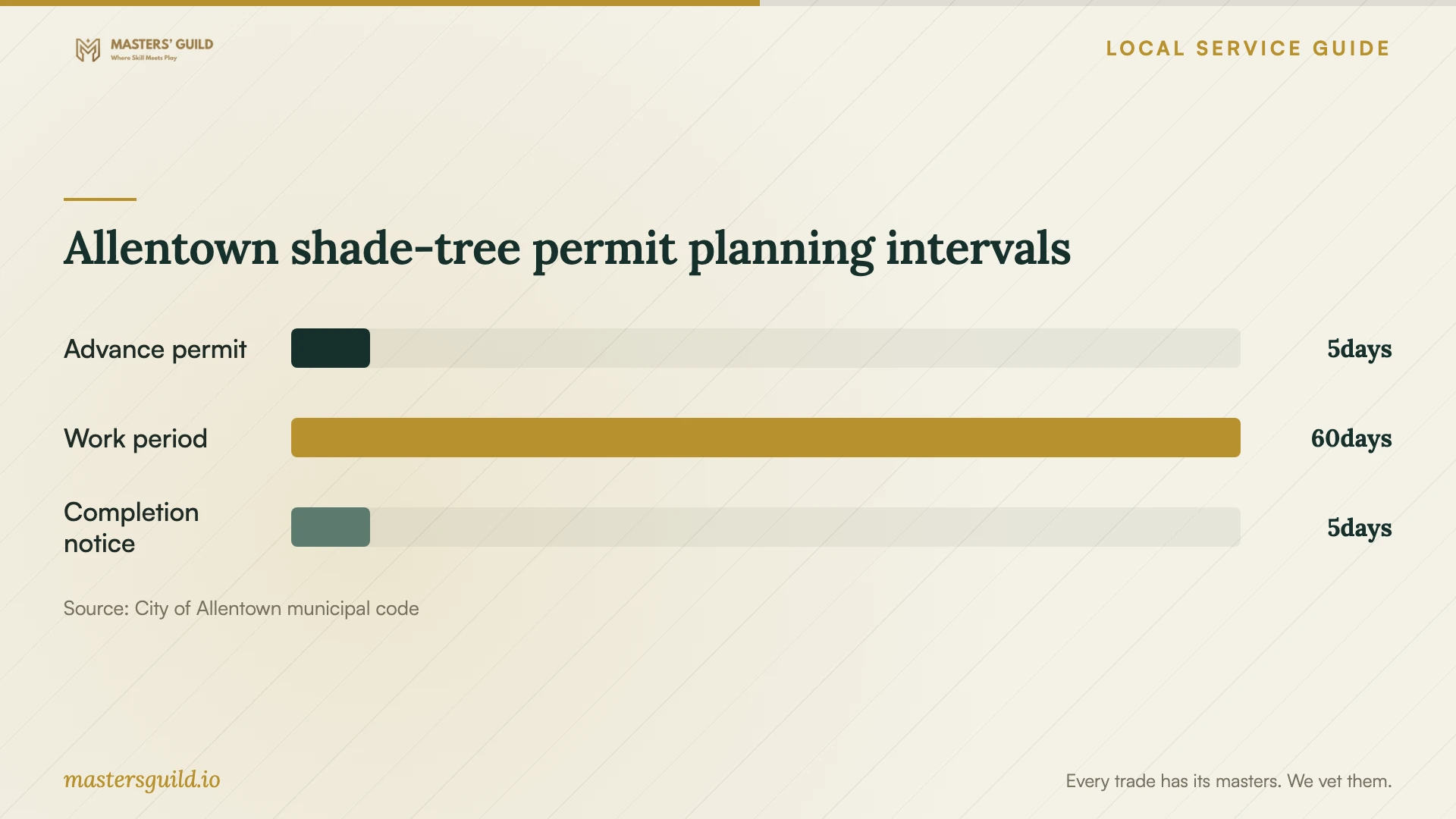
The City requires you to secure the permit at least five days before work. The permit specifies the completion period, which cannot exceed 60 days from issuance unless the Construction Operations Manager grants an extension for good cause. Notify the manager or designee within five days after completion so the City can inspect. [1]
Assign responsibility for the application, approval documents and completion notification in writing. Ask whether approved removal carries replacement requirements; section 597-5 includes one-for-one replacement for approved shade-tree removal. Include any required replacement planting in the scope you compare. [1]
Check credentials and private-property restrictions
Section 597-7 requires a City tree surgeon’s license for professional arboricultural procedures on trees and shrubs in the public right-of-way. The City issues its arborist license to ISA certified arborists and requires current certification for yearly renewal. Ask for the individual’s name and City arborist number, then confirm the license with the City. [1]
Private-property removal needs a separate scope check. The supplied zoning text applies significant-tree provisions to specified parcels, including sites abutting named waterways, certain development sites and sites over one acre in IX, IG or IM zones. Within that scope, it defines significant trees to include trunks at least 13 inches in diameter at breast height and certain historic, champion or remembrance trees. [2]
The zoning page flags an August 5, 2026 amendment to Chapter 660, but the supplied text does not include that amendment. Before relying on these provisions for your property, ask the Zoning Officer to confirm the current requirements and whether your parcel falls within their scope. Do this before authorizing removal for future construction. [2]
For any job, request evidence of liability coverage and applicable workers’ compensation coverage. Ask who will supervise the crew and who will handle damage claims. Keep copies with the signed proposal.
Compare the full job and prepare access
Request separate descriptions for tree work, stump work and cleanup. Specify whether you want logs retained, branches chipped, debris hauled away and stump grindings removed. Agree on grinding depth and the condition of the remaining hole. Ask who will supply fill, seed or other restoration materials.
Walk the access route with the contractor. Identify gates, fences, overhead wires, parking space and surfaces you want protected. Ask the contractor to explain any utility coordination before setting the work date. Include permission for access through another property if the proposed method depends on it.
Discuss weather postponements and equipment access. The National Weather Service’s KABE tables list normal snowfall of 9.8 inches for January and 10.8 inches for February; NWS labels the page’s climate data preliminary and unofficial. Use that station information to prompt a winter access discussion, rather than to predict conditions in your yard or choose pruning dates. [3]
Ask for a total quote with exclusions and a process for approving changes. Have the contractor identify permit handling, equipment, hauling and restoration in the proposal. Photograph the access route before work and inspect the agreed finished condition with the contractor afterward.
Allentown shade-tree permit planning intervals
Local details that affect your job
Minor work beside your property still needs permission
The City allows an individual property owner to perform minor work on adjacent right-of-way trees or shrubs after obtaining a permit. The Shade Tree Commission decides whether the proposed work qualifies as minor. Ask for that determination before treating a small pruning job as exempt. [1]
A City notice changes your scheduling priorities
A notice to remove or remedy a right-of-way tree includes a compliance period of no more than 30 days and a list of current City arborist licenses. The Construction Operations Manager or designee may grant reasonable extensions on request. Share the notice with your contractor and request an extension if you cannot meet its deadline. [1]
Private trees can trigger public-nuisance action
Section 597-6 covers private trees or branches that overhang or interfere with a public right-of-way and that the City considers a danger to the public. If you receive a nuisance notice, follow its remedy and deadline; private ownership does not remove that obligation. [1]
Match your situation to the next step
| Situation | Next step |
|---|---|
| Shade tree on public land or in a public right-of-way | Arrange the shade-tree permit before pruning or removal. |
| Professional work in the public right-of-way | Verify the individual’s City arborist license as well as the permit. |
| Owner proposes minor adjacent right-of-way work | Obtain a permit and the Commission’s determination that the work is minor. |
| Private removal on a parcel potentially covered by significant-tree rules | Ask the Zoning Officer to confirm current applicability and approval requirements. |
| City notice to remove or remedy | Schedule against the notice deadline or request an extension. |
Your hiring checklist
- Identify each tree and confirm its position relative to the public right-of-way.
- Send the contractor photographs and any City notice.
- Confirm applicable permits and assign application and inspection duties.
- Verify the named individual’s City arborist license for professional right-of-way work.
- Request insurance documents and identify the crew supervisor.
- Specify cuts, stump treatment, hauling and restoration in writing.
- Agree on access protection, utility coordination and weather postponements.
- Inspect the finished scope and retain approval and completion records.
Frequently Asked Questions
Does ISA certification replace the City arborist license?
For professional right-of-way work, verify the City license too. Allentown requires ISA certification to issue its arborist license and current certification for yearly renewal. [1]
Does every private tree need significant-tree approval?
The supplied zoning text limits section 660-73 to specified sites and parcels. Ask the Zoning Officer to confirm your parcel’s status and the effect of the amendment flagged on the page before deciding whether approval applies. [2]
Should stump grinding and hauling appear in the removal quote?
Ask the contractor to state whether each is included. Specify grinding depth, disposal of grindings, hole filling and ground restoration so you can compare the same finished job.
Can I assume the City handles a tree beside my sidewalk?
Confirm the tree’s location and your duties with the City. The shade-tree code assigns adjacent owners pruning duties and provides a notice process for removal or remedy of hazardous right-of-way trees. [1]
Sources and scope
This guide combines the sources below with practical planning guidance. Figures apply to the stated geography and period; request a written quote for your property.