
Local service guide
Plan tile setting in Allentown, PA
Arrange tile setting in Allentown, PA by having contractors inspect your floor or wall and quote preparation, installation, and cleanup separately. Before bathroom demolition, ask the city to review the full scope. Pennsylvania exempts ordinary residential repairs, but excludes removal or cutting of structural beams or load-bearing supports and additions or relocation of specified piping or wiring from that category. Assign responsibility for any required permits in your written agreement. [2]
Define the tile work before requesting bids
Describe the room, the surfaces you want tiled, and whether you want a repair, replacement, or complete renovation. Include approximate measurements and photographs of cracks, loose tiles, staining, and adjoining floors. Have the contractor inspect the area before you accept a fixed scope. Agree on how you will approve and pay for conditions the contractor cannot inspect until removal.
For a floor, ask how the contractor will assess the existing surface, address uneven areas, and finish doorways and transitions. For a backsplash, settle outlet cuts, edge trim, and where the tile stops. For a shower, request a written waterproofing scope covering the base, walls, corners, penetrations, and drain connection. Ask who will check or test that work before covering it.
Resolve permits from the complete renovation scope
Pennsylvania’s residential permit regulation exempts ordinary repairs without naming tile replacement. Its exclusions include cutting away a load-bearing wall or partition, removing or cutting a structural beam or load-bearing support, and specified changes affecting required egress. It also excludes additions or relocation of listed piping, electric wiring, or mechanical systems. Ask the city to assess your complete project. [2]
Send Allentown’s Bureau of Building Standards and Safety a description of demolition, floor or wall reconstruction, drain and supply changes, and electrical work. Ask which permits and inspections apply, who should submit the application, and which work must remain exposed for inspection. Record responsibility for applications, fees, and inspection scheduling in your agreement. [1]
Allentown’s code says an approved application does not become a valid permit until the applicant pays the required permit fee. The city doubles the permit fee when someone starts work without a required permit. Request the issued permit before authorizing work that needs one. [1]
Check credentials and compare written quotes
Pennsylvania has no state licensure or certification requirement for most construction contractors. It distinguishes that from home-improvement registration: most home-improvement contractors must register, maintain minimum insurance coverage, and use contracts that meet consumer-protection requirements. Ask for registration information, insurance documentation, and completed-project examples similar to your job. [3]
For plumbing or electrical changes, identify who will perform that work and confirm the relevant local credentials with the city. Allentown’s code includes plumber and electrician license schedules. Pennsylvania directs homeowners to the municipality for local licensing requirements. Check those credentials separately from the tile setter’s home-improvement registration. [1] [3]
Request separate amounts for tile supply, removal and disposal, preparation, proposed waterproofing, installation, trim, and cleanup. Specify the tile product, size, pattern, grout choice, and who purchases materials. Have bidders state quantities and allowances so you can compare the same work. Use site-specific written bids for your budget.
Ask each bidder to explain any omitted work before choosing an offer. Agree on payment stages, written approval of changes, and responsibility for damaged or unused materials. For a shower, ask the contractor to identify the proposed products and provide their installation and care instructions.
Arrange access, debris removal, and bathroom downtime
Agree on the route workers will use, material storage, and protection for adjoining rooms. Request a dust-control and debris-removal plan. If this is your only bathroom, have the contractor identify the periods when you cannot use the toilet, sink, or shower. Arrange alternatives before demolition.
Ask for separate dates for installation completion and return to use, based on the products the contractor proposes. At the walkthrough, review edges, transitions, grout, sealant locations, and unfinished items against your agreement. Keep preparation and waterproofing photographs with your contract, invoices, care instructions, and permit records.
Allentown building permit application fees
Local details that affect your job
Budget the full residential permit charge
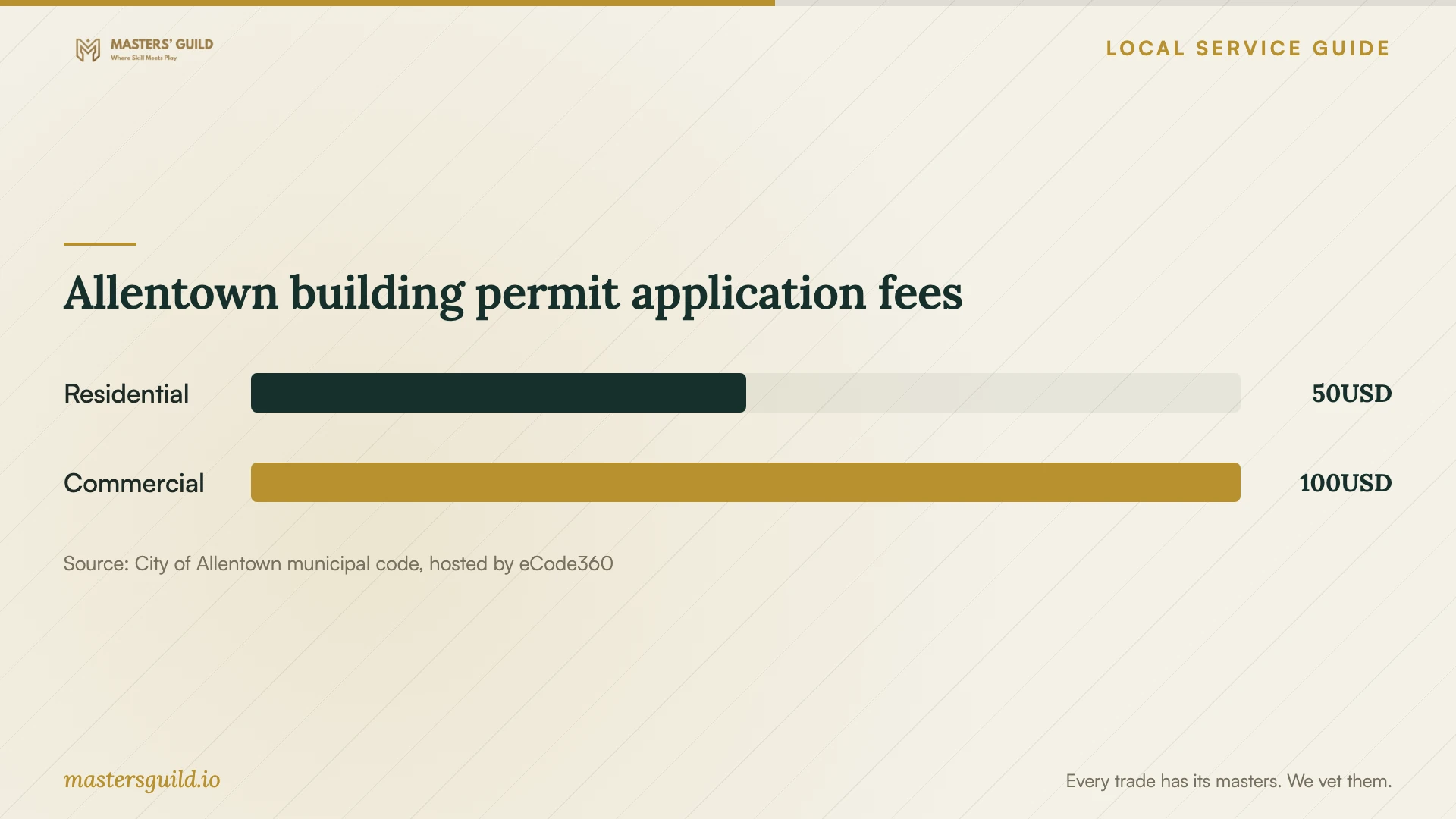
For applicable residential permits, Allentown lists a $50 nonrefundable application fee and a plan-review and inspection charge equal to the greater of $50 or 1% of total work cost. The code includes labor and materials from all trades in that cost. It also lists a $4.50 UCC charge, or the amount Pennsylvania determines. Ask the city to calculate the total for your full renovation before accepting a fixed permit allowance. [1]
Check the fee category for a multifamily building
Allentown’s fee definitions classify buildings with three or more dwelling units as commercial. If your project is in such a building, confirm the applicable category with the city before budgeting residential fees. The commercial schedule lists a $100 application fee and a plan-review and inspection charge equal to the greater of $75 or 1.5% of total work cost. [1]
Separate street-side dumpster fees from hauling
If demolition requires a dumpster in the public right-of-way, assign responsibility for placement approval and municipal charges. Allentown lists $35 per month for an approved dumpster of 20 cubic yards or less and $55 per month for a larger one. Obtain separate amounts for container rental, hauling, and disposal, and ask the contractor whether they can remove debris without a street-side container. [1]
Choose the next step for your tile project
| Proposed work | Question to settle | Next step |
|---|---|---|
| Replace a backsplash without system changes | Does the complete scope qualify as an ordinary repair? | Ask the city to confirm; the residential regulation exempts ordinary repairs without naming tile replacement. |
| Retile a shower and relocate drainage piping | Which approvals cover the plumbing change? | Resolve permits before work; Pennsylvania excludes relocated drainage piping from ordinary repairs. |
| Remove or cut a structural beam or load-bearing support | Who will assess and specify that work? | Seek city guidance before demolition; the regulation excludes this work from ordinary repairs. |
| Renovate in a building with three or more dwelling units | Which fee category applies? | Confirm classification; Allentown includes these buildings in its commercial fee definition. |
| Place a demolition dumpster in the public right-of-way | Who arranges approval and pays the municipal charge? | Agree on placement arrangements and separate the city fee from rental, hauling, and disposal. |
Your hiring checklist
- Photograph the area and list the surfaces, approximate dimensions, and fixtures you want changed.
- Choose the tile and layout, or request a stated material allowance.
- Have bidders inspect the surface and describe preparation and concealed-condition allowances.
- Request registration information, insurance documentation, and relevant project examples.
- Send the complete renovation scope to the city and assign responsibility for any required approvals.
- Compare removal, preparation, waterproofing, installation, trim, and disposal as separate bid items.
- Agree on access, dust control, bathroom downtime, and product-specific return-to-use instructions.
- Keep the signed scope, change approvals, preparation photographs, and care instructions.
Frequently Asked Questions
Do I need a permit to replace bathroom tile?
Pennsylvania exempts ordinary residential repairs, but the regulation does not name tile replacement. Ask Allentown to review the full scope. Removing or cutting structural beams or load-bearing supports, cutting away load-bearing walls, and adding or relocating specified piping or wiring fall outside the ordinary-repair category. [2]
Should I ask a tile setter for a Pennsylvania license?
Ask for home-improvement registration information and insurance documentation. Pennsylvania has no state licensing requirement for most construction contractors, but requires most home-improvement contractors to register. Confirm local credentials for anyone performing plumbing or electrical work. [1] [3]
What should a shower tile quote include?
Request removal, preparation, the proposed waterproofing system, drain coordination, tile installation, grout, sealant, trim, and debris removal. Ask who checks the work before covering it and how the contractor will price concealed damage. Agree on return-to-use instructions before booking.
Is the $50 residential application fee the full permit cost?
Allentown lists additional charges. Its residential plan-review and inspection charge is the greater of $50 or 1% of total work cost, separate from the application fee. The code also includes a state UCC charge. Ask the city to confirm your applicable total. [1]
Sources and scope
This guide combines the sources below with practical planning guidance. Figures apply to the stated geography and period; request a written quote for your property.