
Local service guide
Snow removal in Allentown: hiring and planning
Arrange snow removal with a written scope covering your driveway, public sidewalk, steps and return visits after street plowing. In Allentown, owners, people controlling property and occupants must clear the adjoining sidewalk within 10 hours after snow, sleet or rain stops, using the National Weather Service report at ABE Airport; the code accepts a three-foot-wide cleared path. Ask the provider to commit to that sidewalk deadline even if the driveway needs a separate visit. [1]
Choose service around the sidewalk deadline
Start with the public sidewalk rather than the driveway alone. Section 545-3 assigns clearing responsibility to people owning, controlling or occupying adjoining property. It measures the deadline from the end of snow, sleet or rain as reported by the National Weather Service at ABE Airport. Do not substitute the time you wake up or the time your contractor finishes another route. [1]
Ask how the provider will handle a light snowfall below the driveway plowing trigger. Specify whether someone will shovel or use a snow blower on the sidewalk, clear steps and treat ice. If you share responsibility with another occupant, write down who books service, checks completion and calls for missed areas.
Ask for a backup contact and a plan for equipment failure. Request a completion message or photo, especially if you will be away. Keep enough time to arrange another person if the provider cannot complete the agreed work.
Show the provider where snow can go
Walk the property with the provider and identify where crews should pile snow. Allentown prohibits depositing snow from private property onto a street right-of-way and depositing sidewalk snow onto the portion used by vehicles. The code also includes exceptions involving prohibited curbside parking or unavailable private storage space; the sidewalk article qualifies the curbside-parking exception with a vehicle-travel-lane restriction. [1] [2]
If you have little storage space, ask the city to clarify the applicable exception before approving a disposal plan. Have the provider describe where each pile will go and whether hauling is part of the quote. Avoid giving a broad instruction to push snow toward the curb without identifying the intended location.
Photograph driveway edges, steps and existing surface damage before service begins. Mark the areas you want crews to protect, and identify gates, parked vehicles and narrow passages. Ask which equipment the provider proposes for each surface and request proof of insurance covering the proposed work.
Coordinate parking and return visits
Check your exact street segment against the city's snow-emergency route table. The table lists specified portions of streets, including Hamilton, Tilghman and Union Boulevard. During an effective snow emergency, drivers cannot park or leave vehicles on those routes, subject to the code's stated provisions. Authorized personnel may tow vehicles that violate the restrictions, and the owner pays the removal and storage costs. [2]
Arrange a place for your vehicle before the contractor arrives. Tell the provider whether you need access to a garage or off-street parking space. Include a separate instruction for the ridge left at the driveway entrance after street plowing: who checks it, who requests a return visit and what that visit costs.
Watch for posted street-removal restrictions as well as snow-emergency announcements. For scheduled street snow removal, the code prohibits parking four hours after posting in established metered zones of four hours or less and limited-parking zones, and six hours after posting on other streets. [2]
Compare per-visit and seasonal agreements
Request written quotes for the same mapped areas. For per-visit service, ask whether the charge covers one arrival, a complete storm or repeated passes. For seasonal service, ask for start and end dates, snowfall limits, exclusions and the charge for work outside those terms. Keep ice treatment and snow hauling as named items so you can compare them.
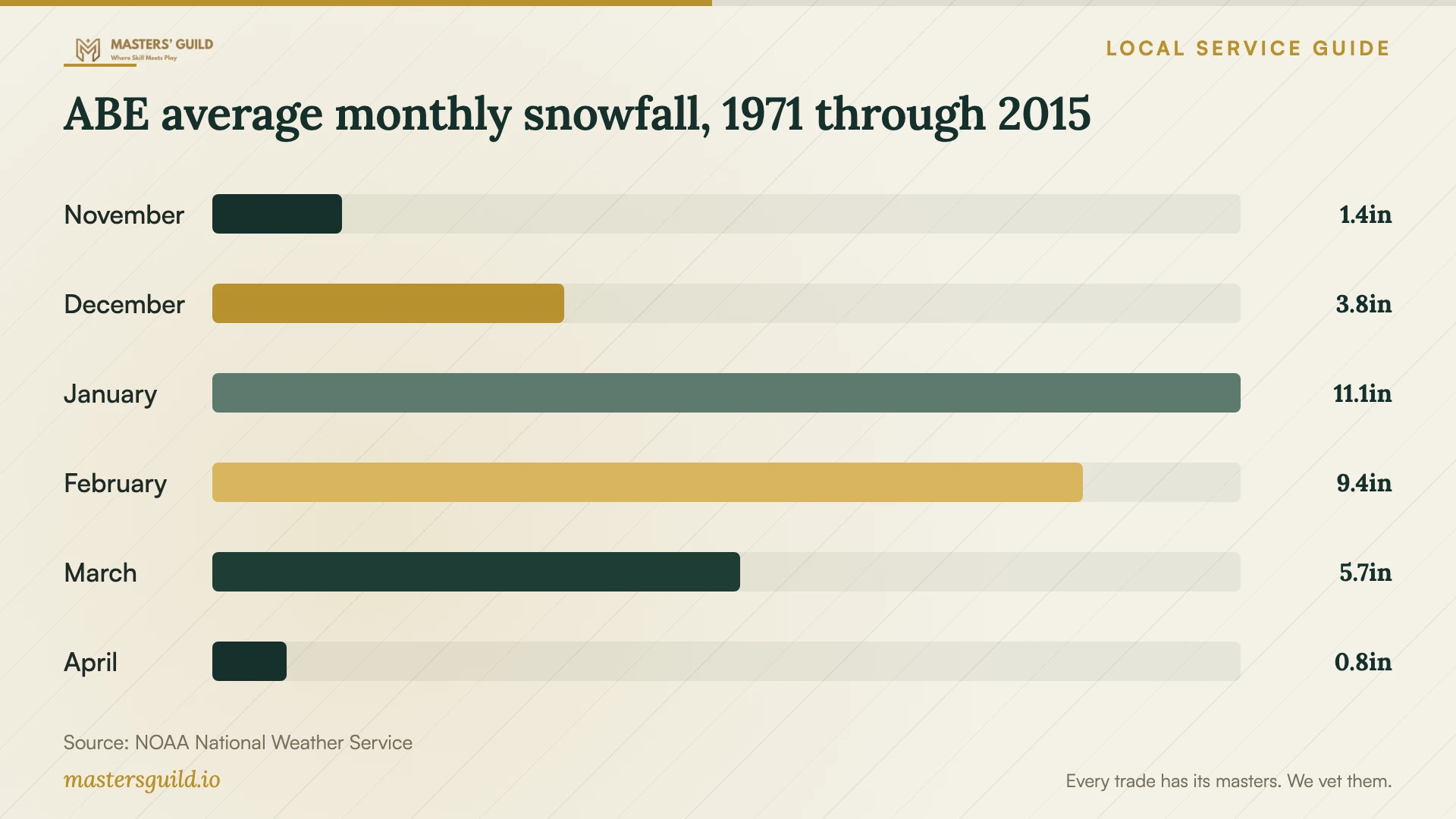
Use local snowfall history to discuss coverage dates, without treating it as a forecast. The National Weather Service's ABE table for 1971 through 2015 reports average snowfall in November, December, January, February, March and April. Ask how the provider handles an event before the contract starts or after it ends. [3]
The supplied official sources do not establish local contractor prices. Get a property-specific quote rather than budgeting from an unsupported city average. Give each bidder the same photos, approximate dimensions, access instructions and requested completion time.
ABE average monthly snowfall, 1971 through 2015
Local details that affect your job
The deadline follows ABE Airport reporting
Allentown requires adjoining sidewalk clearing within 10 hours after snow, sleet or rain ceases as reported by the National Weather Service at ABE Airport. The code accepts a three-foot-wide cleared portion. Ask the provider how it tracks that endpoint and completes sidewalk work when its driveway trigger has not been reached. [1]
Snow emergencies require a vehicle plan
The city's snow-emergency declaration takes effect four hours after announcement. Its route table identifies street segments rather than giving permission to park elsewhere on the same named street. Check your segment, choose a relocation space and tell the contractor how you will keep access available. [2]
Limited storage needs a specific disposal agreement
The city restricts placing private-property snow in street rights-of-way and sidewalk snow in vehicle travel areas, while stating exceptions. The sidewalk article adds a vehicle-travel-lane qualification to the prohibited-curbside-parking exception. If your property lacks a clear storage area, confirm the applicable rule with the city before agreeing to curbside placement. [1] [2]
Match the agreement to the work you need
| Your situation | Service to request | Confirm before booking |
|---|---|---|
| You can clear some areas yourself | Per-visit help for named areas | Who handles the public sidewalk and checks completion |
| You will be away during storms | Automatic dispatch with a backup contact | Sidewalk completion within the city's 10-hour deadline |
| You want coverage across winter | Seasonal agreement | Start and end dates, exclusions and charges outside the term |
| You have little room for piles | A written storage or hauling plan | City clarification before relying on a snow-placement exception |
| You need access after street plowing | Driveway-entrance return service | How to request the visit and whether it costs extra |
Your hiring checklist
- Send bidders photos and approximate dimensions of the driveway, sidewalk, steps and entrances.
- Identify the snow-storage area and request a hauling option if you cannot agree on storage.
- Specify separate driveway and sidewalk triggers, completion expectations and ice-treatment instructions.
- Ask for proof of insurance and record the contact for missed or delayed service.
- Agree on vehicle relocation and access before the first visit.
- Price return visits for driveway plow ridges and repeat clearing during a storm.
- Record seasonal start and end dates, exclusions, cancellation terms and payment timing.
Frequently Asked Questions
How soon must I clear the sidewalk?
Allentown specifies 10 hours after snow, sleet or rain ceases as reported by the National Weather Service at ABE Airport. It accepts a cleared portion three feet wide. Include that deadline and width in your instructions to the provider. [1]
Can my contractor push snow into the street?
The city restricts depositing private-property snow in street rights-of-way and sidewalk snow in vehicle travel areas, with stated exceptions. Ask for a defined storage location. If the provider proposes relying on an exception, confirm its application with the city before work. [1] [2]
Does driveway plowing include the sidewalk and salt?
Ask the provider to list those tasks in writing. Name the sidewalk, steps, entrances, ice-treatment areas and driveway entrance as separate parts of the scope. Confirm whether the quoted charge includes each task and any return visit.
How many visits should I expect in a season?
Do not convert historical snowfall into a promised visit count. Ask the provider to explain its trigger, repeat-pass policy and handling of ice-only events. The ABE historical table describes snowfall averages for 1971 through 2015, not the coming winter or your contractor's workload. [3]
Sources and scope
This guide combines the sources below with practical planning guidance. Figures apply to the stated geography and period; request a written quote for your property.