
Local service guide
Arrange lawn mowing in Allentown, PA
For lawn mowing in Allentown, ask providers to quote the same lawn area, cutting height, trimming, and clipping cleanup, then agree on visits that follow grass growth. Flag overgrown areas before booking: the city includes grass in its weed definition and prohibits covered growth over 10 inches. If you have received a violation notice, share its deadline with the provider and request a confirmed completion date. [1] [3]
Define the job before comparing quotes
Send each provider the same photos and description. Identify the front, rear, and side areas you want cut, plus any areas you want left alone. Include gate width, steps, slopes, exposed roots, and the route from parking to the lawn. Ask the provider to inspect access before agreeing to use equipment that may not fit.
Request separate prices for the first visit and ongoing care. Specify mowing, trimming around fences and beds, edging along pavement, and clearing clippings from walks. Ask whether the price includes bagging, hauling, leaf cleanup, and any applicable charges. Compare written quotes for your property.
Before accepting an offer, request proof of insurance and ask how the provider handles property damage. Agree on gate access, pets, advance notice, payment timing, and cancellation. Put any fertilizer, weed treatment, aeration, or seeding work in a separate scope so you can approve it before the crew starts.
Set the cutting height and clipping plan
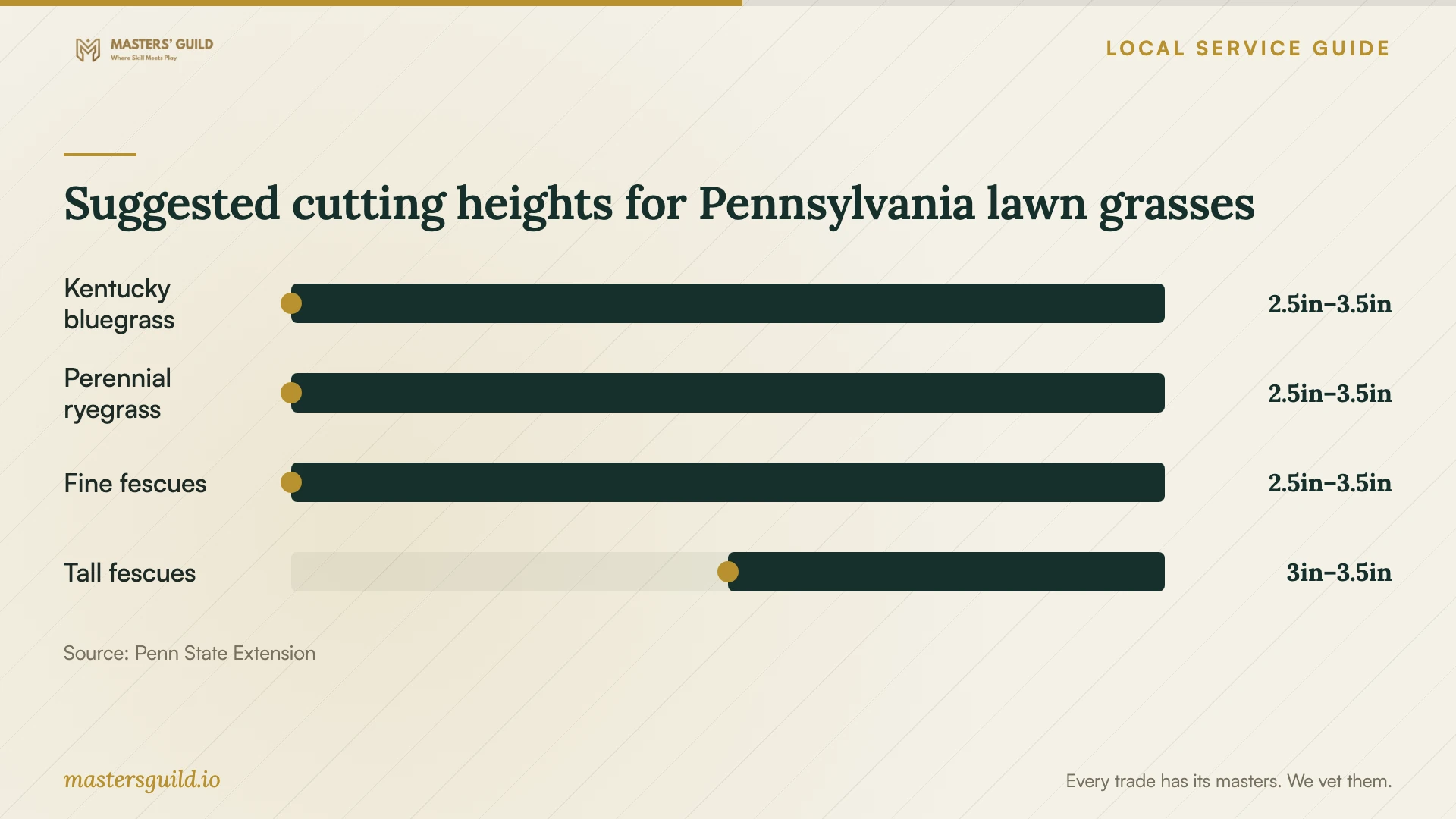
Ask the provider to identify the predominant grass before setting the mower. Penn State's Pennsylvania guidance gives species-specific mowing heights, shown in the chart. Use those ranges when discussing the cut, rather than asking the crew to take the lawn as short as possible. [2]
For routine cuts, consider leaving clippings on the lawn. Penn State explains that leaf clippings decompose rapidly and do not contribute to thatch. Its guidance also calls for mowing often enough to avoid large amounts of residue on the surface. Ask the crew how it will handle visible clumps after an overdue cut. [2]
After prolonged rainfall, Penn State notes that overgrown turf can leave large clumps after mowing. The guidance describes dispersing clumps after drying or collecting them for compost or mulch. Tell the provider about recent herbicide treatment: Penn State warns against placing clippings from turf treated with broadleaf herbicides such as 2,4-D, MCPP, or dicamba around trees, shrubs, or garden plants. [2]
Agree on visits that follow growth
Discuss how the provider will adjust service as growth changes. Penn State recommends mowing while grass continues growing and choosing frequency by growth rate. It says peak spring growth may need more than one visit per week; during drought, mowing may be unnecessary until rainfall restarts active growth. [3]
Ask who decides to postpone a visit, how the crew communicates the change, and whether you pay for skipped cuts. Agree on a rescheduling process after rain and a way to request an extra visit. Before committing to a fixed interval, discuss how the provider will respond to faster or slower growth.
Protect fall repairs during mowing
Mark newly seeded patches and share the planting date before the next visit. Penn State recommends beginning mowing of newly established turf with a lightweight mower when plants are no more than one-third higher than the desired cutting height. Its example starts mowing just before grass reaches 4 inches when the intended cut is 3 inches. [4]
Penn State also advises checking whether seedlings return upright after you step on them. If they do not, it warns that mowing can trample them into the soil. Ask the crew to assess new turf before taking its mower across it, and specify an alternate access route around areas you want protected. [4]
Suggested cutting heights for Pennsylvania lawn grasses
Local details that affect your job
Allentown's overgrowth limit changes the first visit
Chapter 649 includes grass in its definition of weeds and prohibits covered growth over 10 inches within city boundaries. That is an enforcement threshold, not a recommended mowing height. If your lawn approaches or exceeds it, disclose the height and request an overgrowth assessment before agreeing to a routine maintenance visit. [1] [2]
A city notice requires a confirmed completion plan
Under Chapter 649, the city may arrange removal and bill the responsible person if that person fails to remedy the violation within five days after notification. For subsequent violations in the same calendar year, the city may act without another notification. Share the notice with the provider, confirm a completion date, and keep photos and the invoice after the work. [1]
Pennsylvania's seeding calendar affects October add-ons
Penn State says seeding later than mid-October is not suggested for most areas of Pennsylvania. This is statewide guidance, not a site assessment for your lawn. If you are considering seeding alongside October mowing, ask the provider to assess timing and follow-up care before you approve the add-on; arrange mowing around any seedlings already present. [3] [4]
Choose the scope for your next visit
| Your situation | What to request | What to confirm |
|---|---|---|
| Established turf with active growth | Recurring mowing at a species-appropriate height | A schedule the provider can adjust as growth changes |
| Covered growth over 10 inches within city boundaries | An overgrowth assessment and first-cut quote | A completion date and a plan for clipping clumps |
| You have received a city violation notice | A visit that meets the remedy deadline | Completion within five days after notification |
| Drought has stopped active growth | An assessment before the next scheduled cut | The provider's skipped-visit and billing terms |
| Newly seeded turf | A readiness check and lightweight mower | Seedling response to foot traffic and the intended cutting height |
Your hiring checklist
- Photograph the lawn and note its current height before requesting quotes.
- List the areas to cut, areas to avoid, gate width, and access obstacles.
- Request a separate first-cut price and recurring-service price.
- Confirm cutting height, trimming, edging, and clipping cleanup in writing.
- Agree on skipped visits, rain rescheduling, extra cuts, and billing.
- Share any city notice and request a confirmed completion date.
- Mark new seed or sod and tell the crew about recent lawn treatments.
Frequently Asked Questions
Should I choose weekly or biweekly mowing?
Choose by observed growth and agree on adjustments with the provider. Penn State says peak spring growth may require mowing more than once per week, while drought may remove the need to mow until growth resumes. Ask how the provider handles extra cuts and skipped visits. [3]
Do I need the provider to bag the clippings?
Penn State says clippings need not be removed when mowing frequency is adequate. Ask for a cleanup plan when overgrowth leaves heavy clumps. Specify bagging and removal in the quote if you want the crew to take clippings away. [2] [3]
How short should the crew cut my lawn?
Have the provider identify the predominant grass. Penn State recommends 2.5–3.5 inches for Kentucky bluegrass, perennial ryegrass, and fine fescues, and 3.0–3.5 inches for tall fescues. Allentown's 10-inch overgrowth threshold does not set a lawn-care cutting height. [1] [2]
Can the crew mow patches I seeded this fall?
Ask the provider to check readiness first. Penn State recommends a lightweight mower and checking whether seedlings return upright after foot traffic. For a desired 3-inch cut, its guidance begins mowing just before new grass reaches 4 inches. [4]
Sources and scope
This guide combines the sources below with practical planning guidance. Figures apply to the stated geography and period; request a written quote for your property.