
Local service guide
Kitchen Remodeling in Allentown, PA: Hiring and Planning
Arrange Kitchen Remodeling in Allentown, PA by defining what you want to replace, deciding whether to move fixtures or walls, and asking contractors to price the same written scope. Before demolition, confirm permit requirements with the Bureau of Building Standards and Safety and name who will handle applications and inspections. The city calculates residential plan-review and inspection fees from the total labor and materials cost across trades, so include that allowance when comparing offers. [1]
Choose a scope before requesting quotes
Write down the problem you want the remodel to solve: inadequate storage, awkward preparation space, damaged finishes, or an appliance that no longer fits your needs. Separate the work you need from upgrades you could postpone. Ask for separate prices for keeping the existing layout and for any proposed fixture or wall changes.
Specify cabinet construction and finish, countertop material, backsplash extent, flooring boundaries, and appliance model numbers. Ask the contractor to identify allowances for items you have not selected. For each allowance, request the amount, what it includes, and how the contractor will charge for your final choice. Include delivery, demolition, disposal, installation, and patching in the comparison.
Check the permit allowance against the city schedule
Allentown's fee schedule lists a nonrefundable residential application charge of $50. For residential plan review and inspection, the city charges the greater of $50 or 1% of total work cost, including labor and materials from all trades. The ordinance also lists a $4.50 state UCC charge, or the amount determined by Pennsylvania. Ask the city to confirm the amount due for your application. [1]
Use the fee formula to check a contractor's permit allowance, rather than treating it as a remodeling price estimate. Ask the contractor to show the declared project valuation and explain any additional approvals. The Building Code Official can verify or correct the valuation. The city also states that approval for issuance does not constitute a valid permit until the applicant pays the required fee. [1]
Confirm the building classification before applying the residential formula. Allentown's fee definitions classify buildings with three or more dwelling units as commercial. If your kitchen sits in a larger apartment building, ask the bureau which classification and application requirements apply to the proposed work. [1]
Verify the contractor and put the agreement in writing
For contractors covered by Pennsylvania's Home Improvement Consumer Protection Act, check registration with the Bureau of Consumer Protection. The act excludes a person whose total home-improvement work was less than $5,000 during the previous taxable year, among other exclusions. It requires covered contractors to include their registration number on estimates, proposals, and contracts. Ask who will perform electrical and plumbing work, and confirm applicable local trade credentials with the city. [1] [2]
For a covered contract, Pennsylvania requires a written agreement with approximate starting and completion dates, work and material specifications, pricing, and contact information for subcontractors known at signing. The contractor must identify current insurance coverage and provide a completed contract copy when you sign. Ask for insurance documentation and references from kitchen projects with a scope like yours. [2]
For covered contracts priced above $5,000, the act generally caps the deposit at one-third of the contract price plus designated special-order material costs; a specified retailer exception applies. The contractor must list the down payment and special-order costs separately. Before paying for custom cabinets, request the product specification and an explanation of why the contractor considers them special-order materials. [2]
Set the construction sequence and change process
Ask the contractor to map demolition, any structural work, trade work, inspections, cabinet installation, countertop measurement, and final connections. Confirm which materials must arrive before demolition. Put decisions about substitutions, damaged deliveries, and storage in writing, and identify the person you will contact during construction.
Agree on a temporary food-preparation area, dust barriers, daily cleanup, delivery access, and the hours when workers can enter. Ask how the contractor will protect retained flooring and cabinets. Before closing walls, ask the contractor to confirm completion of the inspections the city requires for your scope.
Pennsylvania's act requires signed written change orders for material deviations from covered contract plans or specifications, including the accompanying price changes. If workers uncover damage or you request an upgrade, ask for a description, price, and schedule effect before authorizing the additional work. [2]
Select appliances before finalizing cabinets
Give the designer and installer the manufacturer's dimensions and installation instructions for each appliance. Ask them to check door clearance, utility connections, and access for future replacement. Decide whether you want to retain any appliance before approving the cabinet drawings.
For a dishwasher purchase, ENERGY STAR's published standard-size criteria cap annual energy consumption at 240 kWh and water consumption at 3.2 gallons per cycle. The standard category covers capacity of at least eight place settings plus six serving pieces. These are national qualification thresholds, not a prediction of your utility bill. Compare the selected model's information and capacity with how your household uses the kitchen. [3]
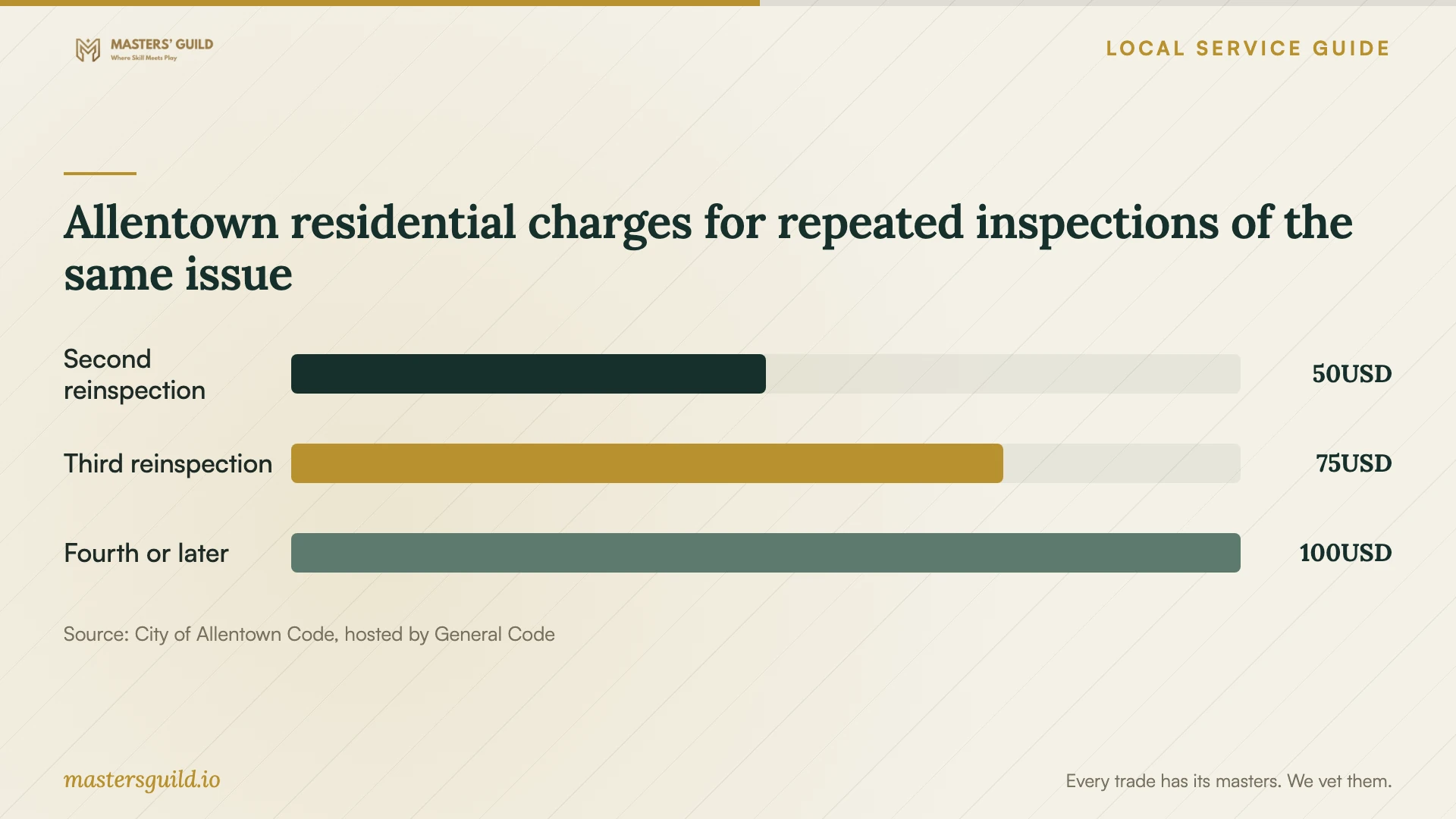
Allentown residential charges for repeated inspections of the same issue
Local details that affect your job
Assign responsibility for repeated inspections
Allentown charges residential fees of $50 for a second reinspection of the same issue, $75 for a third, and $100 for a fourth or later reinspection. Ask the contractor to state who pays these charges when workers need to correct their work. The ordinance also doubles the permit fee when someone starts work without a required permit, so confirm permit status before demolition. [1]
Plan the dumpster location before booking it
For approved dumpsters in the public right-of-way, Allentown lists a monthly fee of $35 for containers of 20 cubic yards or less and $55 for larger containers. Before choosing street placement, ask the city about approval and ask the contractor to separate city charges from rental, hauling, and disposal costs. Compare that arrangement with a placement option on your property. [1]
Choose the next step for your kitchen project
| Your situation | Recommended next step | Clarify in the quote |
|---|---|---|
| You want new finishes with the existing layout | Request a scope that lists each retained and replaced item; confirm permit needs with the city | Surface preparation, installation, patching, and disposal |
| You want to move a sink, appliance, or wall | Ask for drawings and a coordinated review of the proposed work before approving demolition | Trade responsibilities, applications, and inspection sequence |
| Your kitchen is in a building with three or more dwelling units | Ask the city about commercial classification under its fee definitions | Applicable application and plan-review charges |
| You need a street dumpster | Confirm public right-of-way approval before booking | City fee, rental duration, hauling, and disposal |
Your hiring checklist
- Prepare photos, a measured sketch, and a list of items you will retain.
- Give each bidder the same layout, material specifications, and appliance models.
- Ask the city to confirm permit needs and building classification for your address and scope.
- Name the person responsible for applications, inspection scheduling, and correction costs.
- Review contractor credentials, insurance documentation, and kitchen-project references.
- Agree on material delivery, demolition timing, temporary cooking arrangements, and cleanup.
- Request a written price and schedule effect before approving changes.
- Walk through the finished work and collect applicable inspection records, warranties, and product information.
Frequently Asked Questions
How much should I budget for the remodel?
Your budget depends on the scope and specifications. Request itemized quotes and compare city permit charges separately. [1]
Does replacing cabinets require a permit?
Ask the Bureau of Building Standards and Safety to review your exact scope, including any plumbing, electrical, or structural changes. The city's fee ordinance covers alterations and building systems, but does not establish a cabinet-replacement exemption. Get confirmation before work begins. [1]
Can I cancel after signing a contractor agreement?
For covered home-improvement contracts, Pennsylvania allows an individual to rescind without penalty within three business days of signing, regardless of where they signed. The act includes an emergency-work exception. Review the required cancellation notice in your agreement and retain your contract copy. [2]
How should I handle a time-and-materials offer?
For a covered contract, Pennsylvania requires an initial written estimate and disclosure of the total potential cost including a 10% increase. The contractor cannot exceed that estimate plus 10% without a signed written change order. Also ask for labor rates, material charges, and how you will review invoices. [2]
Sources and scope
This guide combines the sources below with practical planning guidance. Figures apply to the stated geography and period; request a written quote for your property.