
Local service guide
Data Recovery and Backup in Allentown, PA
For Data Recovery and Backup in Allentown, PA, choose a provider around your immediate need: retrieving missing files, restoring a known backup, or responding to a suspected attack. Ask for a written diagnostic scope, an approval limit, data-handling terms, and a demonstration that you can open the restored files. For suspected ransomware, disconnect affected equipment from the network and engage incident-response help before arranging a routine restore. CISA recommends isolating affected systems and recovering critical services on a clean network. [1]
Choose the right scope before handing over equipment
Give the provider a short account of the failure: which device holds the data, what happened, when you last accessed the files, and which recovery attempts you have made. Include the device model, storage capacity, encryption status, and your access to recovery keys. List the folders or applications you need first, such as invoices, payroll, or current customer orders.
Ask whether the provider will perform the work at your premises, at its own facility, or through a subcontracted laboratory. For a drop-off or shipped device, request an intake receipt with its serial number and the person responsible for it. Agree on who may access the contents, how the provider will transfer recovered files, and when it will delete working copies.
If you suspect an attack, tell the provider before it changes the equipment. CISA warns that ransomware can accompany data theft and an earlier unresolved compromise. Ask for incident-response expertise, evidence preservation, and a plan for rebuilding clean systems before restoring business data. [1]
Compare quotes by deliverables and approval points
Request separate line items for diagnosis, recovery work, return storage, transport, and any urgent service. For a backup arrangement, separate setup charges from storage subscriptions, monitoring, support, and restore labor. Ask the provider to identify exclusions and obtain your approval before exceeding the agreed spending limit.
Ask what the provider means by successful recovery. Specify priority files and require a readable-file review or agreed application test. Clarify what you owe if it retrieves only part of the requested data, finds nothing usable, or recommends a different specialist. Keep the original device until you have checked the returned files and agreed on its next use or disposal.
Set separate expectations for the diagnostic report and the return of usable data. Ask whether an urgent fee buys an earlier assessment, extra work hours, or a committed delivery date. Have the provider explain how it will communicate delays and whether you can request priority files before the full job ends.
Specify a backup you can restore
Tell the backup provider how much recent work you could afford to lose and how long you could operate without each system. Use those answers to agree on backup frequency, retention, restoration priorities, and an acceptable recovery time. Include business applications and their dependencies in the discussion, rather than listing document folders alone.
CISA recommends offline, encrypted backups because ransomware variants may delete or encrypt accessible backup copies. Its guidance also discusses cloud storage protections, including deletion protection, object lock, and version control. Ask the provider to explain which protections it will configure, who can change them, and how you will recover access if an administrator account is compromised. [1]
At handover, have the technician restore an agreed sample to a separate location and let you open it. Ask for a written test result, a schedule for future restore exercises, and a named person who handles failed backup alerts. CISA recommends testing backup procedures and formalizing security requirements in contracts with managed service providers. [1]
Plan the return to business
Agree on the order of restoration before work begins. Start with the functions you need to serve customers and meet immediate obligations, then check their supporting systems. For ransomware recovery, CISA recommends prioritizing critical services and taking care to avoid reinfecting clean equipment. [1]
Ask the technician to include power interruption procedures in the handover: how staff should shut down equipment, how to confirm backups resume, and who checks a failed job after power returns. Discuss battery backup sizing and shutdown configuration as a separate scope. Use Pennsylvania outage figures as planning context, without treating them as a forecast for your address. [2]
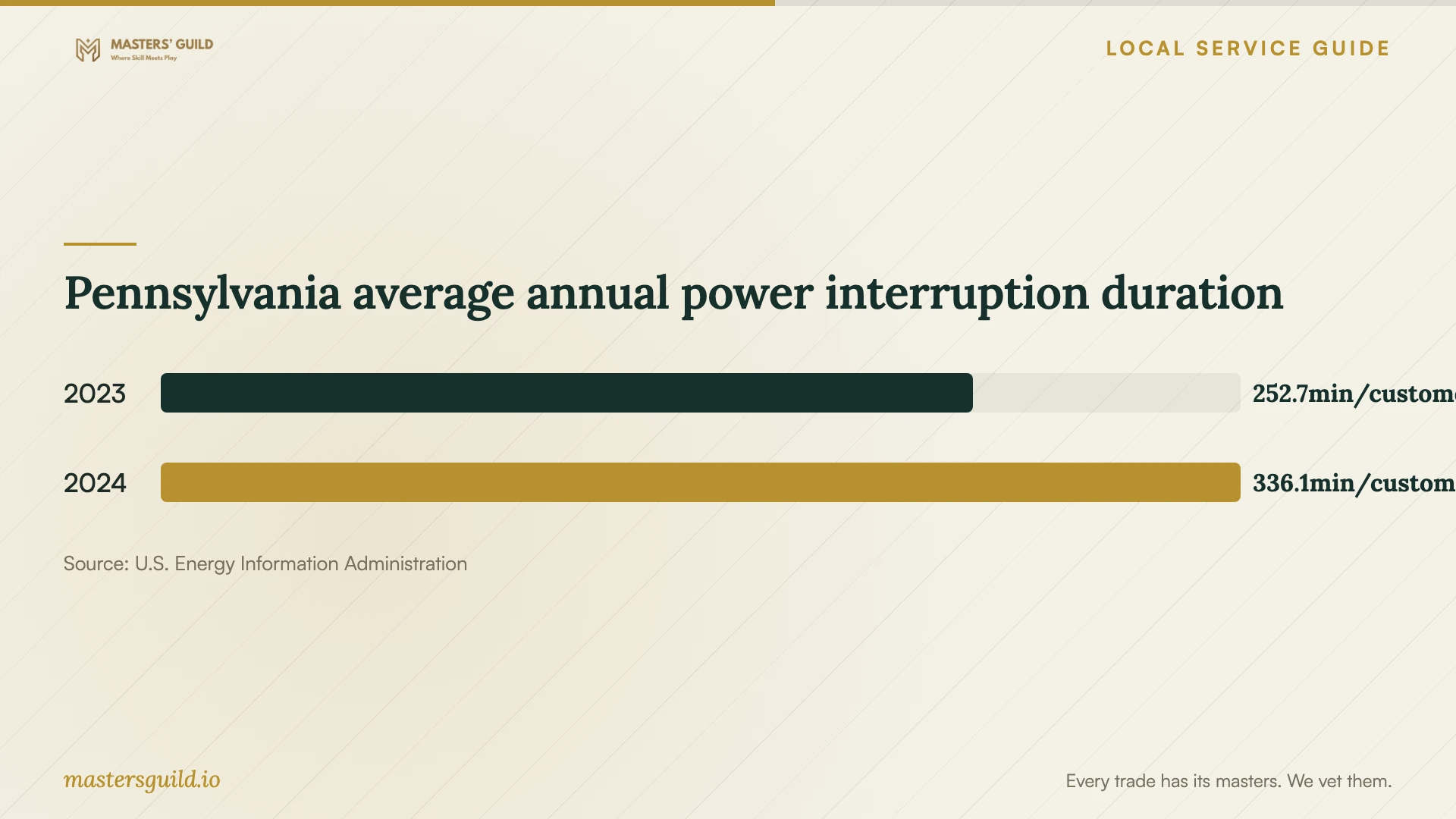
Pennsylvania average annual power interruption duration
Local details that affect your job
Pennsylvania breach duties affect the provider you choose
For an Allentown business handling customer information, distinguish missing data from suspected unauthorized access and acquisition. Pennsylvania's breach law requires covered entities to notify affected residents without unreasonable delay after determining a qualifying breach, subject to its exceptions. Vendors managing another entity's data must notify that entity following discovery. When notice must go to more than 500 affected Pennsylvania individuals, the law requires concurrent Attorney General notice, with an exemption for certain insurance-regulated entities. Ask an incident-response provider and legal counsel to assess your duties and preserve the information needed for that assessment. [3]
Use statewide outage data to discuss continuity
EIA reports Pennsylvania average non-momentary interruption duration of 336.1 minutes per customer in 2024, including major events, compared with 252.7 minutes in 2023. These statewide observations cover an estimated 94.5 percent and 94.4 percent of customers respectively. Ask your backup provider to include interruption recovery and backup restart checks in its scope. The figures do not establish outage frequency or drive-damage risk at an Allentown property. [2]
Check the recycling subcontractor before releasing equipment
Pennsylvania DEP lists desktops, laptops, monitors, peripherals, and televisions as covered devices. For recyclers working on behalf of manufacturers under the Covered Device Recycling Act, DEP requires an accepted certification, such as R2 or e-Stewards, and permit WMGR081 for a Pennsylvania facility. Ask your recovery provider which collection program and recycler it will use, then check the requirements for that route. Arrange data sanitization or destruction in writing and authorize it after checking the recovery result. [4]
Match the provider to the job
| Your situation | Scope to request | Question before approval |
|---|---|---|
| Missing files with no suspected attack | Assessment and file recovery | Which requested files define success, and what do I owe for partial results? |
| Existing backup available | Restore and usability check | Can you demonstrate that the needed files and applications work? |
| Suspected ransomware or data theft | Incident response and clean recovery | Who isolates systems, preserves evidence, and checks for continuing compromise? |
| New ongoing backup arrangement | Protected copies, monitoring, and restore testing | Who tests restores and responds to failed backup alerts? |
Your hiring checklist
- Record the device model, serial number, symptoms, and previous recovery attempts.
- List priority files and define how you will check that they work.
- Identify existing backup copies and arrange secure access to encryption recovery keys.
- Get an intake receipt and identify any laboratory or subcontractor.
- Set diagnostic fees, partial-recovery terms, and a spending approval limit.
- Agree on access controls, return methods, working-copy deletion, and original-device return.
- Request a restore demonstration and a written backup monitoring plan.
Frequently Asked Questions
Should I turn off a computer showing a ransom message?
CISA recommends isolating affected systems from the network first. It advises powering down when you cannot disconnect them, because shutdown loses potential evidence in volatile memory. Use a separate phone to coordinate with your incident-response provider. [1]
What should a backup handover include?
Request a restore demonstration, the backup schedule and retention settings, secure account ownership, instructions for recovering access, and a named contact for failed jobs. CISA recommends testing backups and maintaining offline, encrypted copies of critical data. [1]
Can the recovery provider handle breach notification for my business?
Ask it to define its role in writing. Pennsylvania law requires a vendor to notify the entity whose data it manages following discovery of a breach; the entity retains responsibility for determinations and remaining duties. Arrange legal review alongside technical response. [3]
Does recycler certification mean my files will be erased?
The cited DEP requirements address the recycling route, certifications, and applicable facility permits. They do not establish that your recovery contract includes data erasure. Specify the sanitization or destruction method, authorization point, and documentation you require. [4]
Sources and scope
This guide combines the sources below with practical planning guidance. Figures apply to the stated geography and period; request a written quote for your property.