
Local service guide
Bricklaying and Masonry in Allentown, PA
For Bricklaying and Masonry in Allentown, choose a contractor who explains the repair scope, mortar choice and access plan before you accept a price. For older brick, request comparable restoration work and a sample repair. Check your address and proposed exterior work with the city's Bureau of Building Standards and Safety before setting a start date: covered historic-district work requires staff approval or a certificate of appropriateness before permit issuance. [2] [3] [4]
Get a repair diagnosis before comparing prices
Give each bidder the same photographs and description: the affected wall or chimney, access from ground level, damaged joints, crumbling brick faces and any indoor dampness. Have each contractor mark the proposed repair area and explain whether they recommend repointing, replacing masonry units or investigating movement before repair. Request a separate explanation for work beyond the photographed damage.
Repointing replaces mortar between masonry units. The National Park Service explains that mortar should remain softer than the masonry it holds together, allowing water and salts to pass through the replaceable joints. It also identifies roof leaks, groundwater and precipitation as moisture sources. Ask the contractor which source they suspect and who will address it. [2]
If you see loose overhead masonry or a leaning wall, keep people away and arrange an assessment before requesting a cosmetic repair. Discuss whether the mason needs a structural professional to define the work. Avoid making your own diagnosis from a crack photograph.
Choose a mason who can explain the mortar
For an older building, have the bidder explain how they will identify the existing mortar and choose a compatible replacement. Request photographs of similar work and references you can contact. Establish who will remove the old mortar, how they will protect brick edges and how you will approve the finished joint appearance.
GSA's historic-masonry guidance calls for matching mortar strength, color, grain size and texture, supported by analysis and mockups. It also addresses joint tooling and damage-free removal. Use these points to compare restoration proposals. This federal preservation guidance requires project-specific professional judgment; it does not establish a universal Allentown specification for private homes. [4]
Agree on a sample area's location and acceptance criteria before the contractor starts the main repair. Include the mortar product or proposed mix, joint finish and removal method in the written scope. Require the contractor to explain any material change proposed after you approve the sample.
Confirm approvals before reserving the start date
Allentown's historic-district ordinance covers Old Allentown, Old Fairgrounds and West Park within defined boundaries. For covered exterior work visible from a public right-of-way, the city requires the applicable historic approval before issuing a building permit. An alley or sidewalk can count as a public right-of-way, so review more than the front facade. [3]
Send the city your address, photographs and proposed materials. Ask whether your repair qualifies as routine maintenance, staff approval or review for a certificate of appropriateness. The routine-maintenance exclusion concerns work without a change in design, arrangement, texture or material and for which a building permit is not required. Confirm the classification with the city before accepting a contractor's description of the work as maintenance. [3]
Put responsibility for applications, supporting drawings and inspections in the contract. Have the contractor distinguish an anticipated start from a confirmed start after approvals. Allentown's fee ordinance states that an approved application is not a valid permit until the applicant pays the required permit fee. [1]
Compare the complete quote and curing plan
Ask whether the contractor's quote includes municipal permit, review and access fees, and record who will pay them. Request an itemized price for your repair scope, with separate lines for mortar removal and replacement, brick or stone replacement, access equipment, debris removal, samples and moisture-related work. Have each bidder identify exclusions and the process for pricing concealed damage.
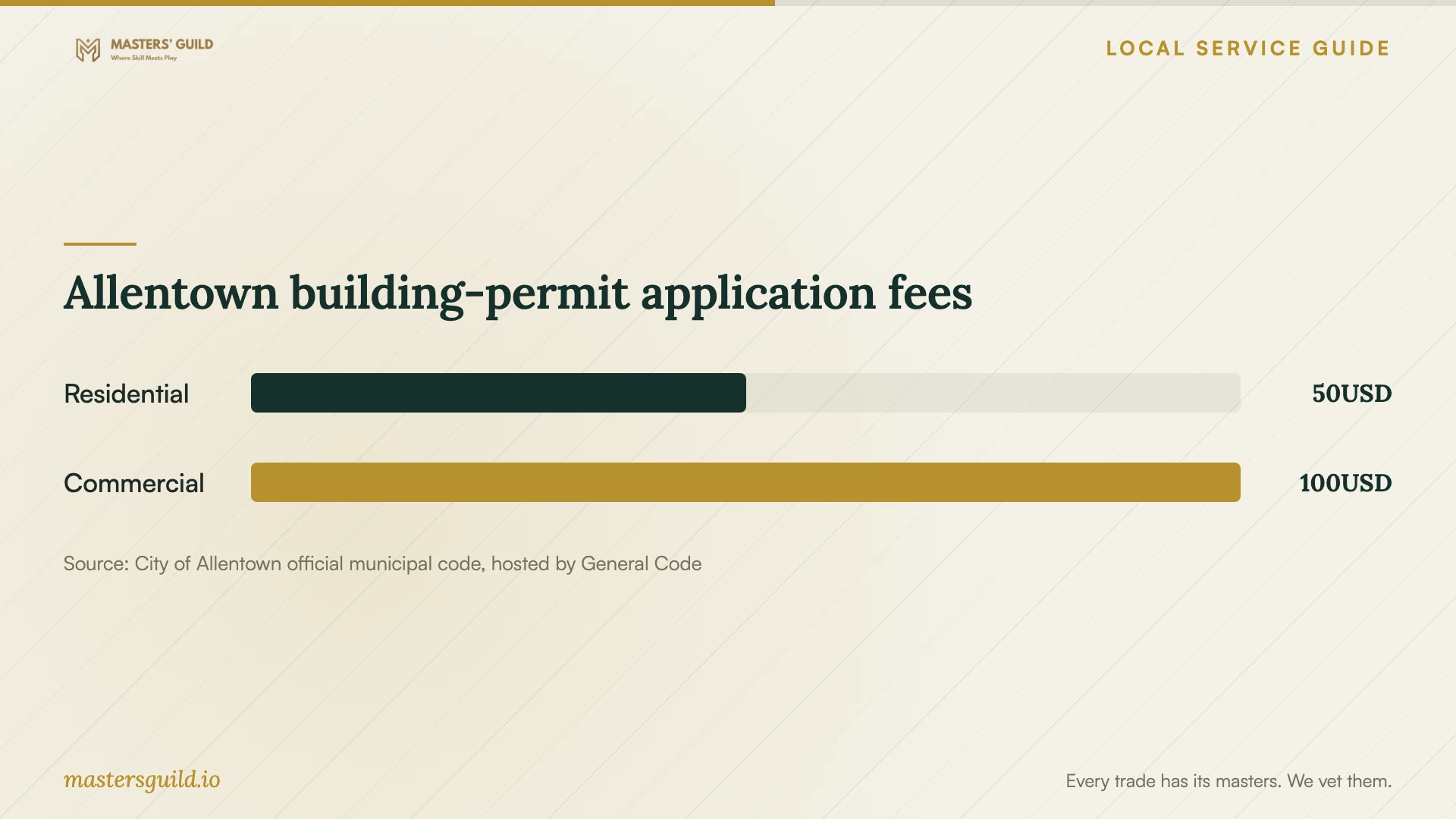
For a required residential building permit, the city lists a $50 application fee and a plan-review and inspection charge equal to the greater of $50 or 1% of total work cost. The schedule also lists a UCC charge of $4.50, or the amount determined by Pennsylvania. Ask the city to confirm the applicable charges and project classification before budgeting. [1]
Discuss how the contractor will protect the repair during rain, cold weather and curing, including who will check it when the crew leaves. GSA's historic-repointing procedure includes temperature and rain restrictions and damp-curing requirements. Have the mason provide a plan suited to your materials and site rather than treating the federal procedure as your home's automatic specification. [4]
Allentown building-permit application fees
Local details that affect your job
Historic review depends on your address and proposed changes
Check the mapped boundary before hiring for an exterior restoration in Old Allentown, Old Fairgrounds or West Park. The city allows staff approval for qualifying requests and provides a routine-maintenance exclusion under defined conditions. Ask the HARB Secretary which route applies before ordering replacement masonry or committing to a changed mortar appearance. [3]
Arrange street and sidewalk access as part of the bid
If the mason proposes placing equipment or a dumpster in the public right-of-way, establish who will obtain the necessary approval and pay the access charges. Section 270-44 lists approved temporary encroachments excluding dumpsters, soda machines and other vending machines at $20 per year plus $0.25 per square foot per month. It lists approved right-of-way dumpsters at $35 per month for 20 cubic yards or less and $55 per month for larger dumpsters. Confirm the proposed setup with the city rather than treating these fees as permission to occupy the sidewalk. [1]
Choose the next step for your masonry project
| Your situation | Next step | Ask the bidder |
|---|---|---|
| Worn joints in older brick | Discuss compatible mortar and a sample repair | How will you match strength, texture and joint finish? |
| White deposits or peeling brick faces | Request a moisture investigation alongside the repair | Which water source will you investigate and address? |
| Exterior changes in a designated historic district | Confirm staff approval or certificate requirements with the city | Who prepares the material details for review? |
| Equipment or dumpster proposed in the public right-of-way | Confirm city approval and applicable access fees | Who arranges access and pedestrian protection? |
Your hiring checklist
- Photograph the affected area and note where you have seen water or loose material.
- Give bidders the same repair area, access description and requested finish.
- Request comparable restoration references and current insurance documentation.
- Confirm the property's historic-district status and the approval route with the city.
- Record who handles permits, inspections and public right-of-way access, including who pays the fees.
- Approve a sample repair and written mortar specification before the main work.
- Agree on weather protection, curing visits, cleanup and written change orders.
Frequently Asked Questions
Does every historic-district repair need a certificate of appropriateness?
The ordinance excludes qualifying routine maintenance without changes in design, arrangement, texture or material where no building permit is required. It also allows staff approval for qualifying permit requests. Ask the city to classify your specific scope before work begins. [3]
Can I choose mortar by color alone?
Have the mason explain strength and compatibility as well as color. The National Park Service warns against combining soft historic masonry with hard modern mortar. GSA's preservation guidance also addresses grain size, texture and joint finish. [2] [4]
What do the chart's permit fees include?
The chart shows only nonrefundable building-permit application fees. Allentown lists plan-review and inspection charges and a UCC charge separately. Confirm any historic-review, zoning or access charges that apply to your scope. [1]
What should I receive when the contractor finishes?
Request photographs, the final material specification, care instructions, warranty terms and copies of applicable approvals and inspection records. Agree on these deliverables in the contract so you can review them before closing out the job.
Sources and scope
This guide combines the sources below with practical planning guidance. Figures apply to the stated geography and period; request a written quote for your property.